





Russia fabricates and distorts air crash statistics — a report by the Russian Interstate Aviation Committee (IAC) deliberately omits the casualties of the Azerbaijan Airlines Embraer E190, which was struck by Russian air defense systems on December 25, 2024, over Grozny and crashed near Aktau, Kazakhstan. Dallas compared Kazakhstan’s preliminary investigation report with Russia’s annual aviation safety statistics and found significant discrepancies — evidence of an attempt by Russia to avoid responsibility for the shootdown. This, in turn, undermines trust in any Russian civil aviation safety data.
However, from September 23 to October 3, the 42nd session of the Assembly of the International Civil Aviation Organization (ICAO) will take place. At this session, Russia will attempt to regain its seat on the ICAO Council — the organization’s governing body — which it lost in October 2022 due to gross violations of the Convention on International Civil Aviation.
From this investigation, you will learn how Russian aviation safety authorities:
- selectively record fatalities,
- manipulate navigation system data,
- euphemistically call explosions “effects,”
- omit any mention of missile fragments, and
- conceal details about restricted airspace.
Flight 8243
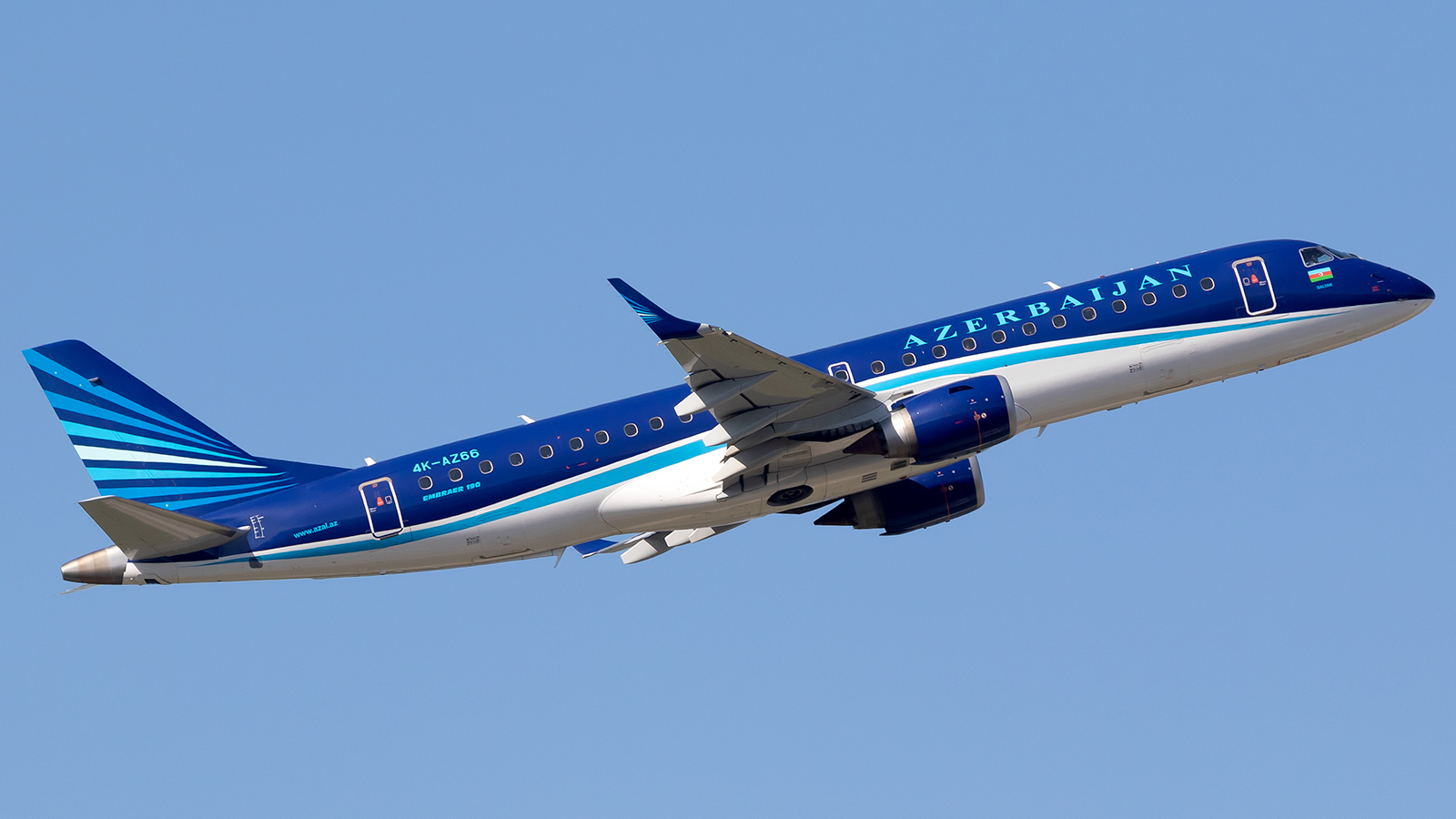
On December 25, 2024, an Embraer E190-100 IGW4 passenger aircraft operated by Azerbaijan Airlines (AZAL), performing flight J2-8243 from Baku to Grozny, crashed five kilometers from Aktau Airport. There were 67 people on board, including 5 crew members and 62 passengers, among them 2 children.
According to the official version, the aircraft attempted to land twice at Grozny Airport but was forced to abort the landings due to severe weather conditions and the loss of GPS signal. The crew then decided to return to Azerbaijan.
On the way back, the aircraft was struck by a missile, reportedly launched from a Russian Pantsir-S1 surface-to-air missile system. As a result of the impact, part of the control systems was lost, and the crew decided to make an emergency landing at an alternate airfield in Aktau, Kazakhstan.
Five kilometers from Aktau Airport, the aircraft crashed. The disaster claimed the lives of 38 people, including both pilots, the chief flight attendant, and 35 passengers. According to official data, the victims included 25 Azerbaijani citizens, 7 Russians, and 6 Kazakh nationals. Twenty-seven passengers and two flight attendants survived.
This is the deadliest aviation disaster in the history of Azerbaijani Airlines, and it quickly escalated from a tragedy into a diplomatic scandal. In an address to the nation, Azerbaijani President Ilham Aliyev accused Russia of attacking a civilian aircraft, demanding an admission of guilt, an official apology, criminal prosecution of those responsible, and compensation for the victims’ families and the state.
Official Moscow initially denied involvement, promoting contradictory versions of events—closely following the same narrative as after the downing of flight MH17 over Donbas in 2014. However, under pressure from the facts, Vladimir Putin was forced to apologize to Azerbaijan. Still, he did not acknowledge that Russia bore responsibility. Putin stated that the “tragic incident” occurred while Russian air defense systems were actively repelling Ukrainian drones.
Following the incident, Russia and Kazakhstan proposed assigning the investigation to the Interstate Aviation Committee (IAC), an organization based in Moscow that has often faced criticism for bias. However, Baku firmly refused, stating that only an international investigative team involving Embraer representatives and independent experts had the right to determine the truth. Azerbaijan also insisted that the black box data be decoded outside of Russia.
In February 2025, Kazakhstan’s Ministry of Transport published a preliminary report, and on August 7, information emerged suggesting that the final report may be released in the coming months.
How The Interstate Aviation Committee Manipulates The Numbers
After the collapse of the USSR, 12 countries signed the Agreement on Civil Aviation and the Use of Airspace. This agreement established the Interstate Aviation Committee (IAC), which is headquartered in Moscow.
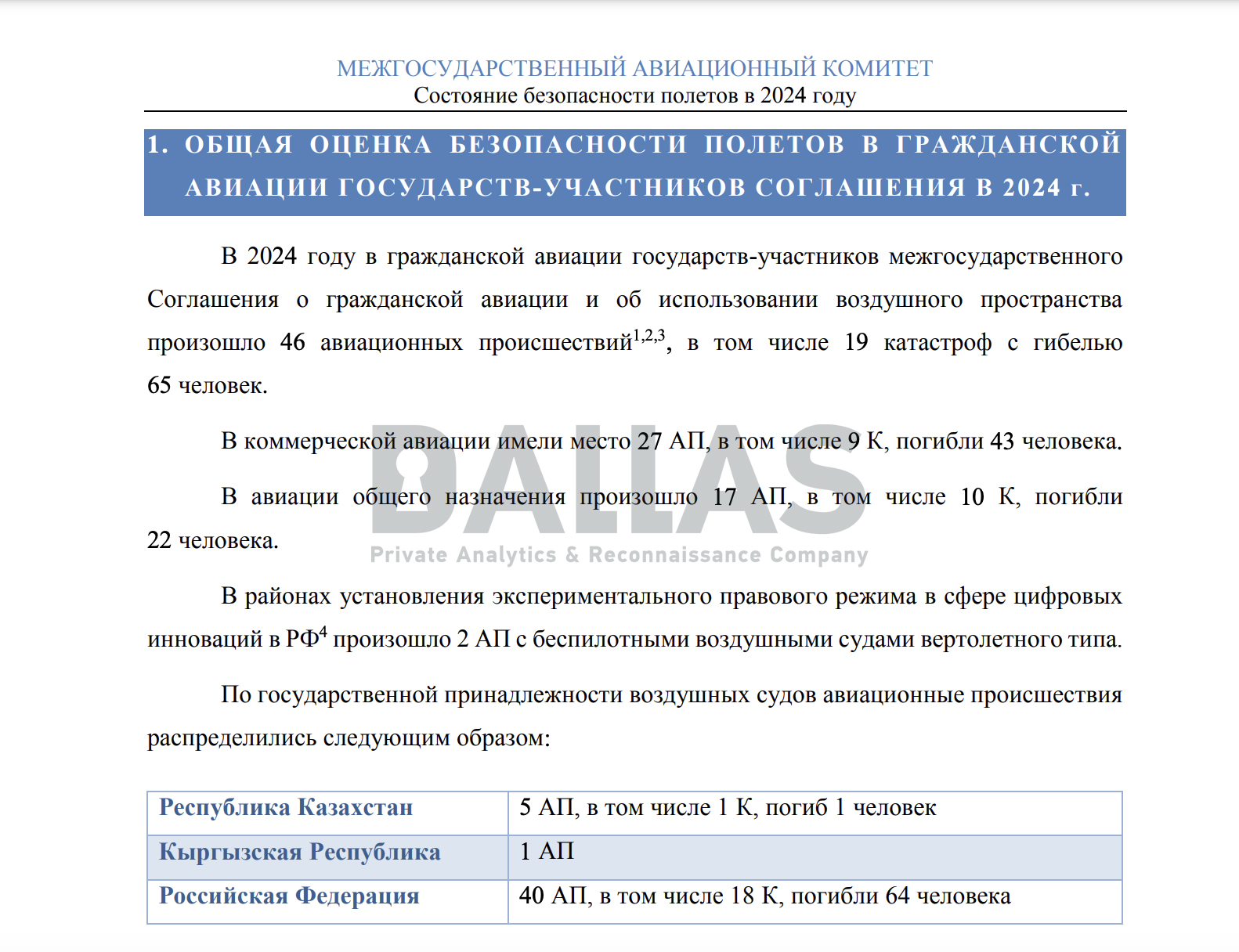
Overall statistics for aviation incidents in 2024: 5 incidents in Kazakhstan, 1 in Kyrgyzstan, 40 in Russia, with 65 fatalities.
The IAC is responsible for investigating aviation accidents and incidents, training aviation specialists, certifying aircraft and their production, equipment, and airfields. Its powers also include providing recommendations for the development of national aviation safety regulations and legislation governing flight operations.
However, as will become evident, this body can hardly be considered independent or objective. It is yet another political tool of the Kremlin used to extend its influence.
Each year, the Committee publishes a report on the state of civil aviation flight safety for the previous year. This is a comprehensive analysis featuring statistics on flights and aviation incidents — including accidents and crashes.
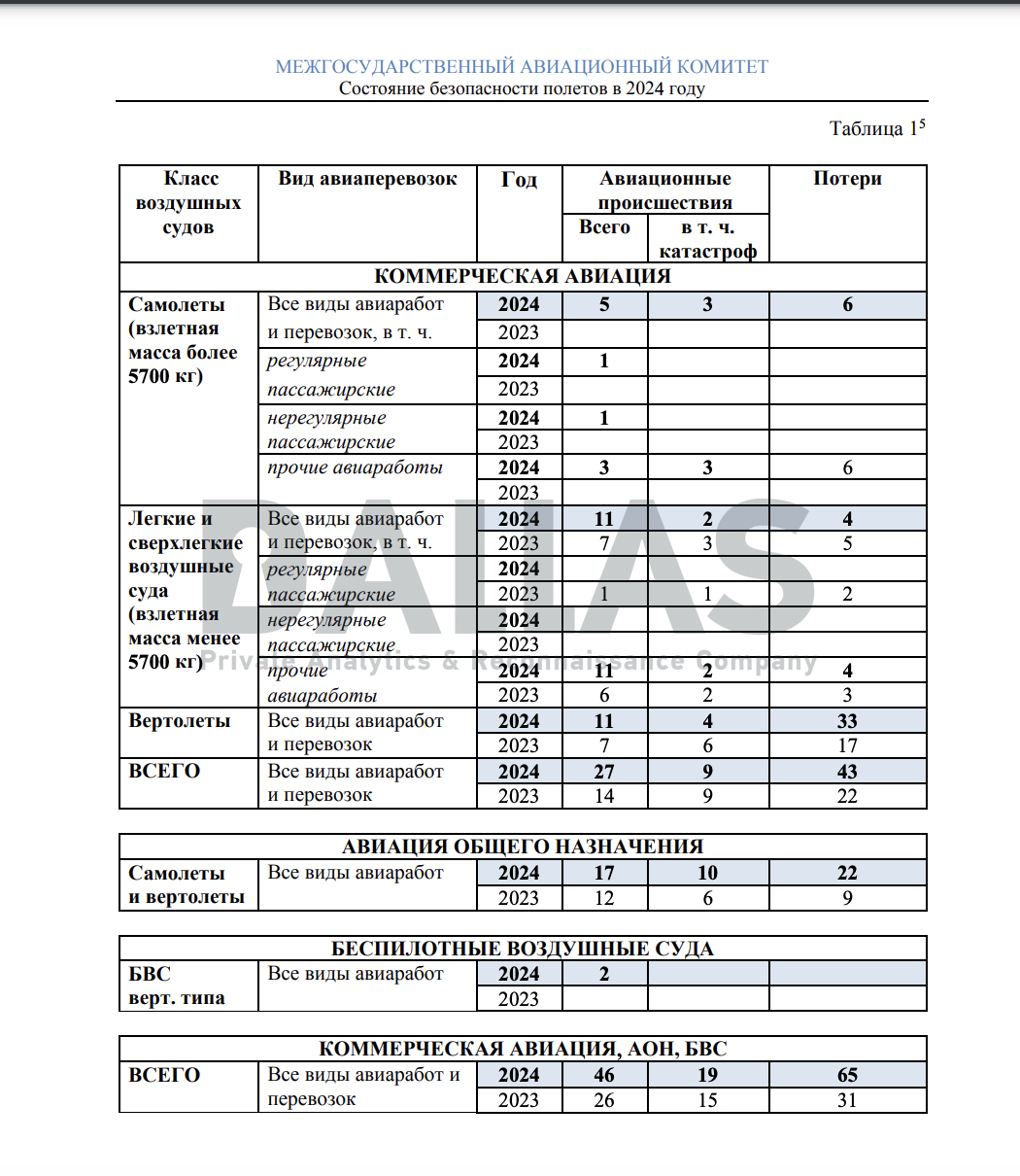
Comparison of the number of aviation incidents and fatalities in 2023 and 2024
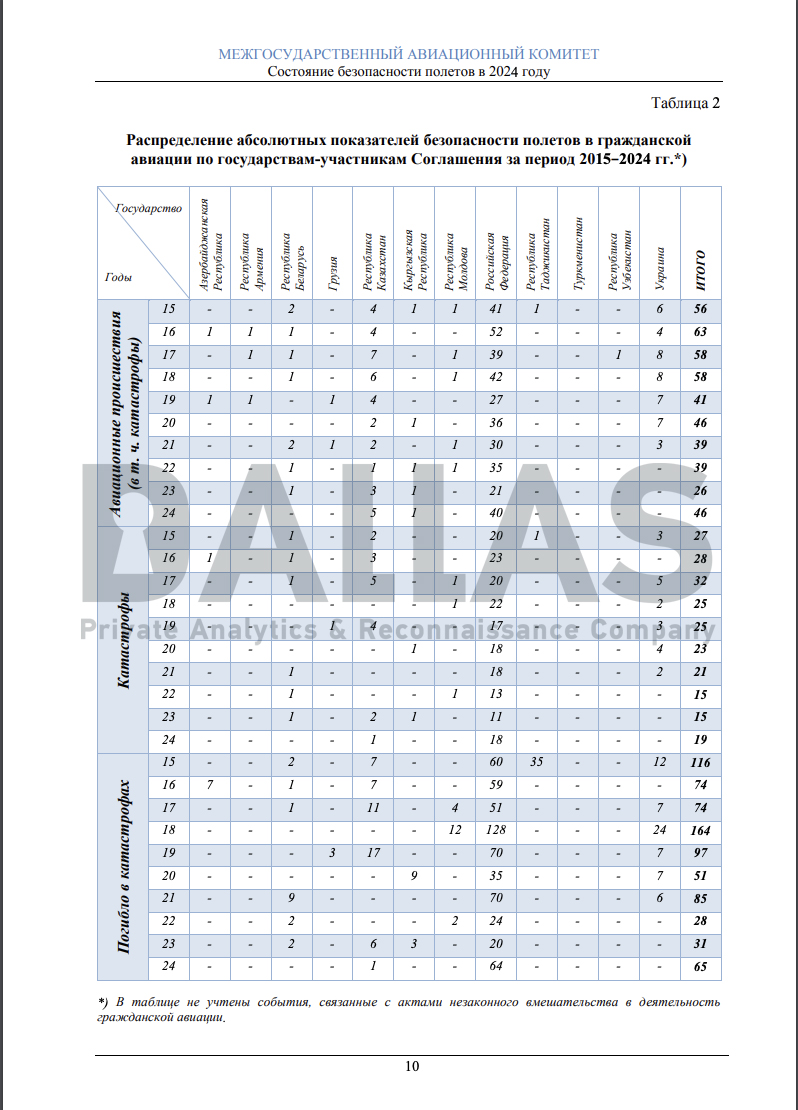
Statistics from 2015 to 2024, with the note that the table does not include cases of “unlawful interference with civil aviation activities.”
The current report, analyzing crashes from 2024, immediately draws attention to the fact that the victims of the Azerbaijani airliner tragedy are simply not included in the statistics. At the very beginning of the report (page 8), there is a footnote that states:
“The crash involving the Embraer ERJ 190-100 IGW 4K-AZ65 aircraft operated by CJSC ‘Azerbaijan Hava Yollari’ on 25.12.2024 near Aktau Airport (Republic of Kazakhstan) is not included in the statistics.”
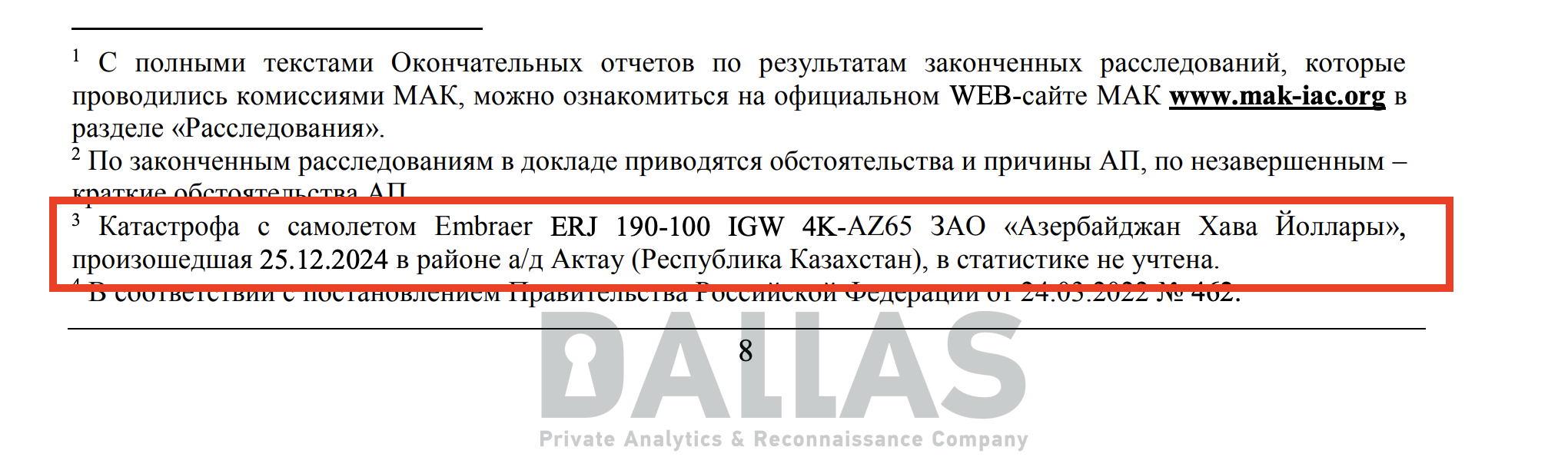
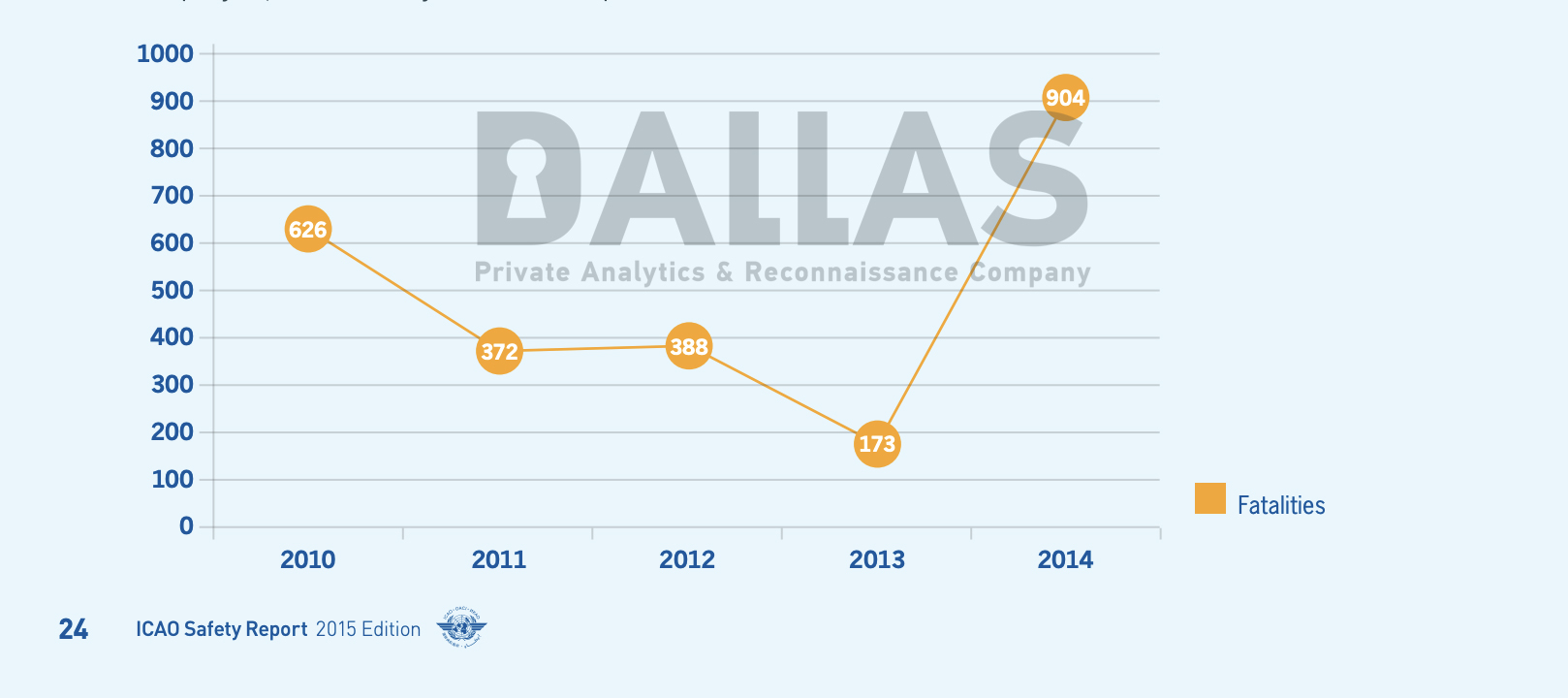
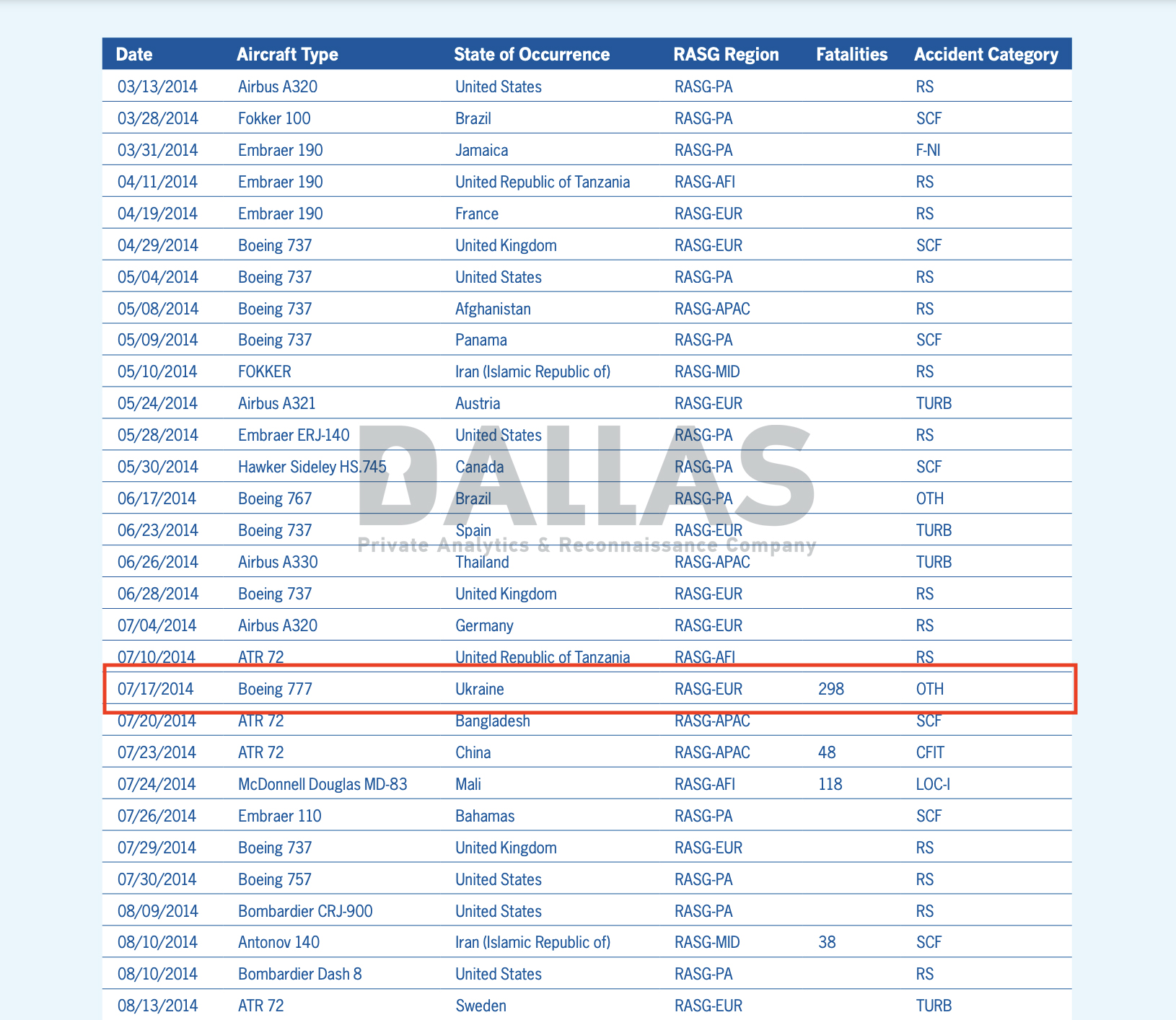
After comparing previous IAC reports, we found that this is standard practice for the organization — to exclude aircraft shoot-downs from their statistics. For instance, the 2014 statistics contain no mention whatsoever of Malaysian Airlines flight MH17, which was shot down by a Russian Buk-M1 missile system. As if nothing had ever happened — as if there were no 298 victims.
Of course, one might assume that excluding incidents involving the use of force against aircraft is common practice among such organizations. However, the ICAO flight safety report for 2014 did include all 298 victims of the MH17 crash in its overall statistics.
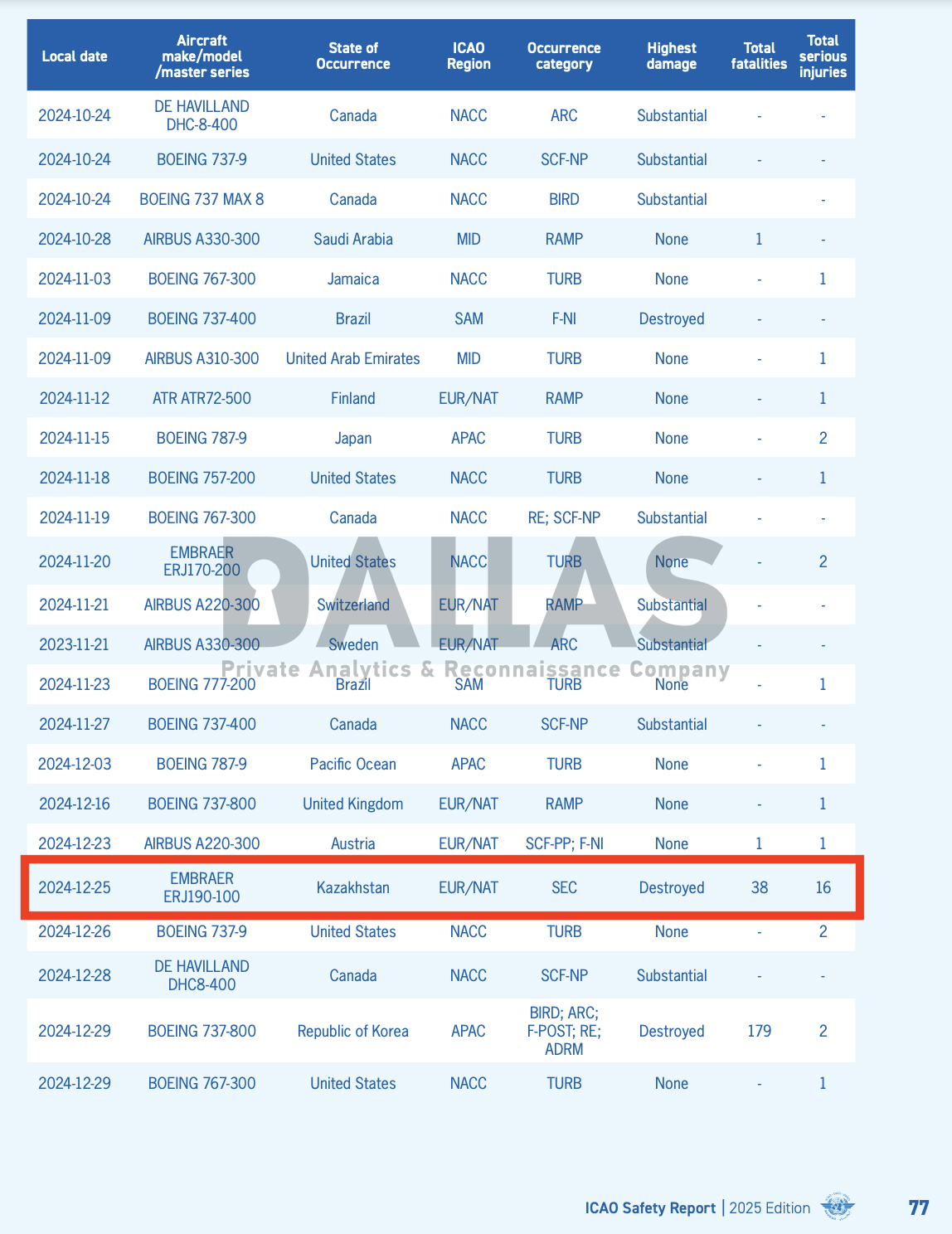
A few days ago, the ICAO report for 2025 was released. The crash of the Embraer E190-100 is included in both the global and the regional European statistics. The fatalities from the crash are also reflected in all relevant charts. The cause of the crash is listed as Security related: Criminal/Security acts which result in accidents or incidents.
Therefore, we can already conclude that Russian authorities deliberately omit such aviation disasters for political reasons.
It’s Not Just The Numbers That Are Distorted
At the same time, the IAC report does provide details about the crash of the Azerbaijan Airlines flight—but “not included in the statistics.”
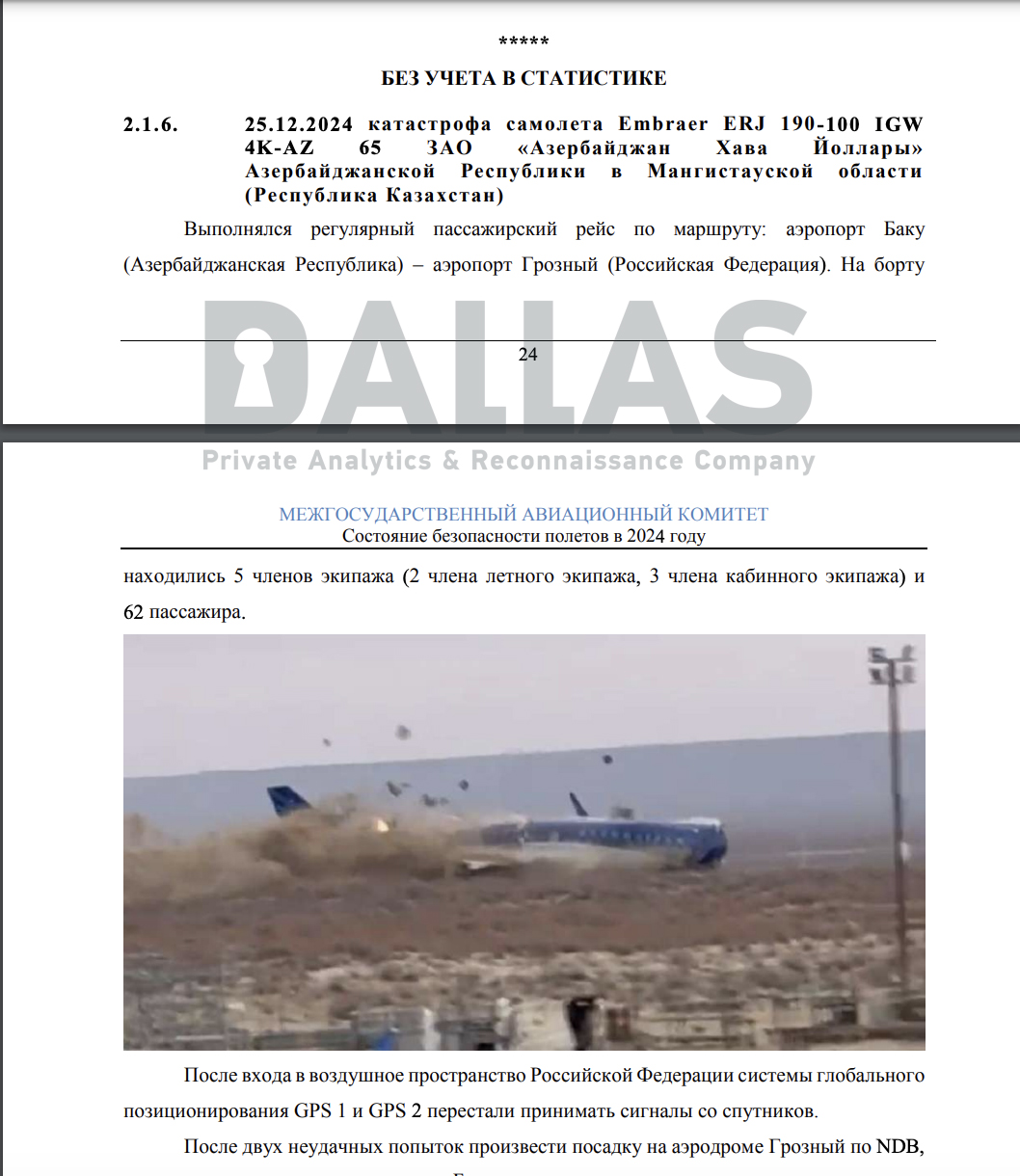
The information presented in this section of the Russian document is based on the preliminary report from the Kazakh commission investigating the crash (the preliminary report is in Russian, but an unofficial translation is available here). And while some sentences are repeated verbatim, upon comparing the two texts we found differences that significantly change the context.
Difference 1 – Loss of navigation
The Russian version of the report lacks detail about the aircraft’s flight path and omits any transcript or description of communications between the crew and Russian air traffic controllers. It simply states:
“After entering the airspace of the Russian Federation, the GPS 1 and GPS 2 global positioning systems stopped receiving satellite signals” (p. 25).
In contrast, the Kazakh commission’s report specifies that, according to flight data recorders, the Embraer E-190 exited Azerbaijani airspace (and entered Russian airspace) at 04:12 UTC. At 04:13, the crew made contact with “Rostov Control.” Only at 04:26, while preparing to descend for the landing approach, did the crew report the loss of both GPS signals to the Russian side.
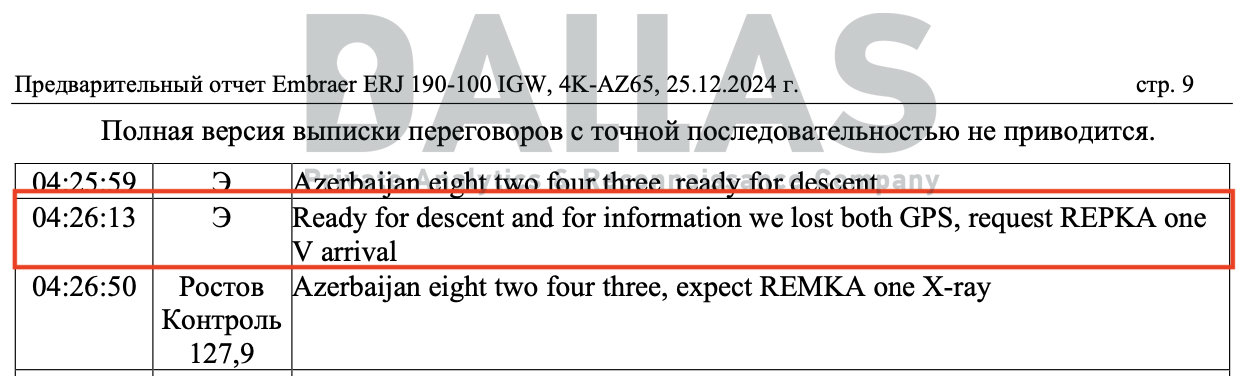
At first glance, this might seem like a minor discrepancy. However, it clearly reflects an effort by the Russian side to dilute or shift responsibility.
If one follows the Russian version, the aircraft entered Russian airspace and—at an unspecified moment, possibly immediately—lost navigation. This implies that the crew had ample time after entering Russian airspace to assess the risks of continuing to fly “blind” and could have decided to turn back.
In reality, there was a 14-minute gap between entering Russian airspace and the loss of GPS signal—a significant factor, especially given the short distance of the Baku–Grozny flight. The aircraft lost GPS right at the moment it was preparing to land in Grozny and was forced to circle above the Chechen capital in poor weather conditions.
Difference 2 – The Moment of Impact
In the Russian report, the moment when the first missile struck the aircraft is described as follows:
“At 05:13:31, audio recordings obtained from the CVR captured a soundeffect, followed by the activation of the autopilot disconnect warning (voice warning “AUTO PILOT”), and the autothrottle disconnect warning (voice warning “Throttle”).”

However, in the original report by the investigative commission, the same sentence uses a very different word:
“At 05:13:31, audio recordings obtained from the CVR captured a sound impact, followed by the activation of the autopilot disconnect warning (voice warning “AUTO PILOT”), and the autothrottle disconnect warning (voice warning “Throttle”).”

Clearly, the term “sound effect” used in the Russian version and “sound impact” in the original are fundamentally different in meaning. When a missile strikes an aircraft, there is an impact — a violent, physical event. A “sound effect,” on the other hand, is something far less significant, even trivial.
Why would the Russian IAC experts, while copying the report from their Kazakh counterparts almost word-for-word, choose to alter this one specific term?
This is undoubtedly not an error — because the same technique is repeated later in the report when describing the second impact:
“At 05:13:56, the CVR recording captured a repeated sound effect” (p. 26).
Difference 3 – Nature of the Damage
When describing the nature of the damage, the Russian side once again distorts the content. However, this time, they copied a paragraph from the investigative commission’s report but omitted the final sentence.
The original paragraph reads:
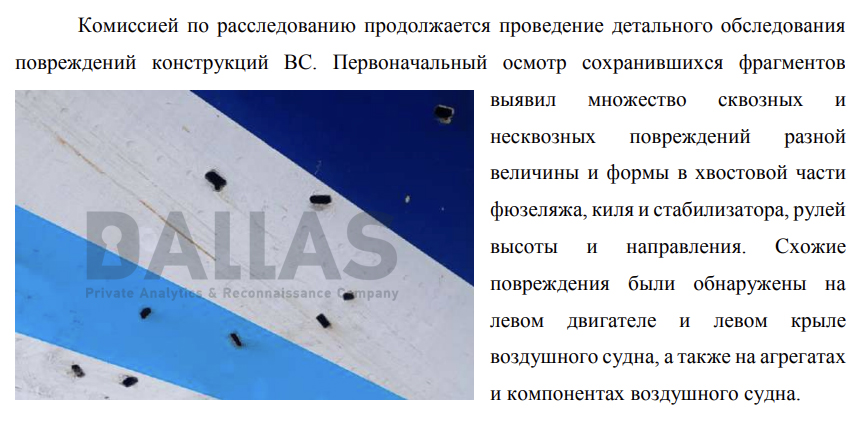
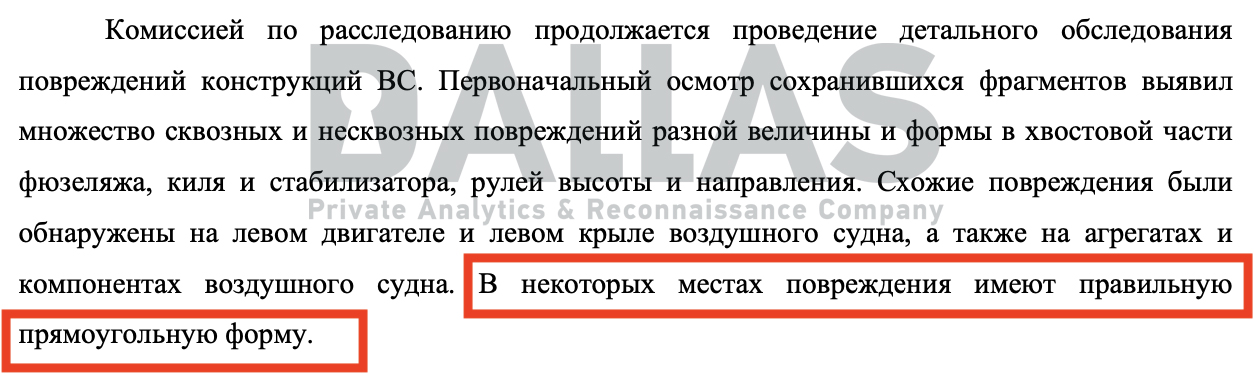
“The investigation commission continues to conduct a detailed examination of the aircraft’s structural damage. An initial inspection of the recovered fragments revealed numerous penetrating and non-penetrating damages of various sizes and shapes in the tail section of the fuselage, the vertical stabilizer, and the horizontal stabilizer, as well as the elevators and rudder. Similar damage was observed on the left engine and left wing of the aircraft, as well as on various components and systems of the aircraft. In some areas, the damage is of a distinctly rectangular shape.” (p. 20 of the investigators’ report)
In the Russian version (p. 26), the last sentence about the rectangular shape of the damage is entirely missing.
The omission of this specific sentence again distorts the overall meaning. Without it, the report gives the impression that the aircraft sustained a range of random damage types—leaving room for further manipulation and alternate narratives.
Difference 4 – “Kovyor” Protocol
In the investigators’ report, there is a section numbered 1.18, which states that on the day of the incident, the “Kovyor” protocol was activated in the Russian region, covering a radius of 50 km. The “Kovyor” (Carpet) plan is a restricted airspace regime that mandates the immediate landing or removal of all aircraft, helicopters, and UAVs from the designated zone.The only timestamp in the communications from Russian personnel mentioned in the report is 05:21:42 UTC, when information about the activation of the “Kovyor” protocol was relayed to Grozny. This occurred 7 minutes and 48 seconds after the second missile struck the aircraft.
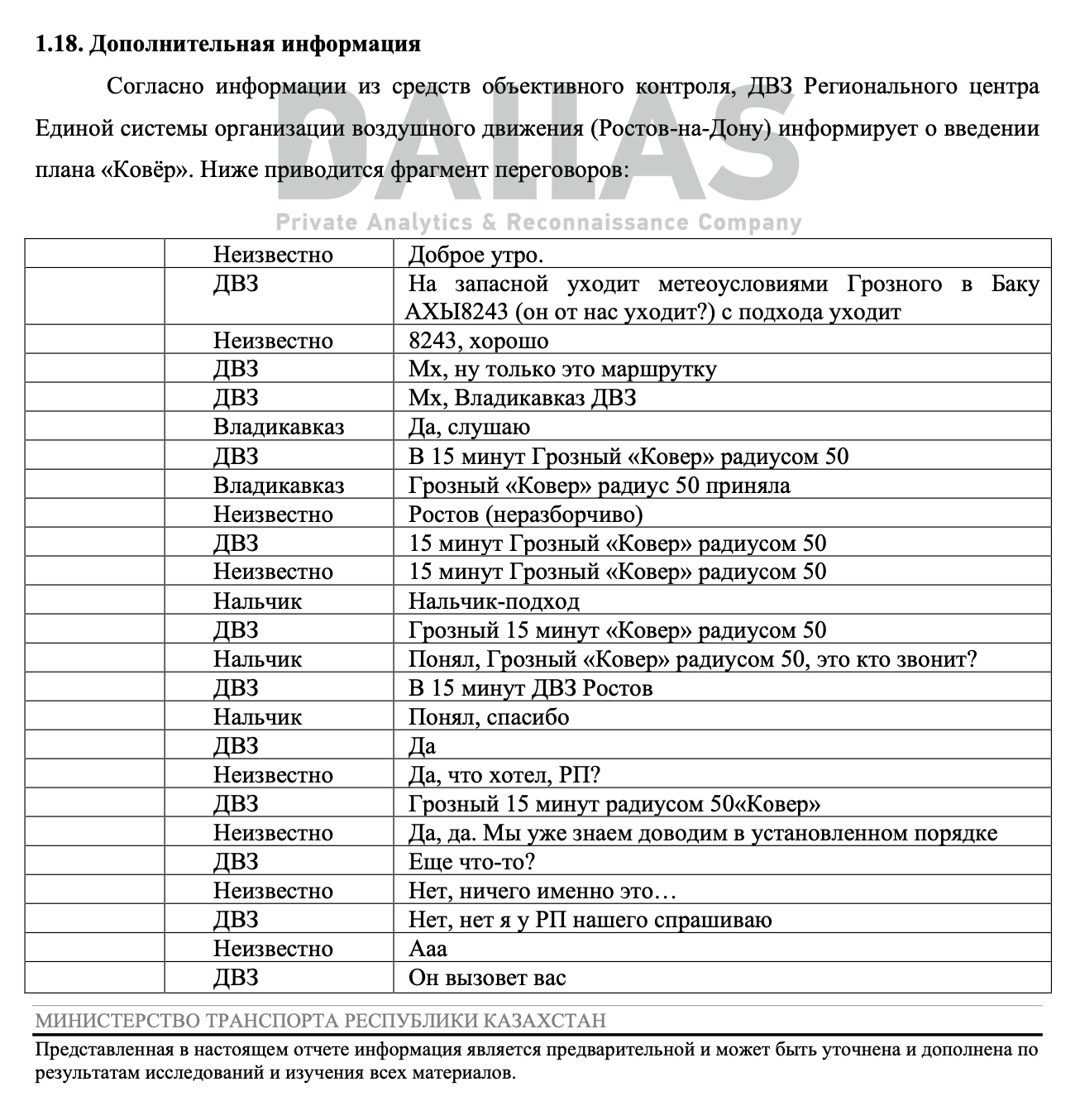
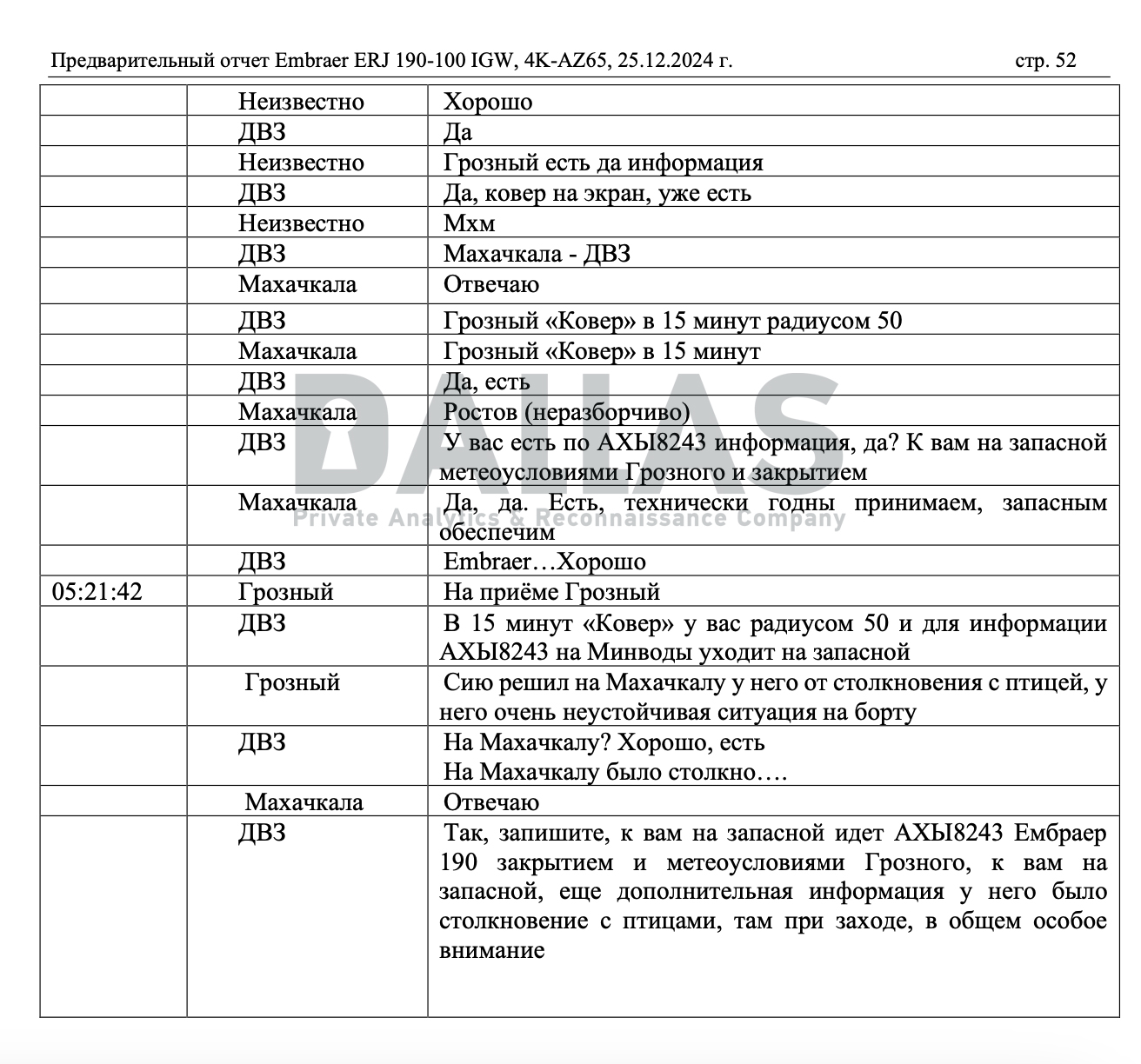
Thus, even in the preliminary report, it was established that the aircraft flying over Grozny was unaware—and could not have known—about any airspace restrictions or an urgent need to leave the area.
However, in the Russian version of the report, this information—as well as any mention of the “Kovyor” plan—is entirely omitted.
Conclusions
So the question arises — why does the Russian side resort to such blatant manipulation?
According to analysts at Dallas, ignoring the victims in the statistics is not only a desecration of their memory, but also a traditional reporting tactic in authoritarian states. The statistics must appear “normal” — without exaggeration or overstatement.
Replacing the phrase “sound impact” with “sound effect” is an example of how the tradition of Newspeak, described by Orwell, is becoming increasingly entrenched in the Russian Federation. This is a form of artificial language manipulation, where real concepts are replaced with euphemisms, used by the authorities and state media to soften public perception of various events — including military and natural disasters. On another level, calling an explosion an “effect” leaves room for future narrative manipulation — to sow doubt about the nature of the object that brought the plane down.
This tactic also relates to the manipulation of descriptions of damage to the aircraft. The warhead of a surface-to-air missile contains a large number of uniformly shaped strike elements. By omitting just one sentence — about the “rectangular shape” of the damage — Russian propaganda prepares the ground to later argue that it might not have been a missile at all. That it could’ve been birds, Ukrainian drones, or even UFOs. The more contradictory or outlandish the theories, the better.
The manipulation of the timing of GPS signal loss on the Azerbaijani aircraft is directly connected to the omission of when the airspace lockdown (“Kovyor”) was initiated. Russian propaganda can now claim that the aircraft’s navigation systems simply failed on their own.
However, the fact that the Kovyor protocol was activated after the second missile strike on the Embraer E190 clearly proves that Russian air traffic controllers failed to warn the plane in time about any flight restrictions. This indicates a lack of communication between Russian military and civil aviation authorities. Therefore, we may assume that any civilian aircraft in Russian airspace could potentially become a target.
And of course, the manipulation of accident statistics undermines trust in the entire work of the IAC and all Russian-supplied aviation data. Given the international sanctions against Russia’s civil aviation sector, it is difficult to reliably verify whether any of the IAC’s reporting is accurate.
Tragically, if we examine the number of civilian aircraft shot down by armed forces or paramilitary groups in the last 15 years, Russia and Sudan top the list of this grim statistic — followed by Iran and Ethiopia. Yet, the Russian Federation is the undisputed “leader” in terms of civilian casualties. And the refusal to include the victims of these crimes in official statistics once again shows that no real lessons have been learned from this terrible combination of mistakes, recklessness, and disregard for international norms.
Instead, there are serious concerns that in just a few weeks, Russia will attempt to secure the necessary number of votes to return to the ICAO Council — the organization’s governing body.
The Council is composed of 36 member states, elected every three years at the ICAO General Assembly. At the previous session, on October 1, 2022, Russia was not re-elected to the ICAO Council — for the first time since 1944.
During that vote, Russia received only 80 out of 193 votes, falling short of the minimum 86 required for re-election. This was a direct consequence of its aggression against Ukraine and gross violations of the Chicago Convention — including the shelling of civilian airports, dual licensing of aircraft in violation of aviation standards, and posing threats to international air routes.
Will ICAO member states have the political wisdom to prevent the return of a country that flagrantly undermines civil aviation safety and resorts to blatant manipulation? That question remains open.