



As of March 10, 2026, the Russian shadow fleet included 1,341 vessels. Of these, 886 are under sanctions by various countries, but a significant number continue to operate on Russian oil transportation routes. From December 2025 to March 2026, the US, India, and EU countries detained at least 14 vessels, including three on suspicion of transporting Russian oil. Last week, the Swedish coast guard detained the Sea Owl tanker, and its captain was arrested.
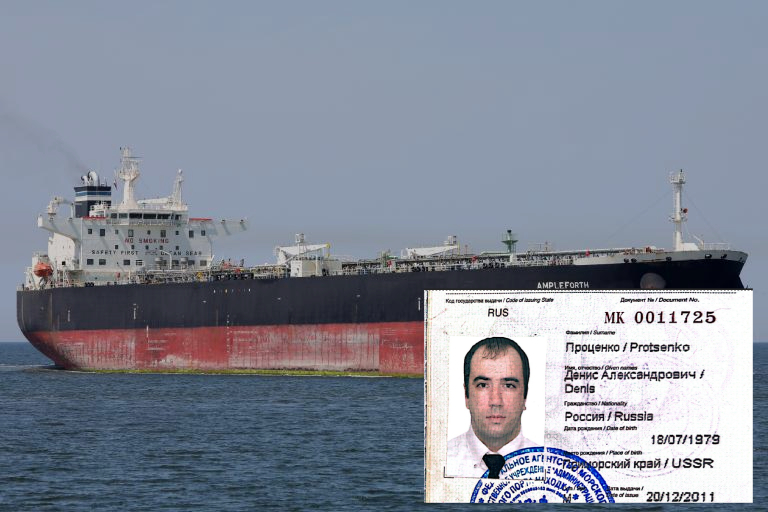
Captains who agree to transport Russian oil to evade sanctions are responsible for violating international law, because they do it knowingly. The correspondence of Russian captain Denis Protsenko, which the Suspilne investigative editorial office received from “256 Cyber Assault Division” hacker group, is the proof of this. The materials include hundreds of letters, official documents, and contracts. We have verified this data with open sources, ship registers, and sanction lists, and traced the participation of the Russian captain in the routes of the Russian shadow fleet.
Six days after the beginning of Russia’s full-scale invasion of Ukraine, Denis Protsenko signed a document waiving any claims against his employer in the event of his death in the war. That same week, he boarded a Norwegian oil tanker in the Russian port of Ust-Luga on the Baltic Sea. Over the next three years, Protsenko commanded at least four tankers that carried Russian oil and were later sanctioned by the United States, the European Union, and other countries.
Protsenko signed his last known contract on October 14, 2025, for a tanker that was already under sanctions by the EU and five other countries. In December 2025, Ukraine also imposed sanctions against it. As of March 2026, the tanker continued its voyage heading to India from Primorsk, Russia.
The story of Denis Protsenko shows how the shadow fleet operates – intricate chains of companies, changing flags and names of ships, and documents that relieve the employer of any responsibility.
Sea service before the full-scale invasion
Denis Protsenko was born in Nakhodka, Primorsky Krai, Russia, on July 18, 1979. He signed his first contract in 2002 for a tanker of Primorsk Shipping Company. In 2011, he received a long-distance captain license and in the same year commanded his first tanker.
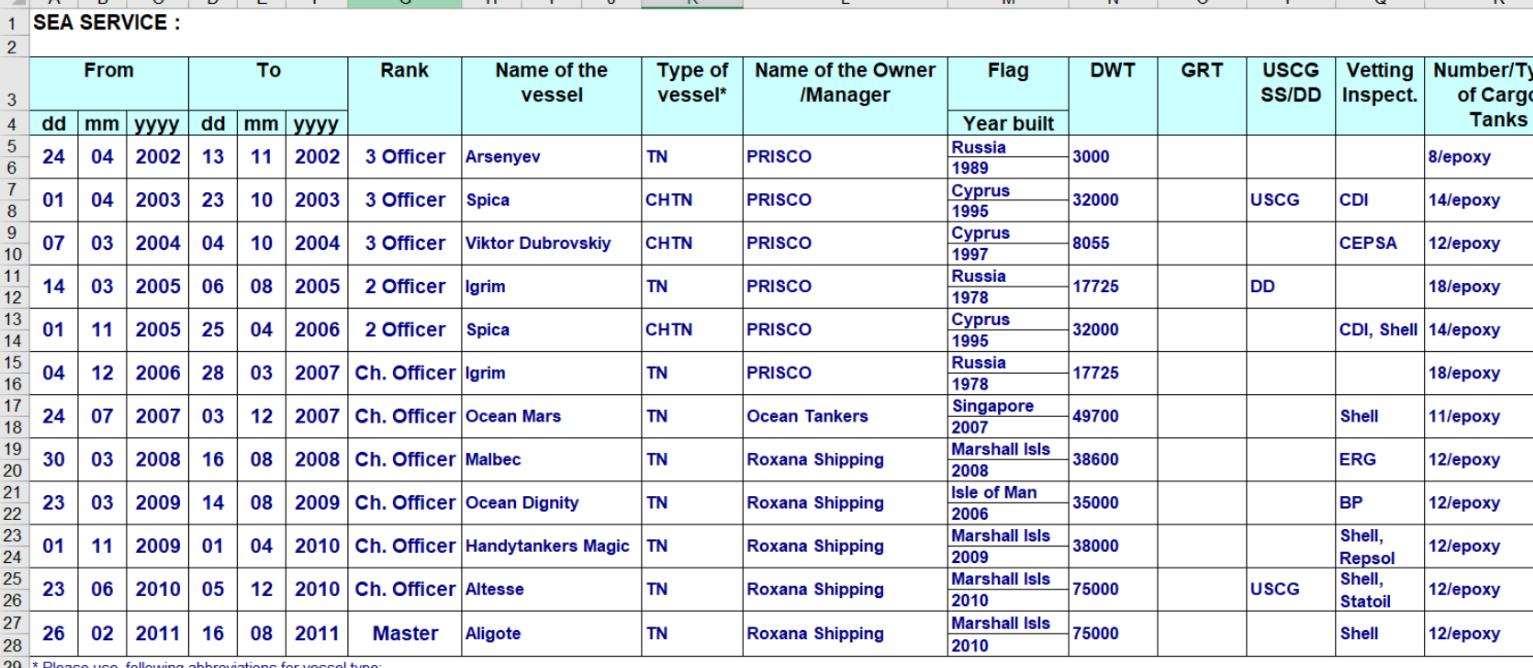
Before 2022, Protsenko had worked on ships of American, Singaporean, Latvian, and Omani companies. His routes ran through the Mediterranean Sea, the Persian Gulf, Southeast Asia, ports of the USA and Africa. Most of the contracts were related to the transportation of oil. In the CV that he sent out in 2025, the captain indicated 14 years of experience in commanding tankers.
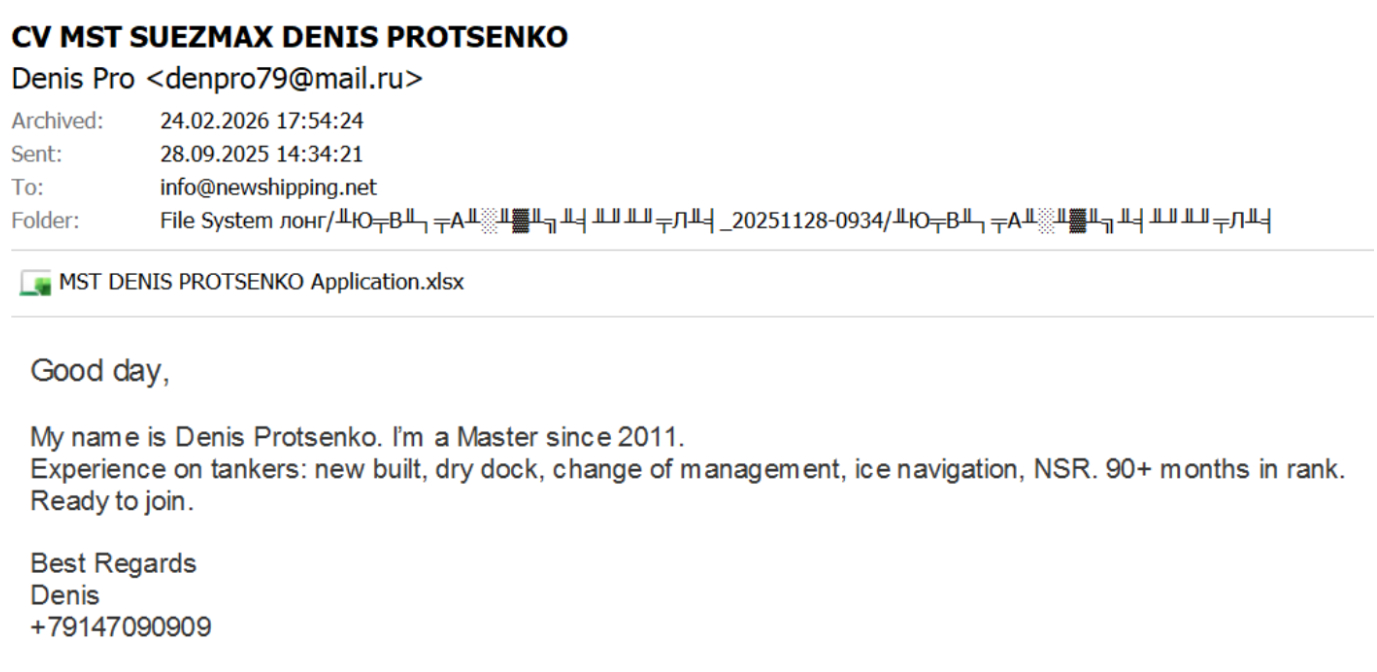
At the end of December 2021, Vladivostok Primorsk Shipping Company, which sent sailors, in particular, to ships of the Norwegian ship manager OSM Maritime, offered Protsenko the position of captain on Front Lynx tanker of the Norwegian ship owner Frontline. The vessel was to transport oil from the Russian port of Ust-Luga on the Baltic Sea.
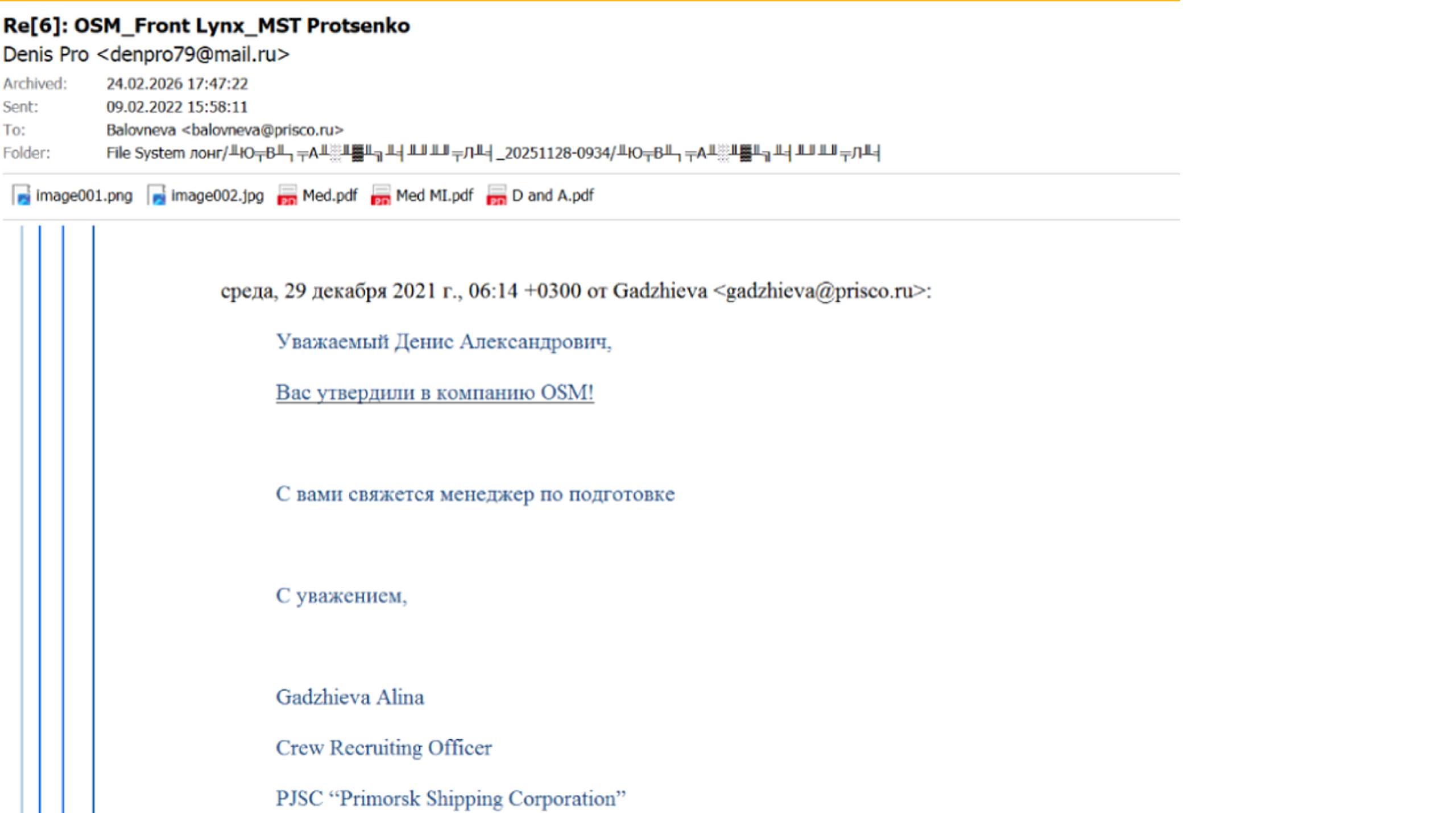
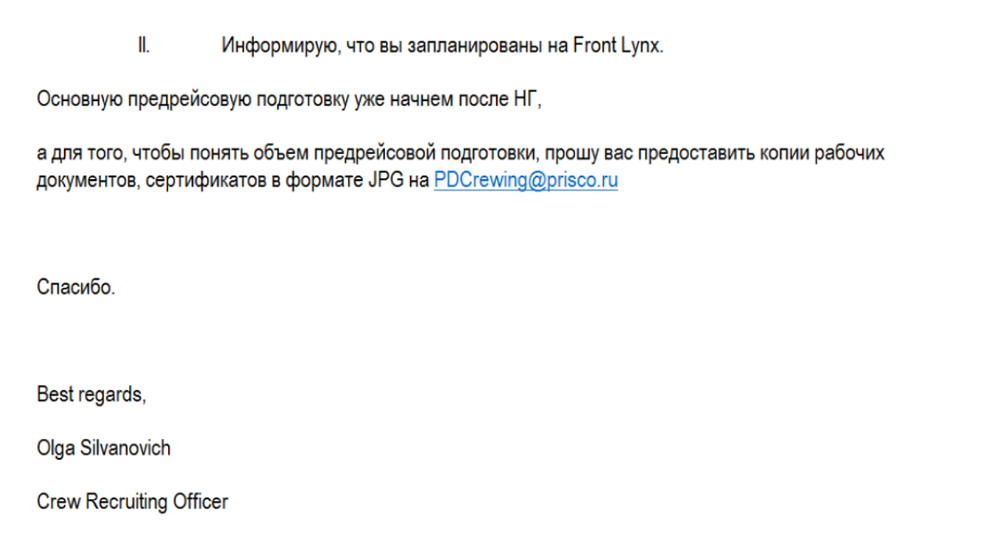
At that time, Protsenko was preparing to work in polar waters and was taking a course in ice navigation.
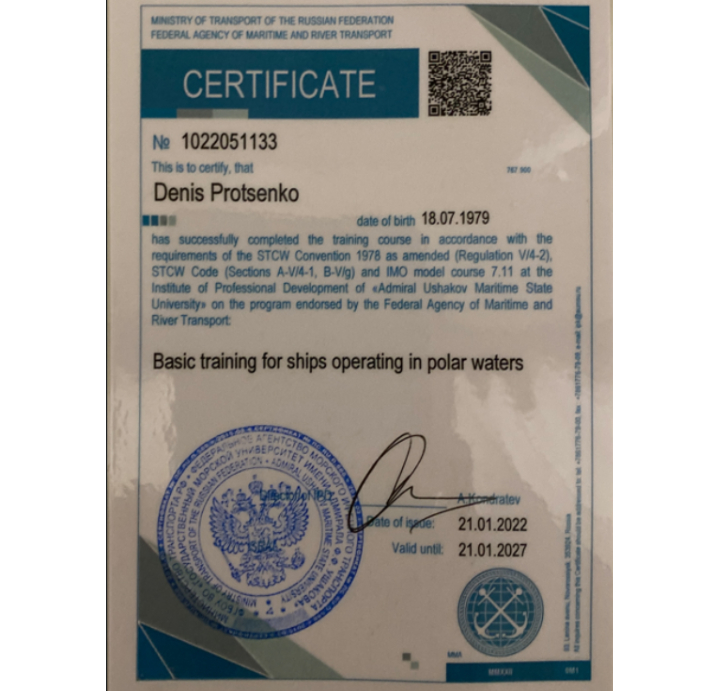
After the beginning of Russia’s full-scale invasion of Ukraine, the Northern Sea Route became one of the ways for exporting Russian oil. Part of the Arctic transportation is now carried out by shadow fleet vessels – tankers that change flags, owners, and managers to avoid sanctions control.
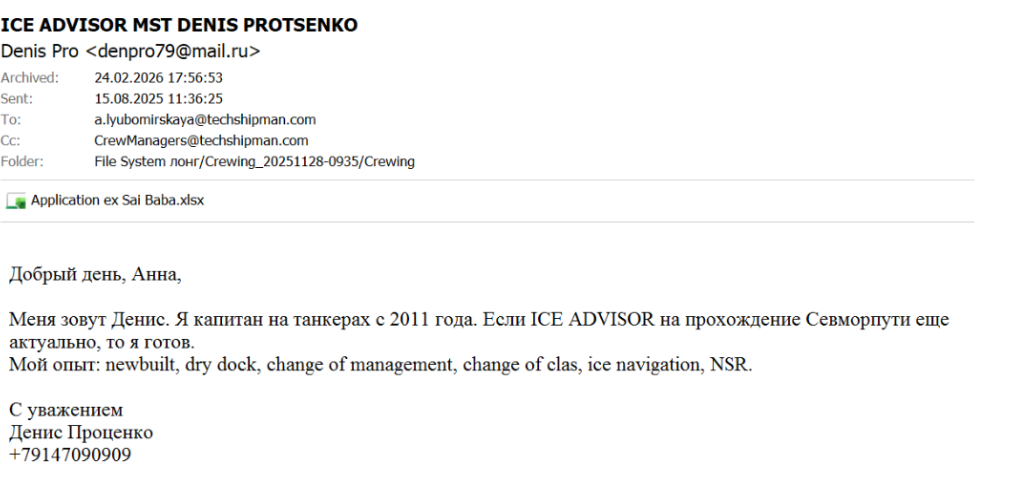
There is no direct confirmation in correspondence of Protsenko’s participation in polar voyages after 2022. However, in August 2025, while looking for work, he approached one of the Russian shipping companies with a proposal to consider him as a specialist in ice navigation.
Sea service after the beginning of Russia’s full-scale invasion of Ukraine and suspensions
In March 2022, after the start of Russia’s full-scale invasion of Ukraine, international container carriers began to massively suspend operations with Russia. The tanker sector reacted differently. For example, Greek companies continued operations until November 2023, when US sanctions pressure finally forced them out of the market.
Frontline Company, the owner of Front Lynx tanker, said it was complying with sanctions against Russian vessels. However, its CEO admitted that the company had transported one cargo from Russia after the invasion began due to contractual obligations. It is likely that this was the voyage taken by Protsenko.
The crew change on this vessel was planned even before the invasion. This is a standard rotation procedure: the previous captain completes his contract and leaves the vessel, and another takes his place. On Front Lynx, the rotation was planned to be held on February 14, 2022, in the port of Ust-Luga.
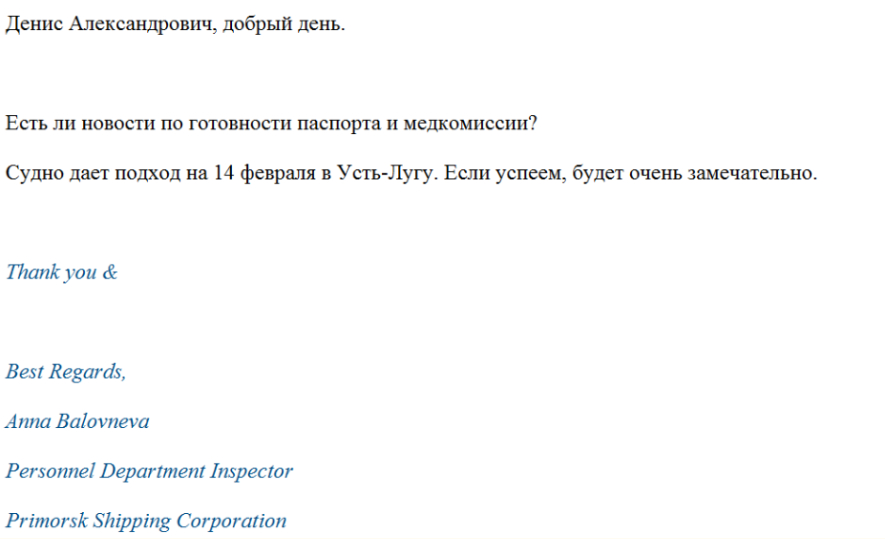
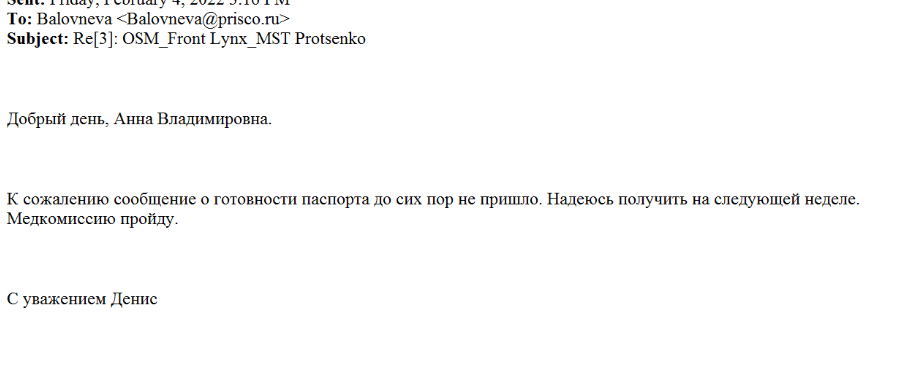
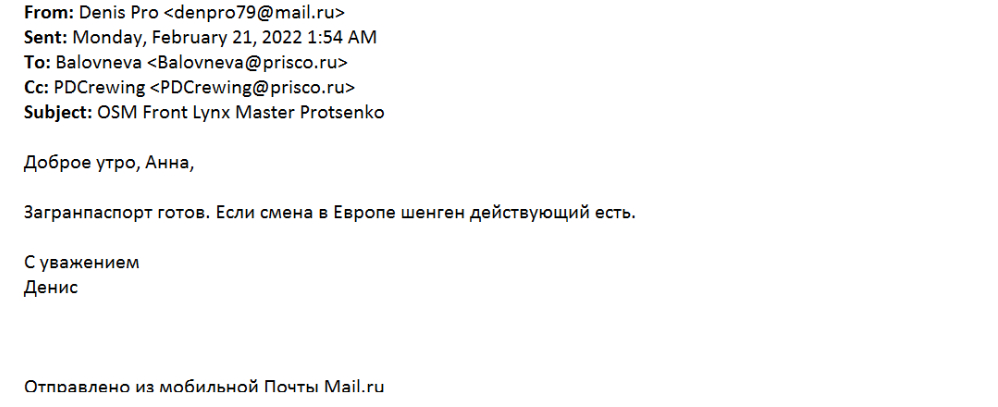
The company required a new passport, which had to be valid for at least a year from the date of embarkation. The document was delayed, and the captain received it only on February 20.
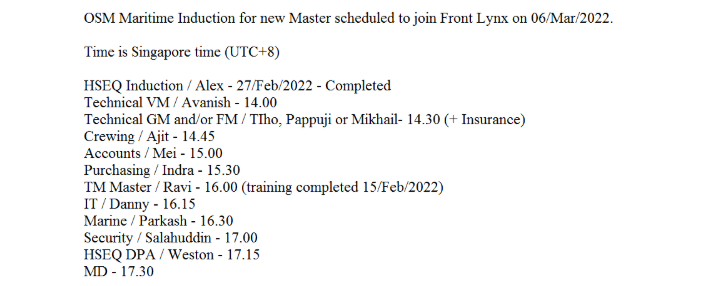
On February 28, OSM Maritime informed Protsenko that he was to join Front Lynx on March 6.
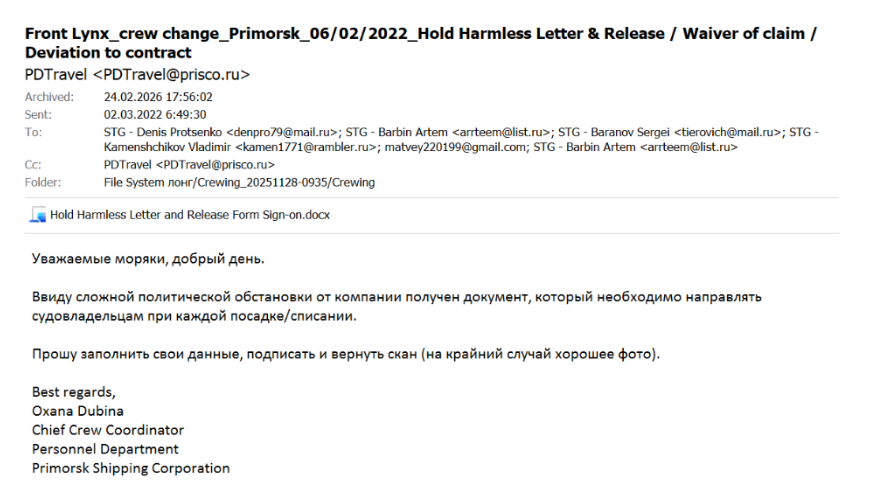
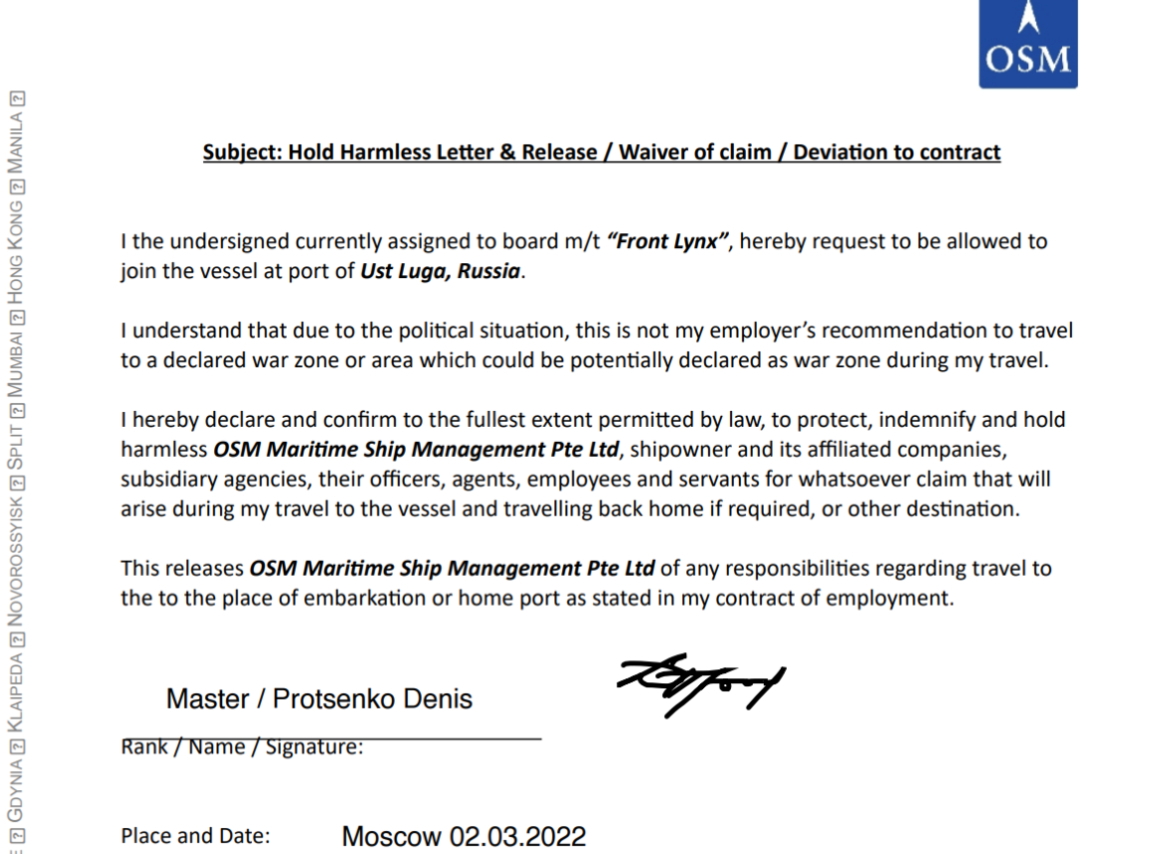
On March 2, 2022, the Primorsk Shipping Company coordinator, Oksana Dubina, sent to Protsenko Hold Harmless Letter.
In it, he confirmed that he understood the risks of traveling to a declared war zone or area which could be potentially declared as war zone, and released OSM Maritime of any responsibilities. Protsenko signed the document the same day.
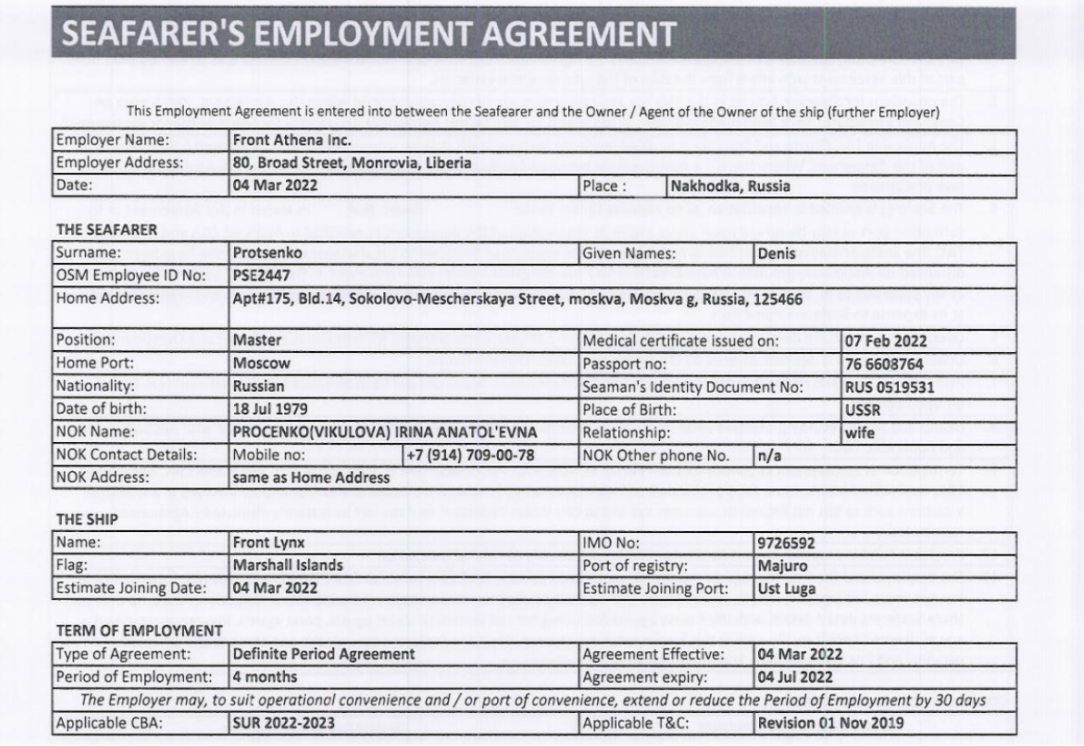
The next day, airline tickets and a signed contract were sent to him.
Protsenko commanded the vessel until July 4, 2022. The tanker transported crude oil, and the captain’s formal employer was the Liberian company Front Athena Inc.
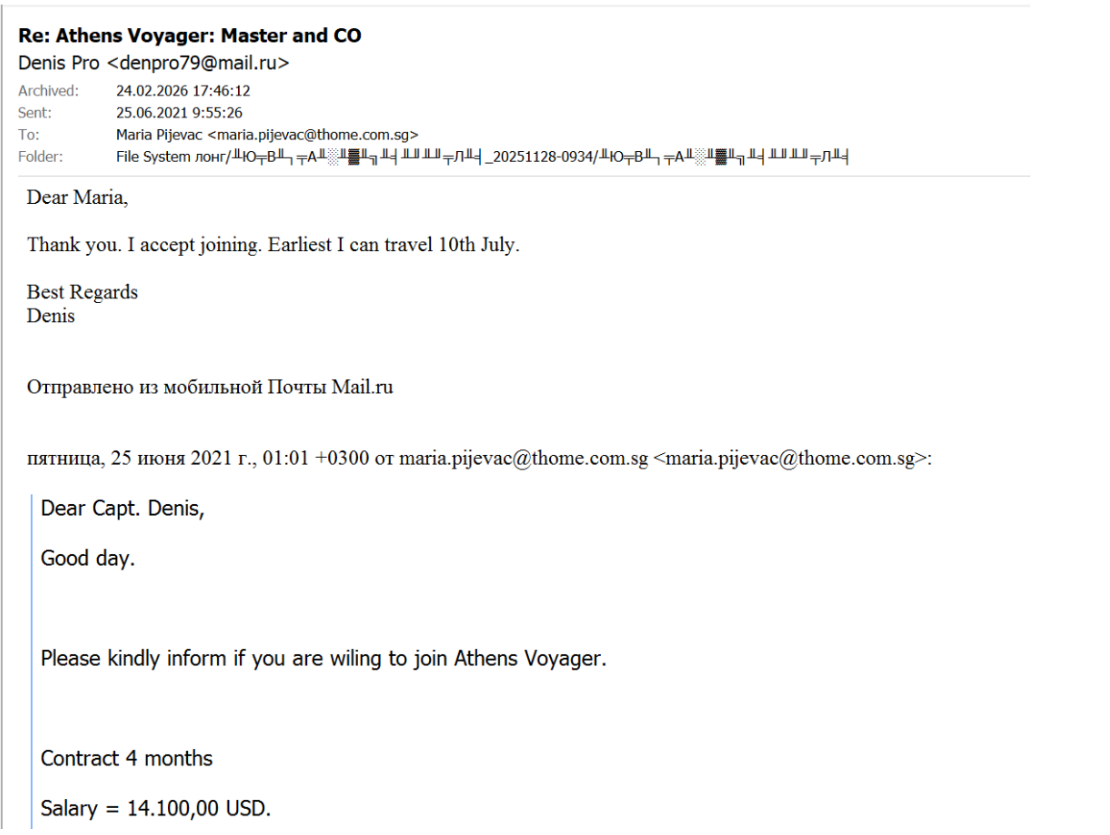
After the voyage, Protsenko tried to return to work at the large international company Thome Ship Management, with which he had previously collaborated.
In 2020–2021, he commanded tankers Nordic Anne and Athens Voyager for the company, receiving about $14,100 per month. Interestingly, in June 2020, Athens Voyager was already on the US Treasury Department’s sanctions list for transporting Venezuelan oil – even before Protsenko joined the ship in August 2021.
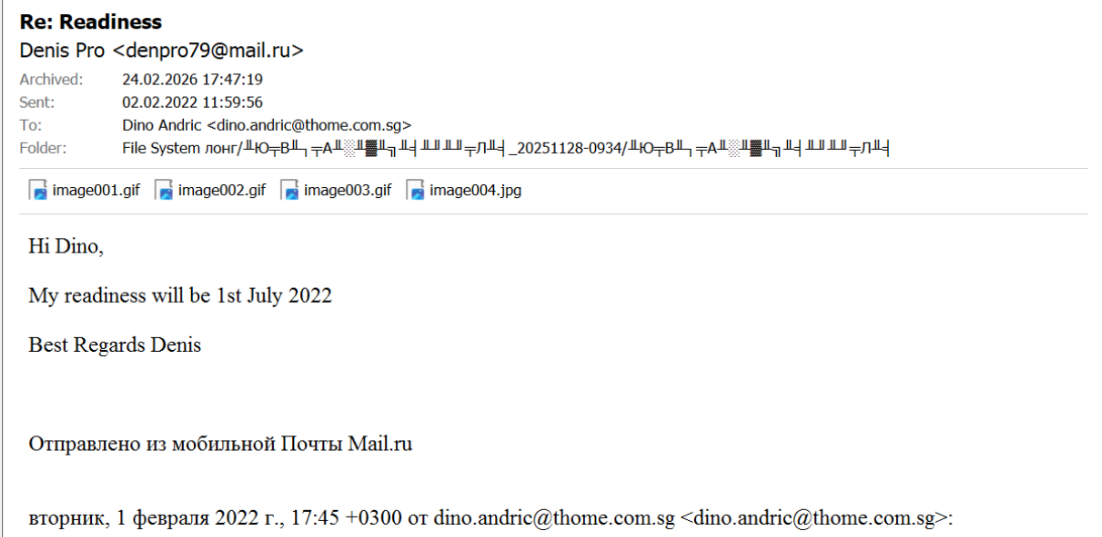
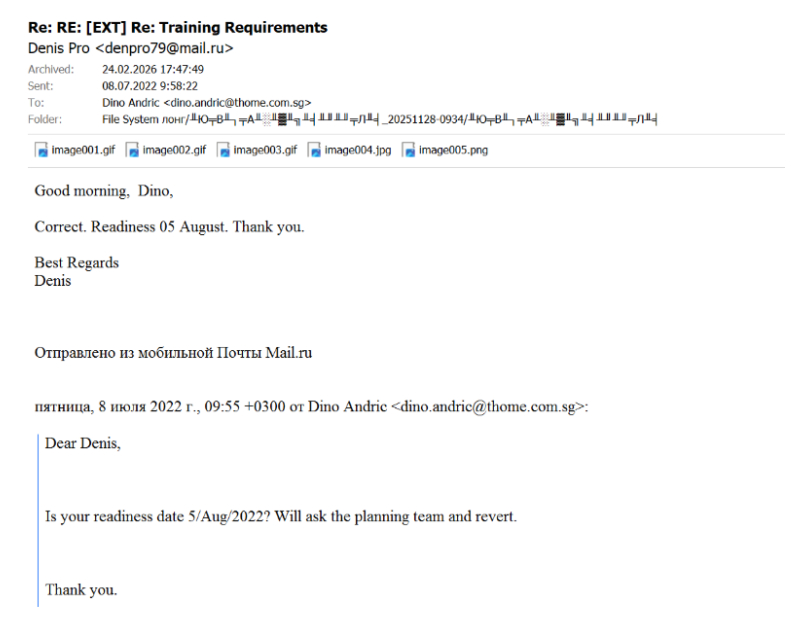
On February 2, 2022, Protsenko confirmed his readiness for a new contract starting in July.
However, when the Front Lynx voyage ended, the planning of a new contract got delayed. In July, he wrote to the company’s manager. Initially, the parties agreed on a new contract starting August 5, 2022.
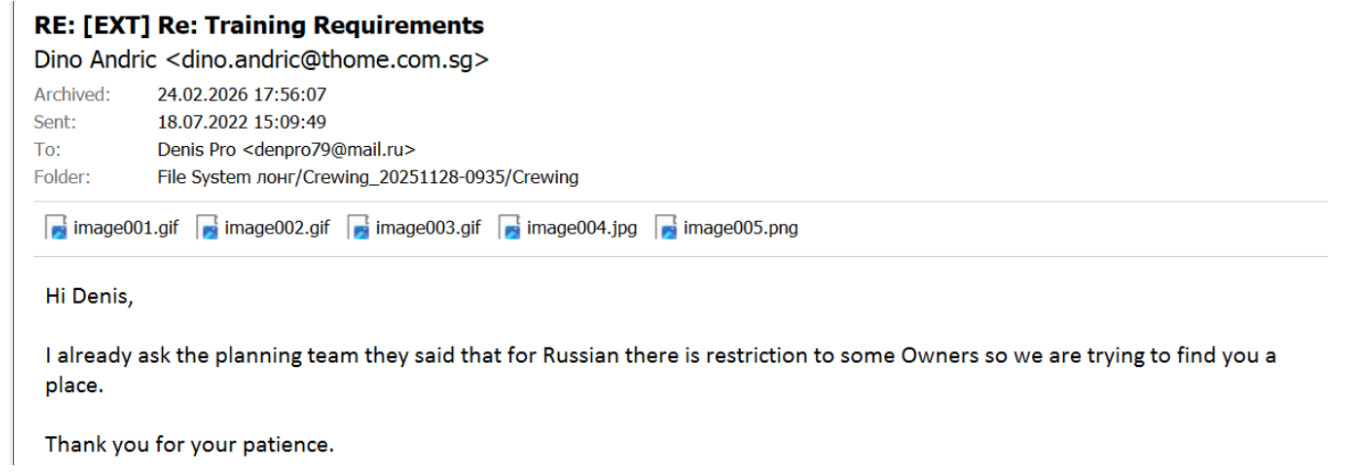
On July 18, the manager informed Protsenko that some ship owners had imposed restrictions on Russian sailors, but the company was trying to find another job for him. However, they did not find it.
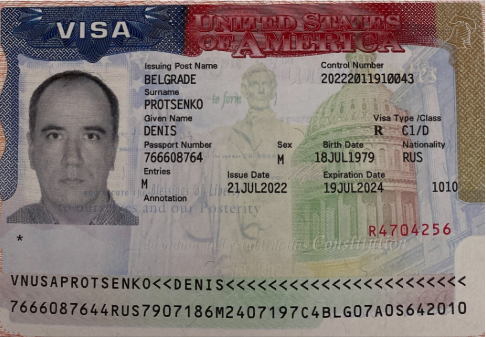
Nine days later, Protsenko sent a copy of the American sailor’s visa he had received, which allowed him to enter US ports.
Obtaining this visa was not easy. After the full-scale invasion began, American consulates in Russia suspended visa issuance. To obtain a US visa, Russians had to physically travel to a third country.
Topsail agency from Kaliningrad, which specializes in the preparation of maritime documents, offered two options: Warsaw or Belgrade.
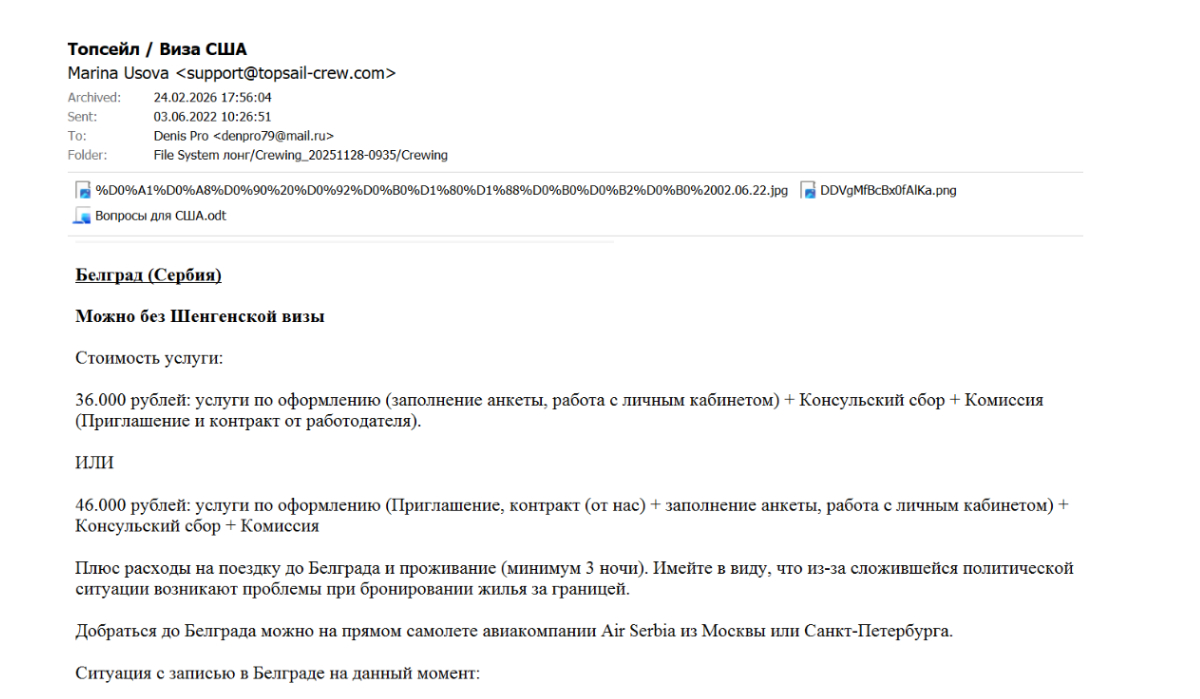
Serbia did not join the sanctions against Russia, did not introduce a visa regime for Russians, and maintained air connections with Russian cities. In 2022, Belgrade became one of the main hubs for Russians who needed foreign documents or services unavailable at home.
Tankers with non-transparent ownership
In September 2022, Protsenko found a job on the oil tanker of the Cypriot company Oracle TBN Harmonia, which was soon renamed Harmonia. He joined it in the Bahamas. Protsenko flew there from Moscow via Istanbul and Miami.
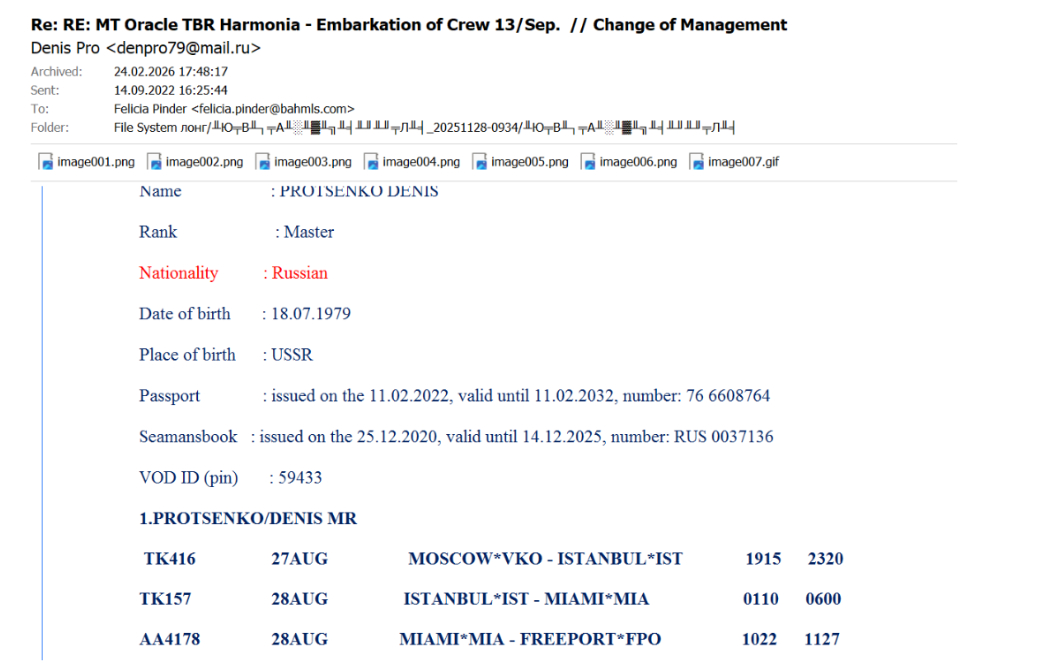
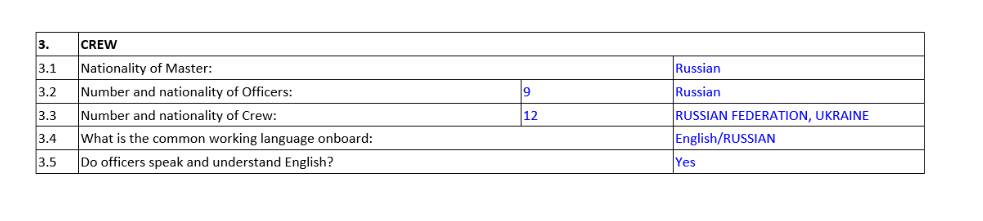
The crew was transported aboard by a private boat. Along with Protsenko, 21 other sailors from Russia and Ukraine joined the ship.
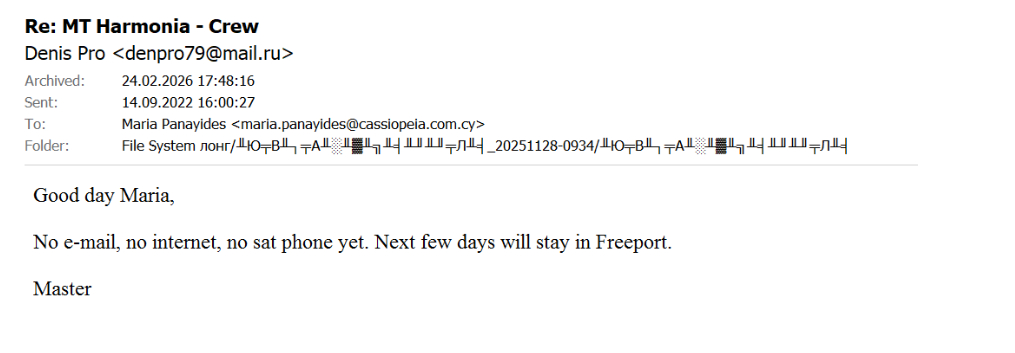
The next day, the newly appointed captain informed the managers about the communication problems.
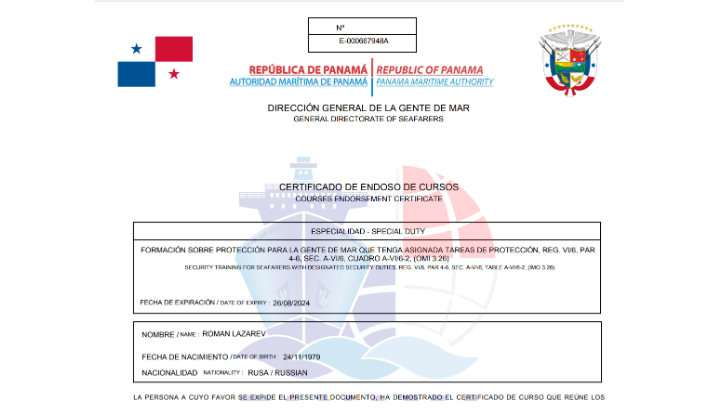
Over the next few days, the ship’s management changed. New documents were sent in packages, and crewmembers received Panamanian certificates.
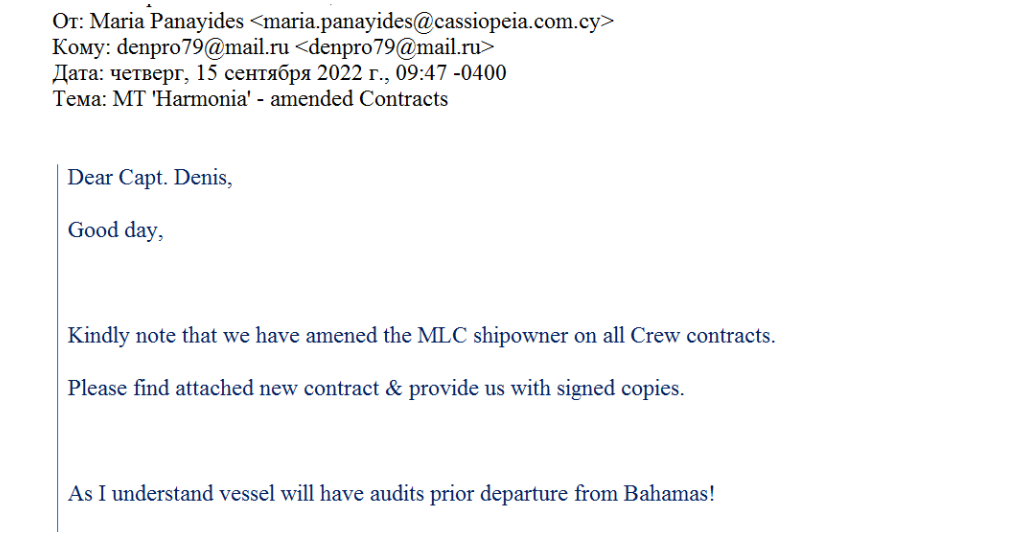
The contracts were re-signed with another ship owner.
A chain of companies was behind the ship. Cassiopeia Shipmanagement from Cyprus, which was responsible for personnel issues and signed contracts with the crew, communicated directly with Protsenko. At the same time, the Latvian company Ultramarin, as well as the Bahamian BAHM Logistics and the Philippine Cassiopeia Marine Services also appeared in the correspondence.
It later emerged that renamed Harmonia was linked to Dubai-based Fractal Marine DMCC. It had organized a fleet of old tankers to transport Russian oil after sanctions were imposed in 2022.
Part of this fleet belongs to a wider network of shipping companies linked to the son of a top political advisor to Iran’s former supreme leader. This network transports Iranian and Russian oil to buyers around the world.
On July 30, 2025, the United States imposed sanctions on Harmonia, and on October 24, 2025, the European Union joined in. By then, the tanker had changed its name twice. The vessel had called at Russian ports in Ust-Luga, Primorsk, Kozmin, Taman, and St. Petersburg.
Protsenko was on board when the vessel actually was part of this network. Formally, there were no sanctions at that time, but the re-registration of documents, the change of management, and the complex ownership structure already corresponded to a scheme that American regulators later qualified as sanctions evasion.
Contracts from Ukrainian companies
Denis Protsenko’s ties with Ukrainian crewing companies lasted from at least 2015, and did not stop even after the start of the full-scale war.
One of these companies is Maritime Agency Ukraine. It regularly sent Protsenko job offers related to large international ship owners.
Each time Protsenko refused – he either already had a contract or an agreement with another employer.
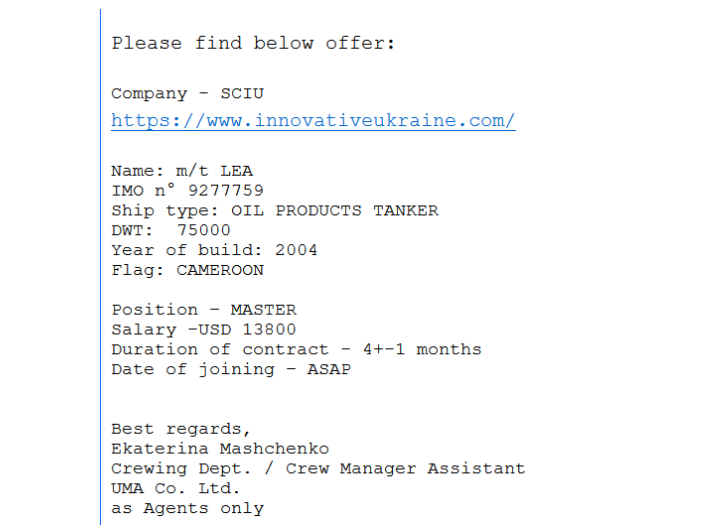
The contacts with this company did not stop after February 24, 2022. On August 25, 2022, after Protsenko joined Harmonia tanker, he was sent a new offer. It was about m/t Lea tanker under the Cameroonian flag from the Ukrainian company SC “Innovative Ukraine”. Protsenko replied that he already had a contract, but made it clear that he was interested in the offer and indicated the next possible date for the voyage – February 2023.
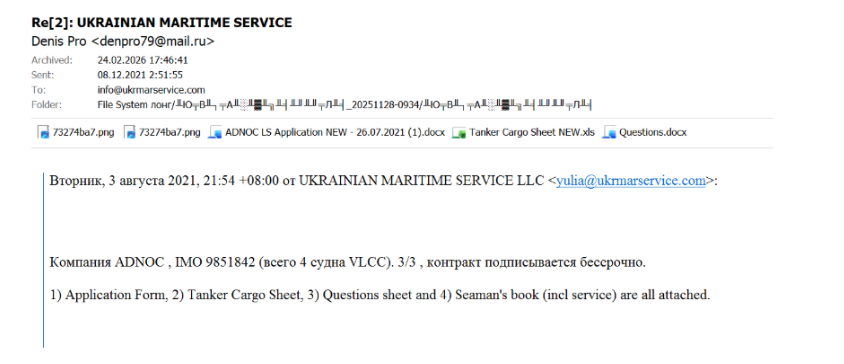
Protsenko responded only in December 2021. There is no further correspondence in the archive, so it is unknown whether he received this position.
The second contact took place in August 2023. On August 4, the company manager wrote a letter to Protsenko.
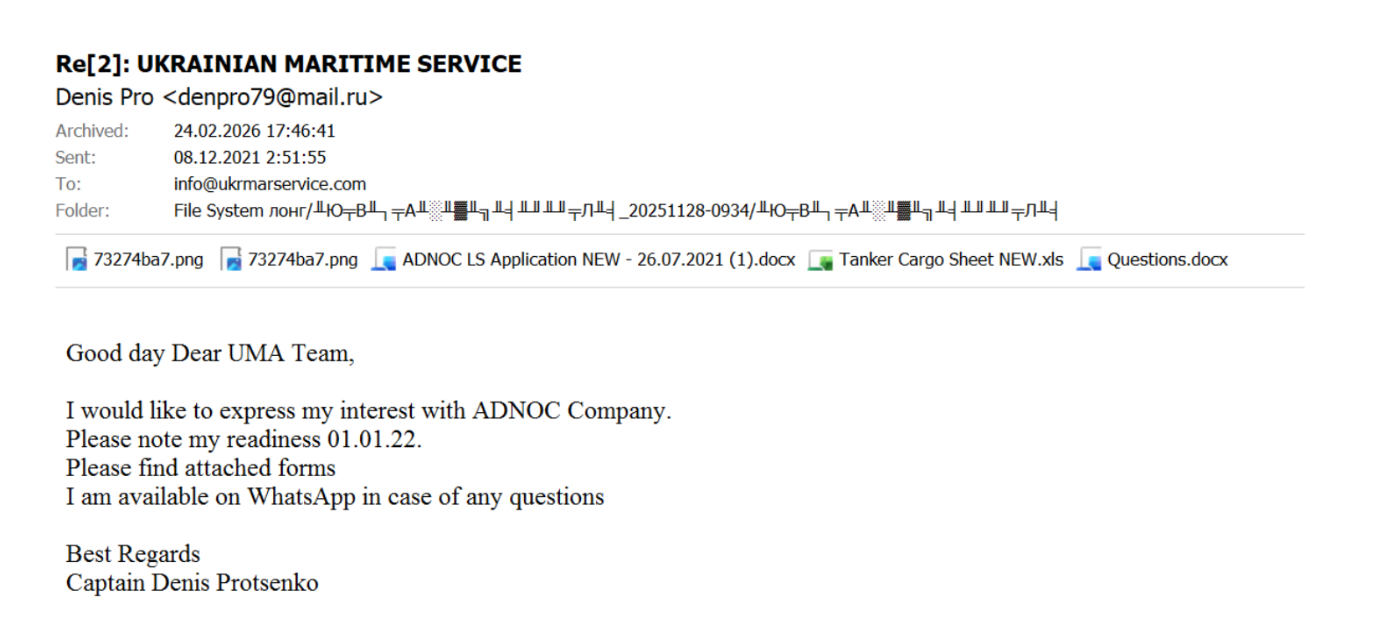
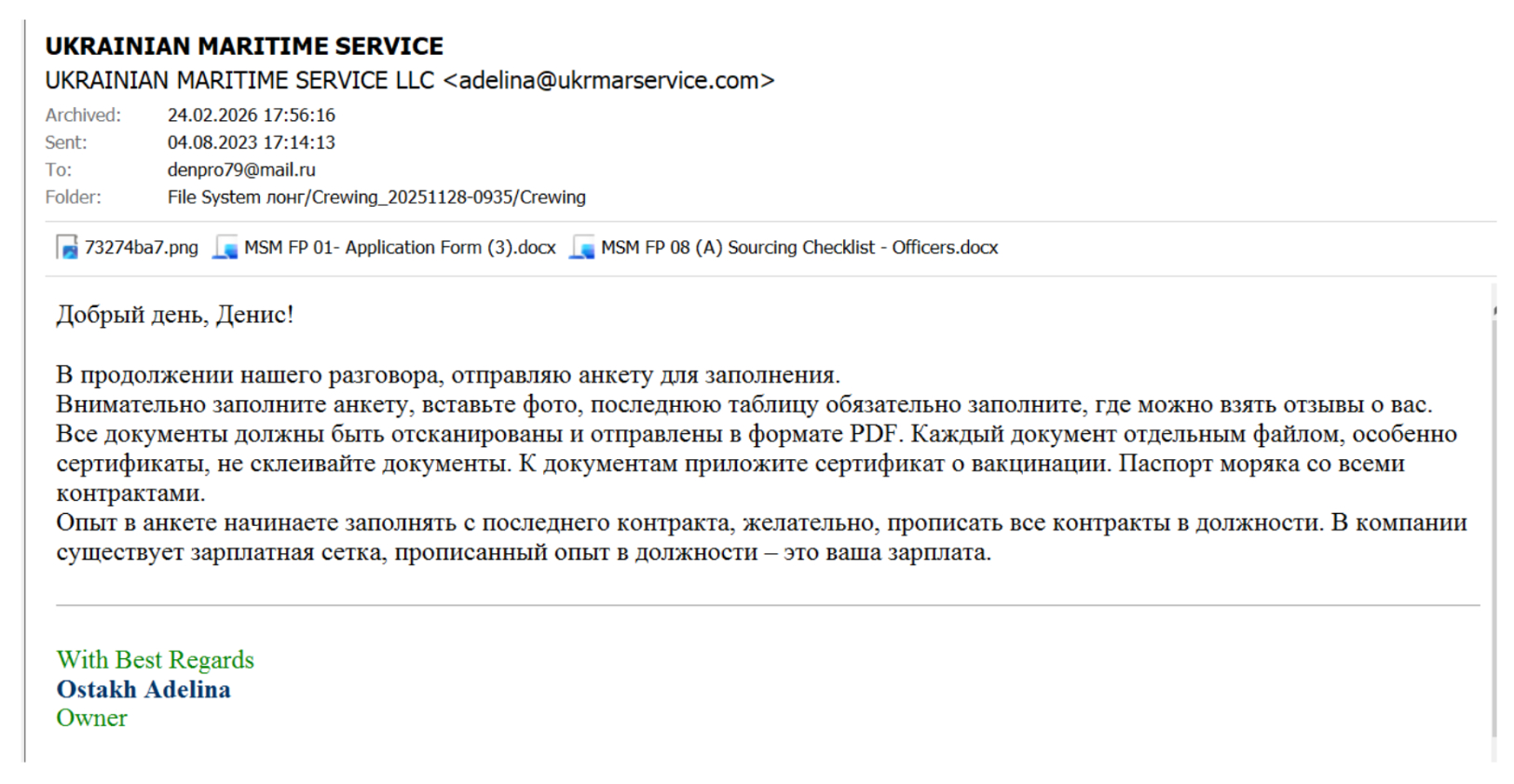
On August 6, Protsenko replied that he had filled out the questionnaires and sent an archive of documents.
What happened next is unknown. There is no subsequent letter from the Ukrainian company in the archive. However, Protsenko found another job.
No later than the beginning of 2024, he was already on board Aion tanker of the Indian company Marshal Ship Management.
After the end of that contract, he sent out the CV for several months, and in June 2024, he joined the next tanker.
Work on sanctioned vessels
In 2024, Denys Protsenko worked on two other tankers that were under sanctions, Wilma II and Sai Baba.
Wilma II is a tanker that changed names and flags several times. After Protsenko left the ship, it was renamed Regal I and was added to the sanctions lists of the European Union, Australia, and New Zealand. The reason was the transportation of Russian oil from the ports of Novorossiysk, Primorsk, and Ust-Luga to India and China.
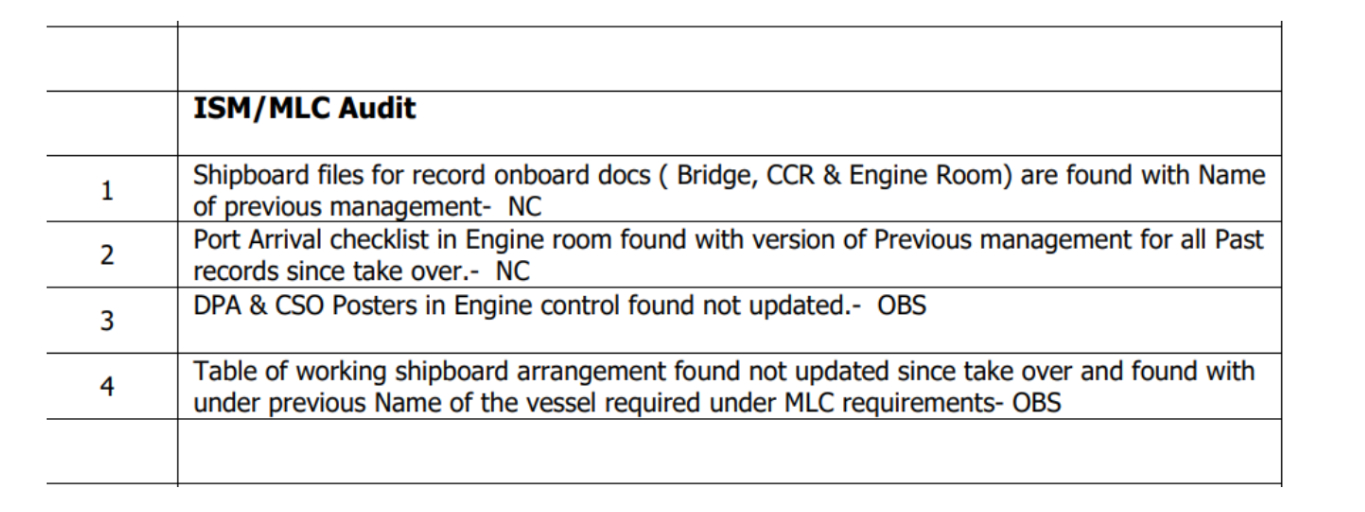
Protsenko was aboard Wilma II as captain from at least June 2024. At the same time, the tanker was changing management. On June 13, the ship underwent an inspection in the Suez Canal. The auditing company noted discrepancies: documents on the captain’s bridge, in the central control station, and in the engine room still contained the name of the previous operator.
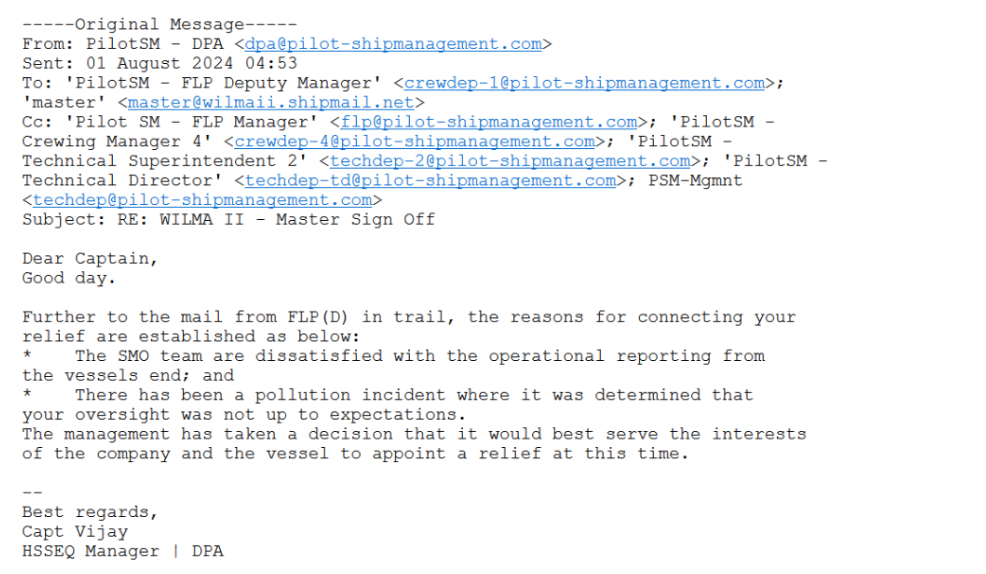
The contract ended earlier than planned and not on the initiative of the captain. On July 31, Protsenko unexpectedly learned that he would be replaced: the new captain was supposed to arrive the next morning. In a letter to management, he asked why he had not been informed in advance and whether he would receive compensation for the two months remaining until the end of the contract.
The response came the next day. The company said it was dissatisfied with the onboard reporting and mentioned the pollution incident. According to the management, the captain’s control did not meet expectations, so the decision to replace him was final.
In August 2024, Protsenko was already aboard another tanker, Sai Baba, in the port of Khor Fakkan in the United Arab Emirates.
The vessel is affiliated with the Indian company Gatik Ship Management, which is considered one of the largest operators of the shadow fleet transporting Russian oil after the imposition of sanctions.
At the time of Protsenko’s work, the tanker was flying the Gabonese flag and had just changed management: the new company Damasaku Shipping FZE ordered an inspection after the vessel was transferred to its management. Protsenko became the first captain after this change.
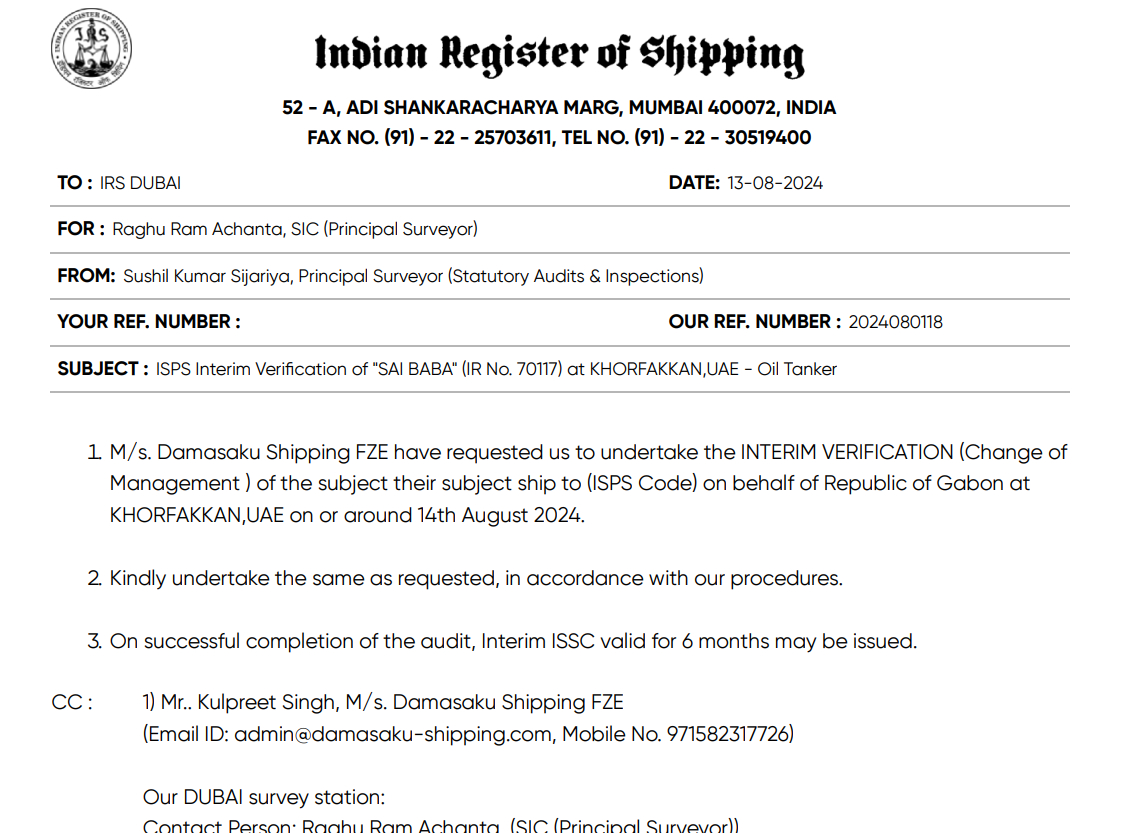
According to the Ukraine’s Main Directorate of Intelligence sanctions materials, Sai Baba transported oil from Russian ports to China and India. After Protsenko left the ship, it was renamed BARQ and re-registered in Oman. Already under the new name, it entered the port in occupied Kerch in November 2025.
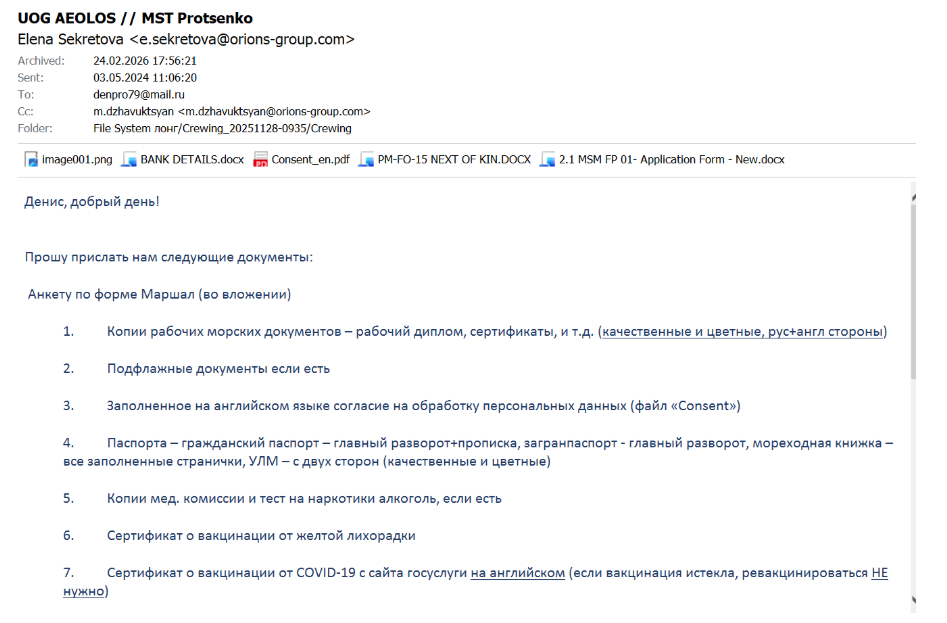
On May 3, 2024, Protsenko received an email from the Russian company Orions Group regarding the new ship.
The letter provided a list of documents required for onboarding, including diplomas, certificates, and a Marshall Islands application. On the same day, Protsenko responded confirming receipt of the request.
The tanker he was working on later became subject to international restrictions. A year after the aforementioned offer, the vessel was sanctioned by the UK, Canada, Australia, and the EU for participating in the export of Russian oil, after which it changed its name to Xing Chen.
After the contract ended, Protsenko was unemployed for several months. In August-October 2025, he sent at least 30 letters with his CV to shipping companies in the UK, Latvia, Singapore, Russia, and India.
Account blocking
In parallel with the change of employers, Denis Protsenko’s financial logistics also changed.
Until 2022, he received his salary in accounts in Russian banks – first in “Vladivostok”, and later in Moscow “Alfa-Bank” and “Sberbank”. Transfers were made via the SWIFT system using American correspondent banks.
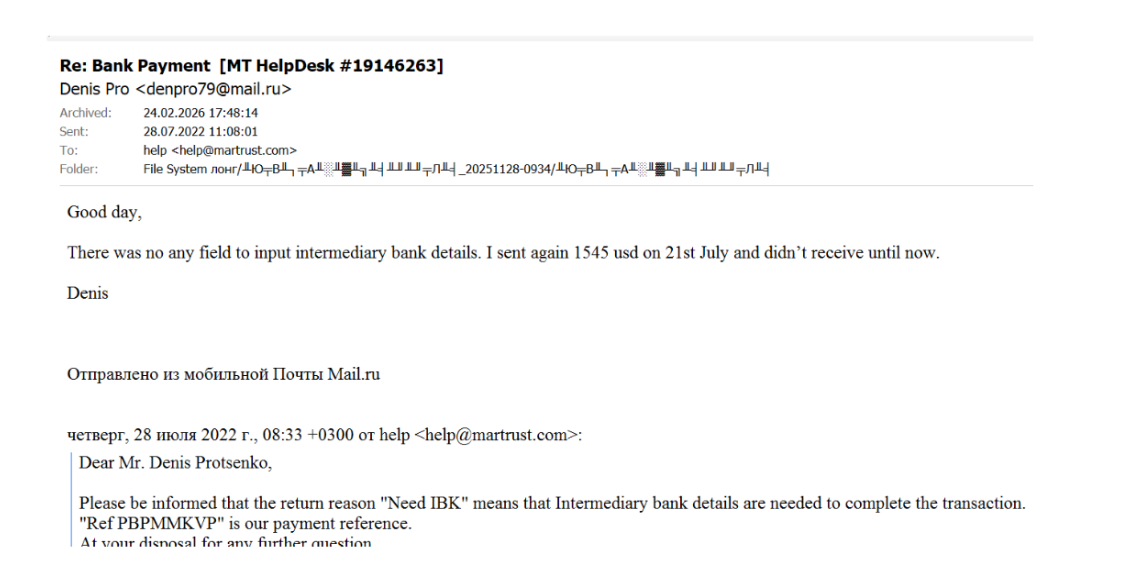
When Protsenko left the first tanker after the start of the full-scale invasion, in July 2022 he complained to the MarTrust payment system: one of the transfers was returned due to the lack of details of the intermediary bank.
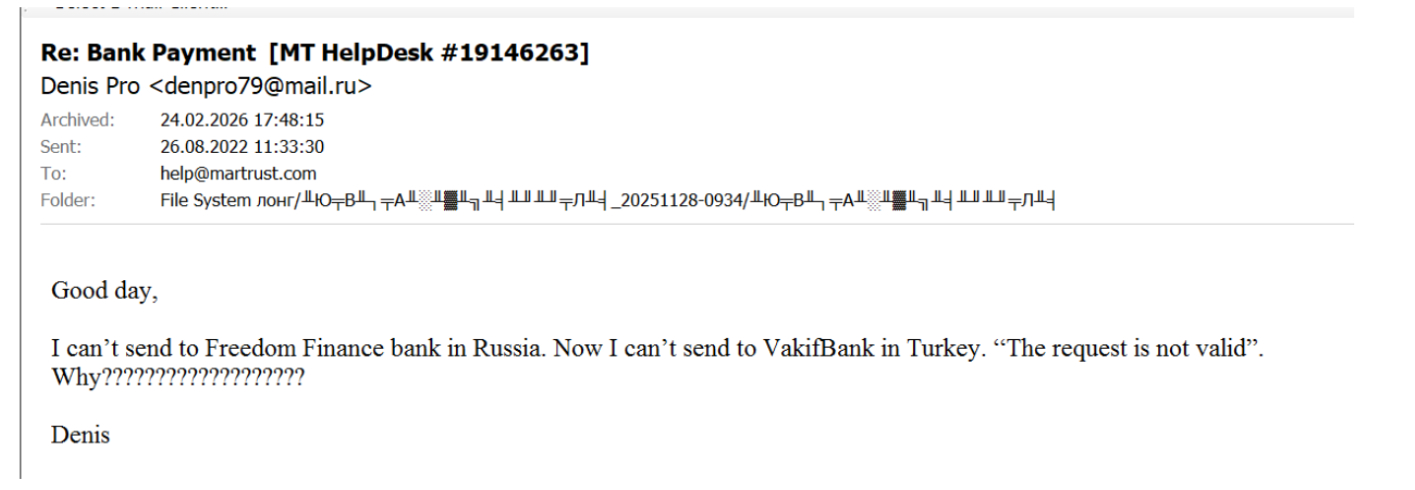
In August, before starting work on Harmonia, Protsenko reported that he was unable to make transfers to Russian and Turkish bank accounts. Payments were blocked in both directions, and he tried to solve the problem by opening an account at another Russian bank.
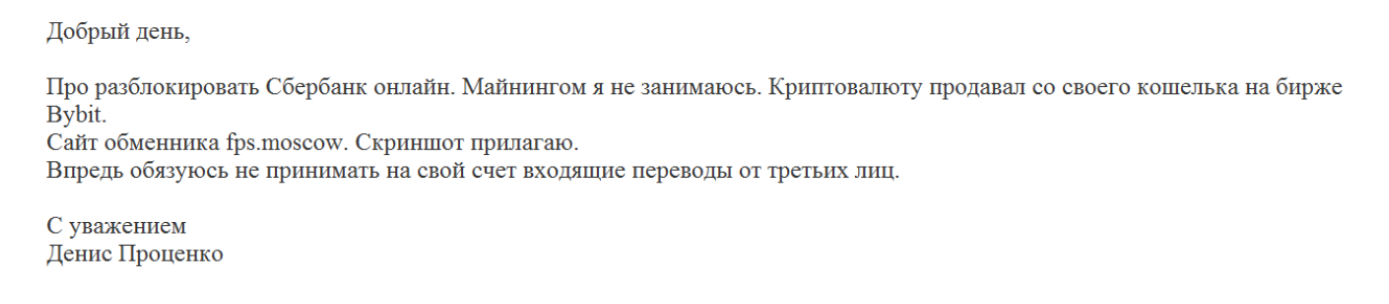
In August 2025, Russia’s “Sberbank” blocked Protsenko’s account and bankcard due to suspicious transactions. In a letter to the bank, he explained that the money came from selling cryptocurrency from an exchange wallet. In September, the bank blocked the account for the second time. Protsenko wrote that he would not accept payments from “third parties”.
When he signed a contract for DESTAN vessel in October 2025, they decided to transfer his salary to an account at the Turkish VakifBank. On November 4, the first payment was received into this account – $7,371 as salary for October from the Indian company VR Maritime.
Protsenko opened an account in the Turkish bank back in 2022, after the US and EU began disconnecting Russian banks from the international SWIFT system and prohibiting them from having correspondent accounts in American banks.
Where is the captain now?
On October 14, 2025, Protsenko received a letter from OSG Ship Management LLC, a Russian crewing company operating under the Orions Group brand. The letter contained a contract.
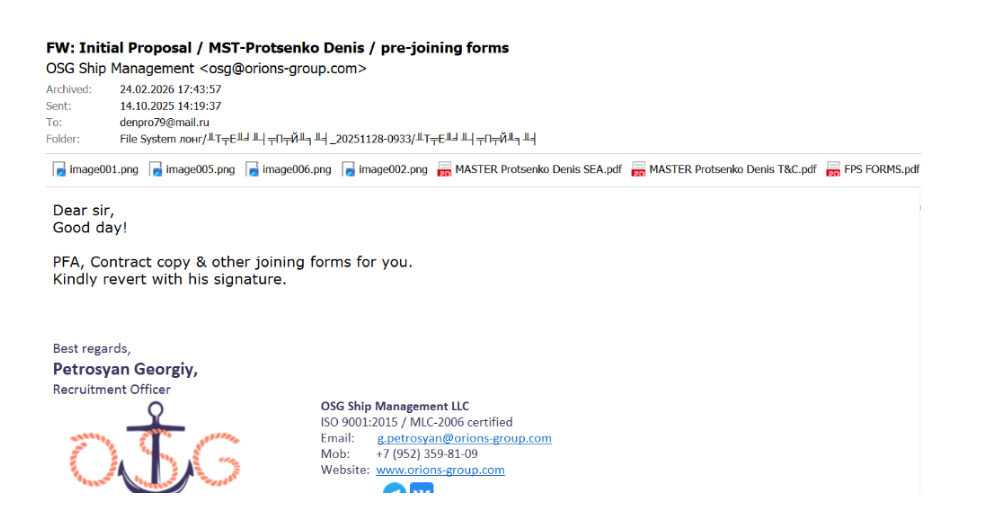
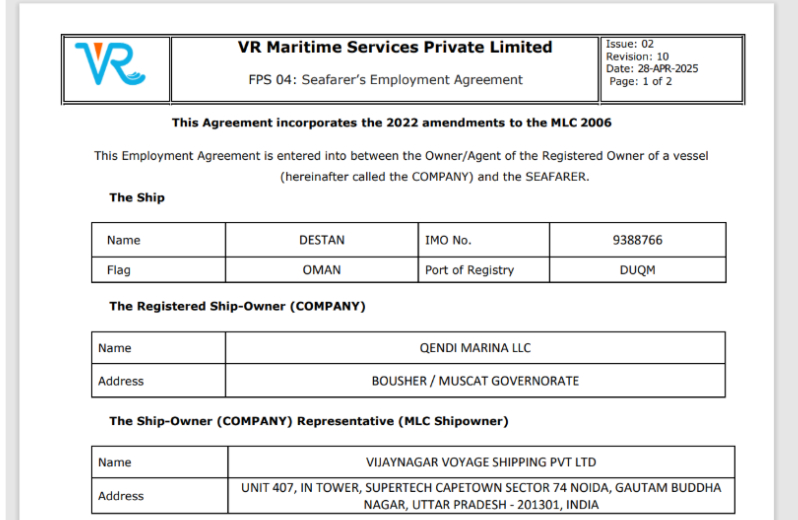
The documents indicated that the owner of the vessel was a company from Oman, and the manager was the Indian company Vijaynagar Voyage Shipping.
At the time of signing the contract, DESTAN was already under sanctions from the UK, Canada, Australia, and the European Union. Ukraine imposed sanctions on the vessel in December 2025, when Protsenko was already the captain.
During its operation, DESTAN has changed three names and four flags. At the time of Protsenko’s boarding, it was sailing under the flag of Oman.
On October 16, 2025, Protsenko joined the vessel in the Suez Canal, replacing the previous captain, Alexander Kalinchenko, whom Ukraine added to the sanctions list back in April 2025.
Captain Protsenko was scheduled to sail from Primorsk to the Indian city of Sikka, which is one of the key points for receiving Russian oil.
As of March 2026, the sanctioned oil tanker DESTAN was heading towards India.
Original article suspilne.media