


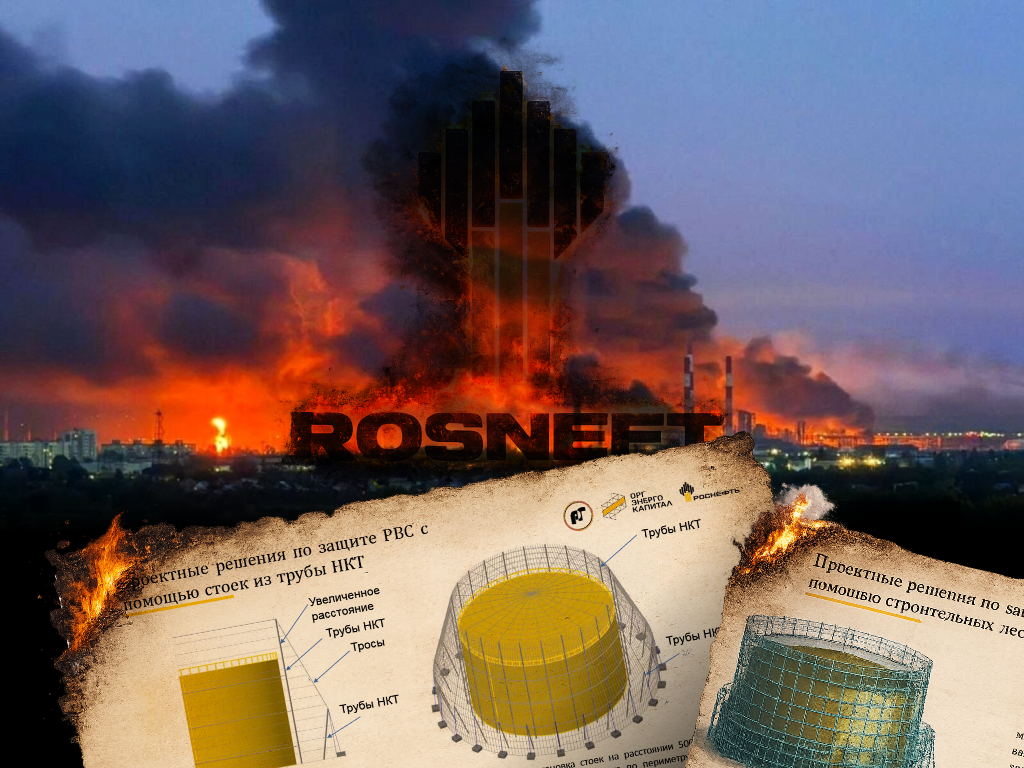
Dallas has obtained a confidential 21-page report outlining the “Systems to protect against the unauthorised use of UAVs at the Company’s sites” — another example of Kremlin-approved newspeak. This language serves a political function — it allows Russian state companies to address a wartime vulnerability through the framework of industrial safety regulation.
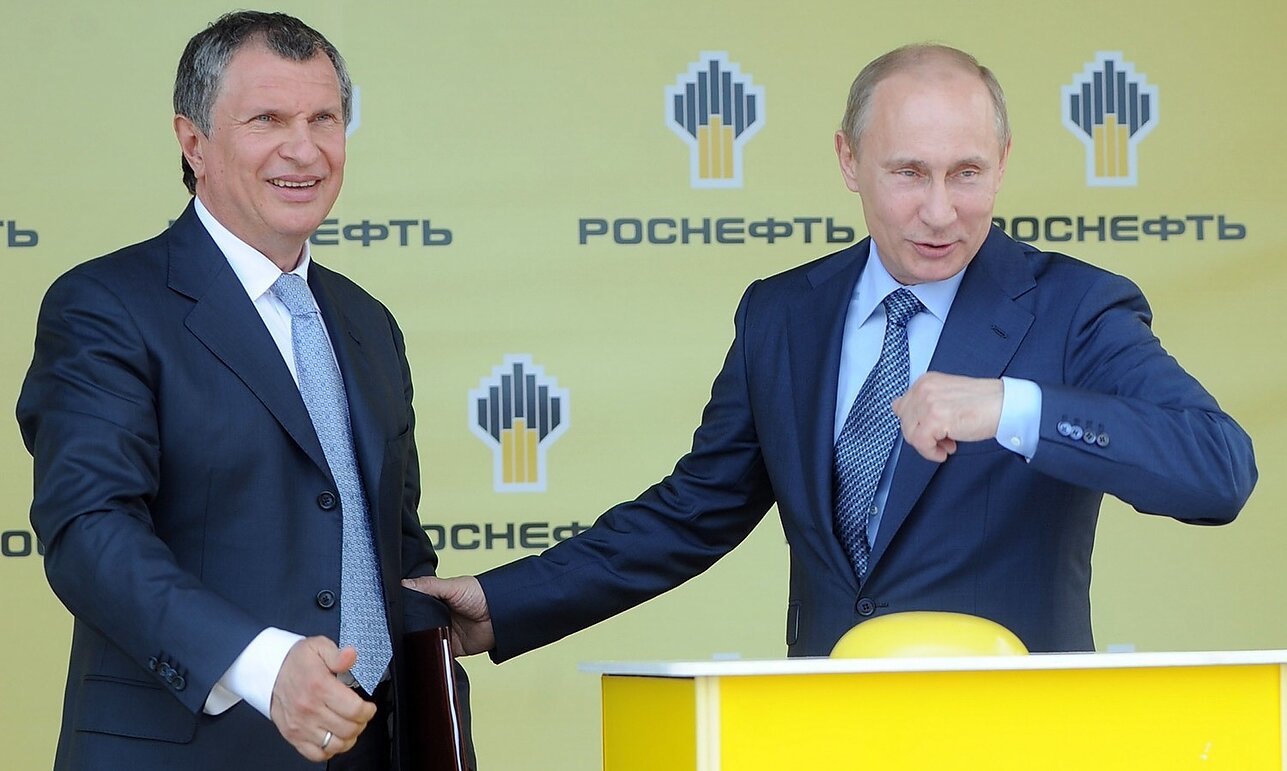
The company in question is Rosneft — Russia’s largest oil producer, long regarded as a strategic instrument of its state power and influence, run since 2012 by Igor Sechin, one of Putin’s closest allies. What happens to Rosneft’s refineries matters well beyond Moscow: the company is the source of about a third of Russia’s crude, and sustained damage to its processing capacity directly constrains the revenue stream that finances Russia’s war in Ukraine. In May 2024, Sechin wrote to Prime Minister Mishustin requesting tax deductions to offset the cost of defending refineries that had already made him extraordinarily wealthy.

The 2026 report has been jointly prepared by Rosneft, Rosgasifikatsiya — a Rosneft-affiliated holding managing industrial service subsidiaries responsible for refinery infrastructure work including post-attack repair and maintenance — and “Orgenergokаpital,” a scaffolding contractor operating within Rosneft’s corporate orbit. The latter’s involvement in facility work across multiple Rosneft refineries confirms that drone defence implementation is being treated as a serious engineering challenge.
The document lays bare the full scope of Rosneft’s physical defence strategy against Ukrainian drone strikes: the threat models it fears, the improvised barriers it proposes, the structural limitations it quietly admits, and the organisational measures it recommends. Following two years of escalating attacks, the presentation reveals a company scrambling to protect facilities worth billions with scaffolding, shipping containers, and steel cables — while ultimately conceding a stark reality: “Physical protection is a set of structural measures that do not guarantee the safety of protected objects. Solutions do not exclude blast load and shrapnel impact.”
The Scale of the Problem: Two Years of Strikes
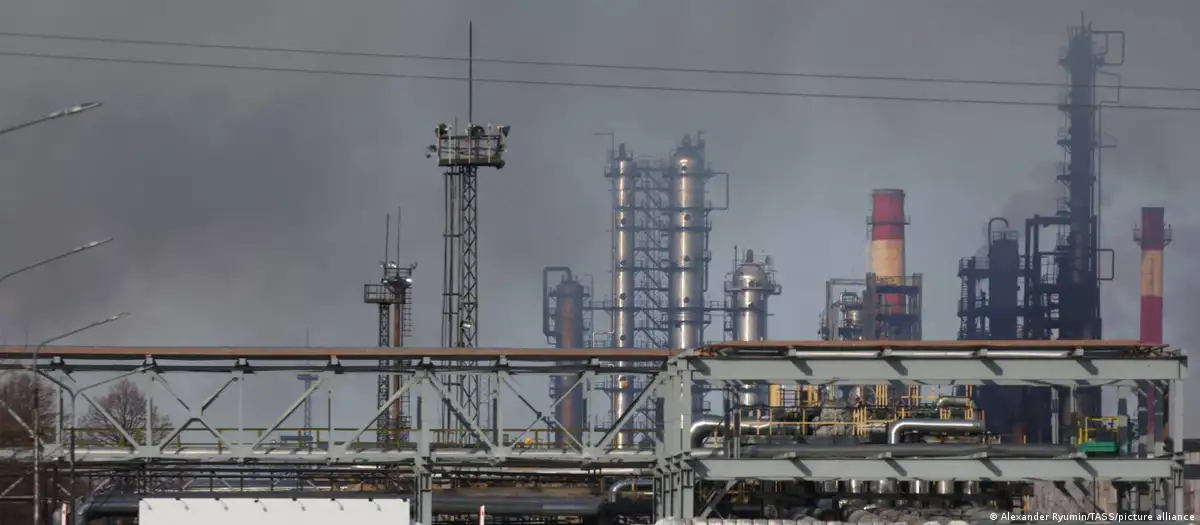
Ukraine’s systematic campaign against Russian oil infrastructure began escalating in January 2024 and intensified further in 2025. The Ryazan refinery — Rosneft’s flagship, with a capacity of 17.1 million tons per year — has been struck nine times over the course of 2025 alone. Other key Rosneft facilities hit over this two-year period included Afipsky, Komsomolsk, Kuybyshev, Novokuybyshevsk, Saratov, Syzran, Tuapse, Ufa, and Ufaneftekhim oil refineries.
Rosneft’s Defence Playbook
The document obtained by Dallas systematically catalogues every physical defence concept a $73 billion oil company has developed. Each section reveals not only the proposed solution but, critically, the limitations the engineers themselves acknowledge.
The Threat Model
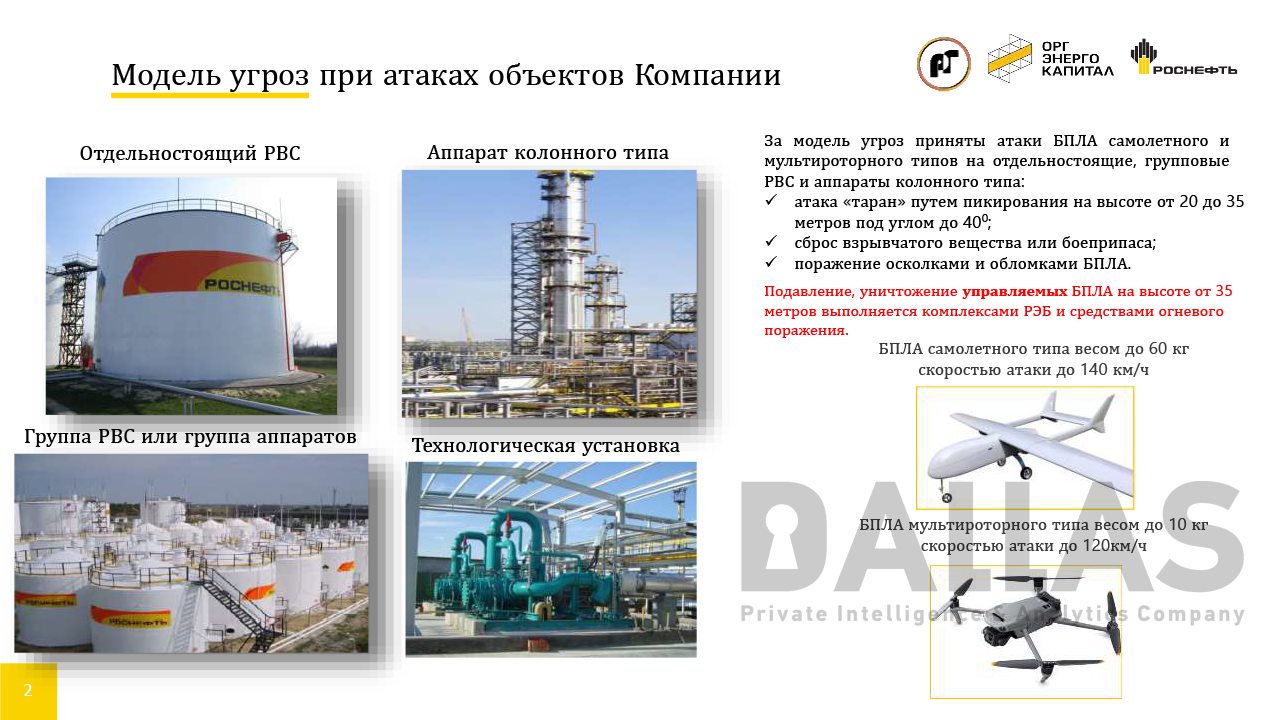
The report opens by admitting a fundamental gap: its own electronic warfare and fire-based countermeasures only work against operator-controlled UAVs flying above 35 metres. Ukrainian long-range strike drones that are actually destroying Russian refineries navigate autonomously on pre-programmed GPS coordinates, with no radio link to jam. In plain terms, Rosneft’s existing active defences are irrelevant against the primary threat, which is why the entire presentation focuses on passive physical barriers instead.
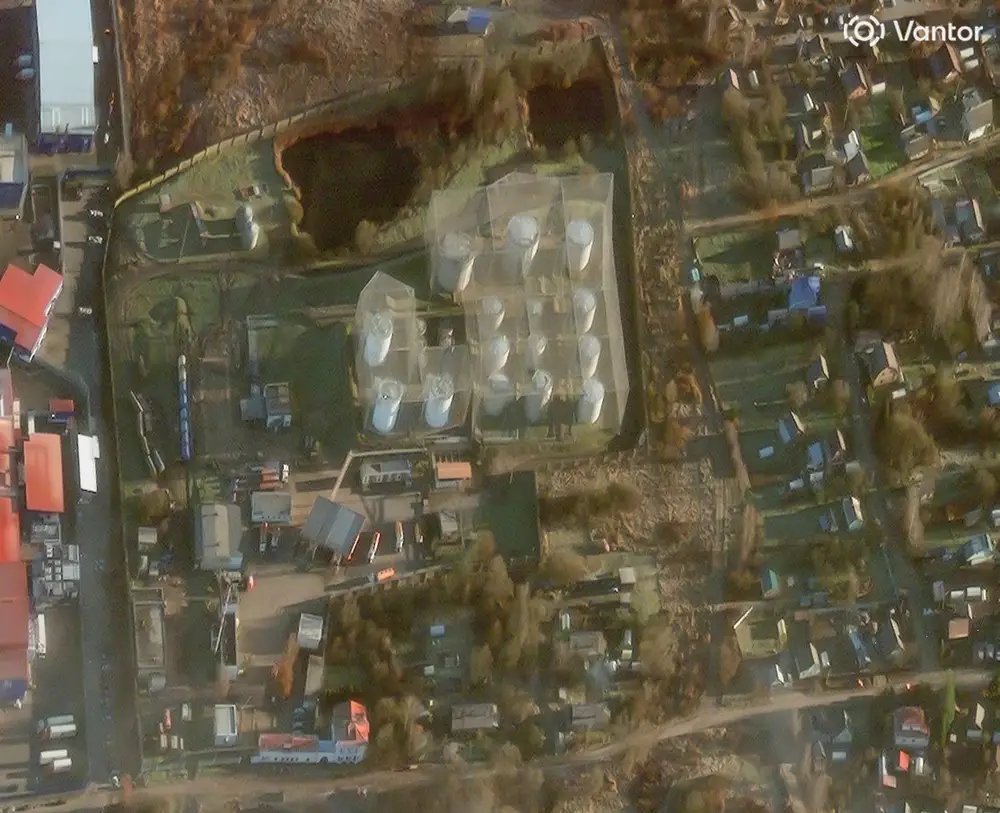
Where such passive defences have already been deployed at Russian energy facilities, the results confirm the presentation’s own disclaimers. For example, anti-drone netting at Velikiye Luki failed to stop a Ukrainian strike in February 2026.
The Eight Solutions — and Their Admitted Flaws
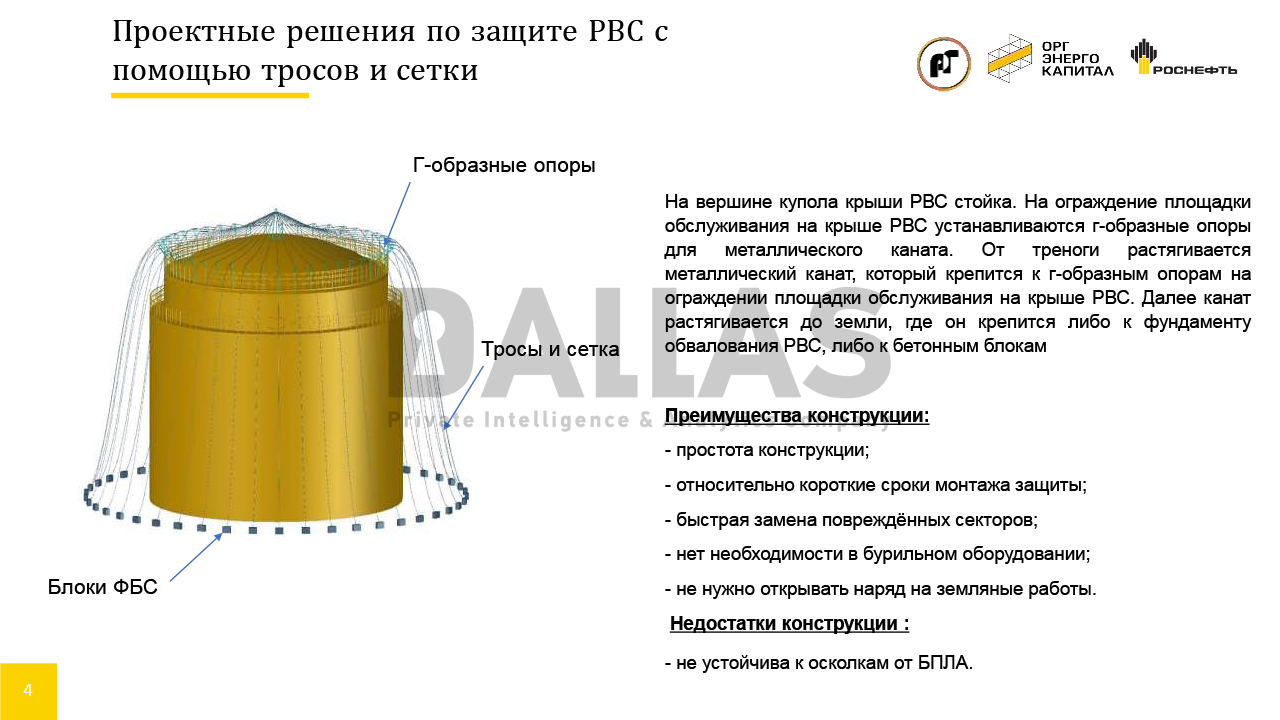
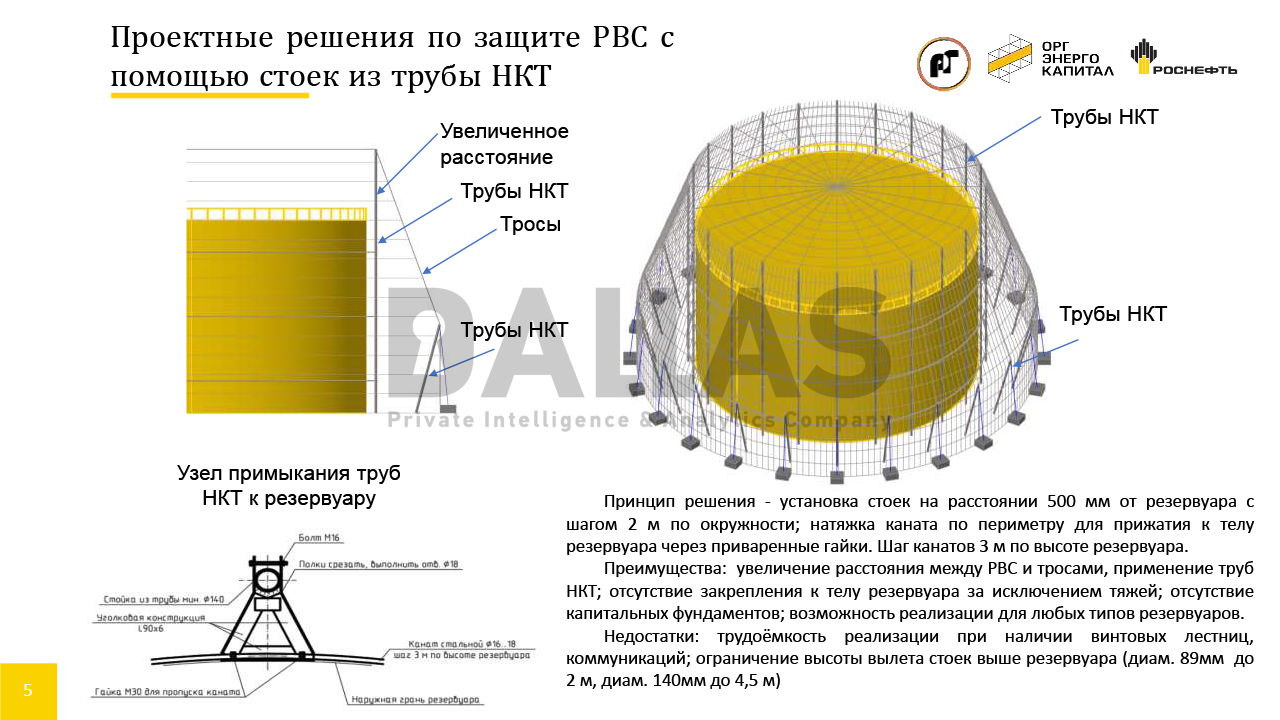
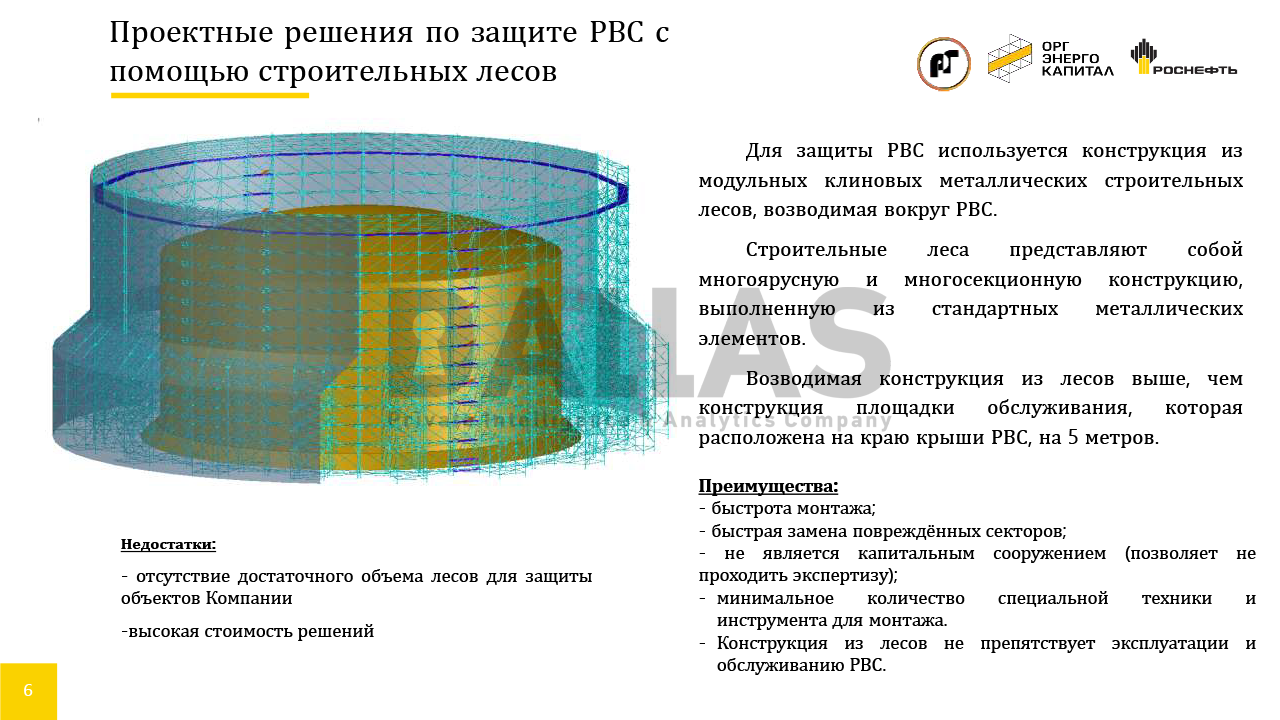
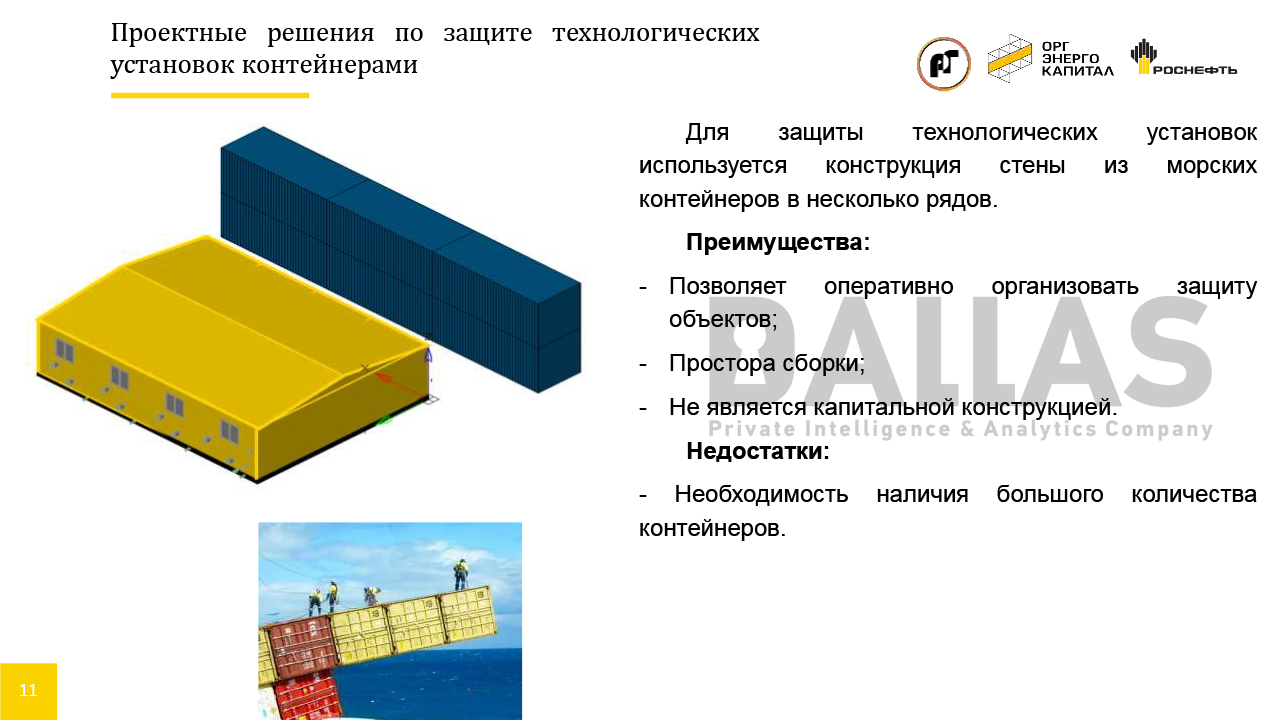
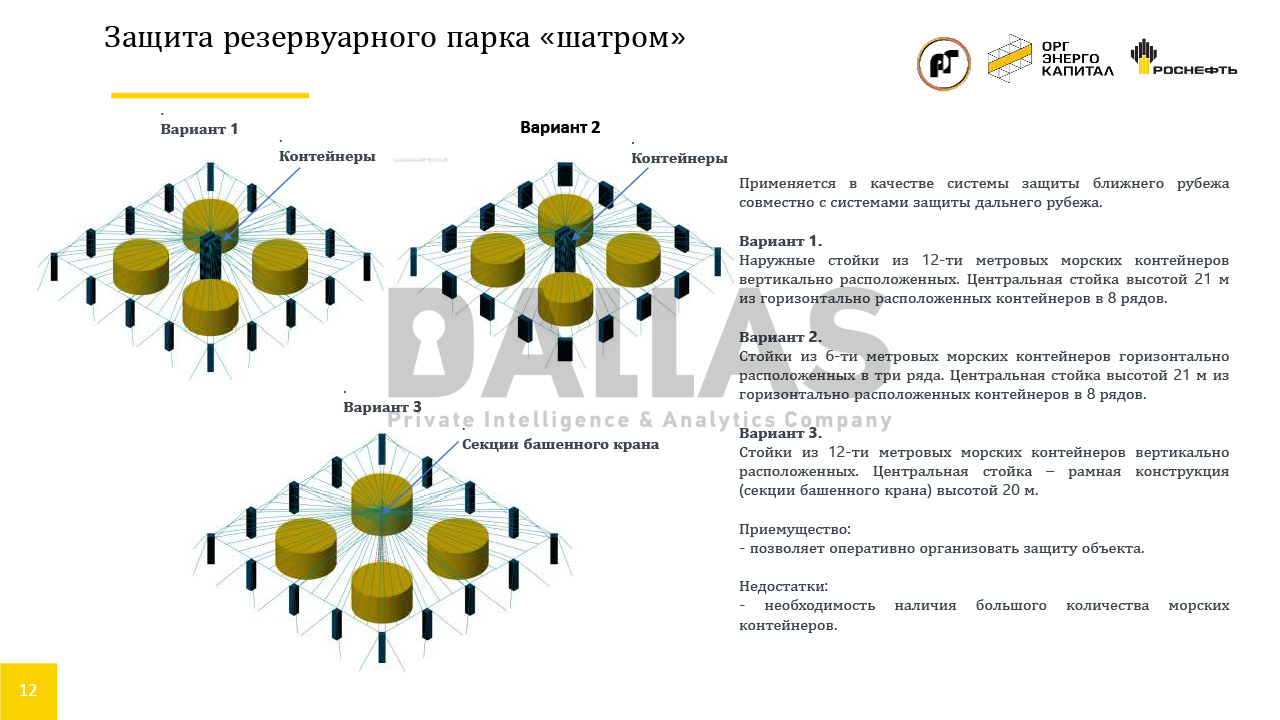
Rosneft’s proposed “protective structures”
The report proposes eight distinct physical protection designs, built from whatever materials are readily available: steel cables, construction scaffolding, shipping containers, tower crane masts, and concrete panels. None is purpose-engineered for blast resistance. A recurring thread is Rosneft’s insistence on avoiding “permanent construction” classification for every structure — not for engineering reasons, but to bypass mandatory state reviews and permits that would add months to deployment. This makes them vulnerable to a well-known tactic: a first strike that damages or topples the support structure, followed by a second strike against the now-exposed facility.
| Solution | What It Is | Rosneft’s Own Admitted Weakness |
| Cable barriers around tanks | Cable/net mesh (40×40 cm) wrapped around storage tanks on pipe stands | “NOT resistant to UAV shrapnel”; only protects against multirotor drones |
| Scaffolding cages | Modular metal scaffolding erected 5m above tank roofs | “Insufficient volume of scaffolding to protect the Company’s facilities”; “high cost” |
| Shipping container walls (far perimeter) | 20-36m high walls from stacked 20/40-ft containers with cable infill at 40 cm spacing | Not yet pilot-tested; requires thousands of containers per refinery |
| “Tent” canopy over tank farms | Overhead cable-mesh tent using containers as structural supports (21m central mast) | “Difficulties during firefighting”; “high snow loads” |
| Tower crane mast cages | Repurposed crane sections forming 4-pillar cage around processing units, cables at 1m spacing | Each unit requires individual engineering; relies on surface foundations or guy-wires |
| Three-barrier column protection | Layer 1: cable screens 1-1.5m out from platforms; Layer 2: nets (40×40 mm mesh); Layer 3: kevlar/aramid wrapping | In case of detonation, destruction is inevitable |
| Cable fencing for pump stations | 6mm cables at 500mm spacing on outrigger brackets | Only designed to destroy drone airframe — does nothing against the warhead |
| Reinforced concrete panels | Reinforced Concrete wall panels replacing sheet-metal wind barriers at pump stations | Only covers pump stations — the narrowest, lowest-value target category |
Rosneft’s improvised fixes
Beyond physical barriers, the presentation recommends four supplementary measures: smoke obscurants on threat detection, mobile shelters for personnel, reducing petroleum storage levels with constant rotation of filled tanks, and kevlar wrapping for critical pipeline joints. The smoke recommendation is self-defeating — the same document acknowledges its EW systems only counter “controlled” UAVs, while GPS-guided drones need no visual lock and modern Ukrainian drones increasingly carry infrared cameras that see through smoke. The suggestion to reduce fuel storage is a tacit admission that strikes will succeed — it manages consequences, not prevention. The Kevlar proposal is equally hollow: Rosneft itself admits it found ‘no information in open sources’ on its effectiveness.
A Confession and a Roadmap: Intelligence Value for Ukraine
The leaked report is both a confession and a roadmap — a confession that Russia cannot protect its energy infrastructure, and a roadmap for those seeking the highest-value targets at any refinery: distillation towers, catalytic cracking columns, and reformers. The technical specifics it contains are of direct operational value. For example, the document effectively advertises the exact gap dimensions an attacking drone must fit through to bypass the outer cable defences.
Relevance Beyond Ukraine
This analysis is of particular interest to Gulf states concerned with protecting energy infrastructure from Iranian drone and missile threats. The fundamental challenge Rosneft faces — defending large, fixed, flammable industrial targets against autonomous precision-guided munitions — is identical to the threat now facing Saudi Aramco, QatarEnergy, and ADNOC from Iran. The Rosneft presentation demonstrates that passive physical barriers, even at significant scale and cost, do not provide reliable protection against modern drone threats — a finding that validates investment in layered active air defence systems rather than static physical barriers, and one that Gulf energy operators would be unwise to ignore.