




When the first Oreshnik intermediate-range ballistic missile struck the Ukrainian city of Dnipro in November 2024, Vladimir Putin used his national television address to project a narrative of unassailable technological supremacy. Praising Russia’s newest weapon system, the Russian autocrat accompanied his rhetoric with standard escalatory threats directed at Western nations supporting Ukraine. Putin was so consumed by the political and psychological optics of the strike that he issued an immediate directive to manufacture a subsequent run of four additional missiles in 2025.

Russian President Vladimir Putin during his November 2024 address following the debut Oreshnik ballistic missile strike
Now, an investigation by Dallas Analytics reveals a profound manufacturing bottleneck within the system’s core guidance mechanism, exposing a critical vulnerability that routinely causes the Oreshnik to deviate by tens of kilometres from its intended coordinates.
Since that initial demonstration, Russia has deployed three of these experimental, solid-fuel variants on Ukrainian territory. A single missile struck the Lviv region in January 2026. Months later, on 24 May 2026, one warhead package famously impacted a civilian garage cooperative in Bila Tserkva, while the second vanished over occupied territory in the Donetsk region. Following active deployment drills monitored at the Kapustin Yar test range, the Ukrainian Air Force issued an urgent advisory on 12 June 2026, warning of a high probability of an imminent Oreshnik strike – likely the very last operational hull left from the Kremlin’s original, rushed contract.
The Frankenstein Blueprint: Resurrecting Forgotten Soviet Secrets
This highly classified programme has placed immense stress on a heavily sanctioned Russian military budget, forcing the defence-industrial sector to execute the Kremlin’s compressed deployment timelines. The underlying reason Russia cannot field the Oreshnik as a standardised, reliable combat platform is its architectural origin: it is an industrial hybrid assembled from fragmented components belonging to completely different missile lineages, most of which date back decades.
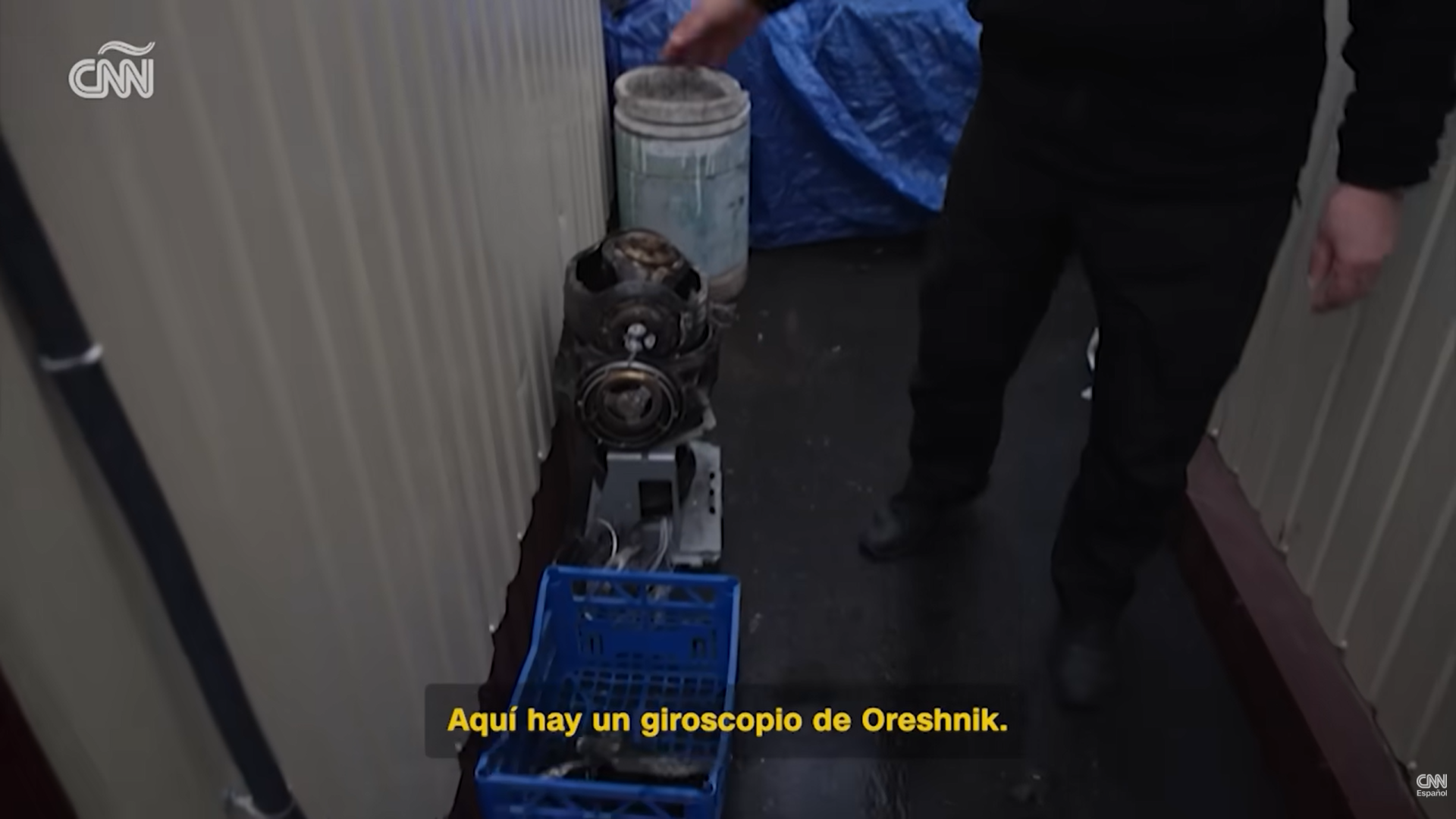



A senior official within the Russian Ministry of Defence procurement apparatus disclosed to Dallas Analytics that several critical sub-components for the Oreshnik platform had been adapted directly from legacy Soviet-era design documentation. These blueprints had been previously discarded and lost to the supply chain during post-Cold War defence drawdowns, having been deemed obsolete for modern precision warfare.
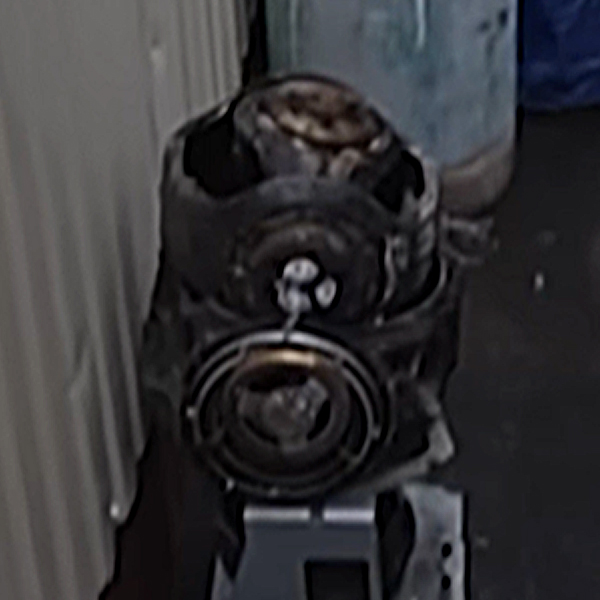
Physical remnants of the legacy GU-503 aviation gyro unit isolated during forensic analysis of the Oreshnik ballistic debris field. Source: CNN Digital Content
One such resurrected component is the GU-503 – a high-precision aviation gyro unit, which is clearly visible in the CNN footage starting at the 1:01 mark. To understand why this specific mechanical instrument is so vital, imagine a missile navigating through the upper atmosphere exactly like a passenger airliner. To reach a target, the onboard computer must continuously track and correct three basic dimensional movements:
- Pitch: The nose pointing upward or downward.
- Roll: The missile tilting or leaning from side to side along its central axis.
- Yaw: The nose swinging left or right.
The GU-503 acts as the missile’s internal balance mechanism. Without a perfectly functioning gyro unit, the weapon flies blind, incapable of detecting if atmospheric wind shear or engine vibrations have pushed it off course. Because a ballistic missile relies on an exact mathematical arc, an uncorrected mechanical error of just 0.5 degrees at hypersonic speeds will compound over the flight trajectory, translating into a catastrophic terminal miss distance of tens of kilometres.
To back up these findings with hard evidence, Dallas Analytics is publishing internal correspondence between Yuriy Vedeshkin, the Deputy Director of the Michurinsk Plant ‘Progress’ (JSC ‘MZP’), and Vasiliy Aksenov, the Director General of the Azov Optical-Mechanical Plant (JSC ‘AOMZ’). While AOMZ operates directly under the state-owned Tactical Missiles Corporation (KTRV) and Progress sits within Rostec’s electronics conglomerate (KRET), both factories function as highly specialised, interdependent nodes in Russia’s premier precision-strike manufacturing pipeline.
Dating back to 18 March 2025, the document exposes a severe accuracy deficit built directly into the Oreshnik production line, proving that its high-velocity reentry profile lacks the precision guidance the GU-503 was intended to provide. Dallas Analytics’ source from the Russian Ministry of Defence confirms that under pressure to meet Vladimir Putin’s rigid deadlines, the manufacturing facilities chose to bypass standard quality-assurance protocols entirely rather than delay the Kremlin’s political schedule.

Official correspondence between Michurinsk Plant ‘Progress’ and Azov Optical-Mechanical Plant
The following is the English translation of the letter obtained by Dallas Analytics:
"In response to your letter No. 347-1157-1832 dated March 18, 2025, we hereby inform you that GU-503 items have not been serially produced by our enterprise for a significant period of time. Given that the circuit design of the equipment used for the adjustment, burn-in running, and testing of GU-503 items was developed in the early 1970s, it is technologically obsolete; many components have failed, and there are no replacements available as they are no longer manufactured. Consequently, a complete redesign of the Design Documentation for this equipment is required, utilising a modern electronic component base.

Based on the foregoing, JSC "MZP" faces a prolonged production preparation period and subsequent qualification testing, which makes it impossible to fulfil your order within the designated timeframe. Furthermore, given such a limited order volume, the unit cost of the item will be prohibitively high.

As one of the options, we suggest that you consider replacing the GU-503 within your system in coordination with specialists from JSC 'ANPP Temp-Avia' (JSC 'Arzamas Research and Production Enterprise 'Temp-Avia'), with whom a preliminary agreement has already been reached."
The Calibration Trap: Why the Oreshnik Flops in the Field
The internal correspondence from the Michurinsk Plant explicitly flags the wholesale loss of production technology for the specialised equipment designated for the adjustment, calibration, and prirabotka (the intensive burn-in testing where components are run under heavy loads to eliminate hidden manufacturing flaws) of the GU-503.
Even when the workshop manages to procure or somehow assemble the instrument, the facility lacks the capability to verify the gyroscope’s exact precision metrics prior to final assembly. This specific manufacturing defect directly explains why subsequent Oreshnik missiles have been erratically striking civilian infrastructure instead of assigned military targets.
The correspondence notes that rectifying this issue is not a matter of simple technical repair, but demands a fundamental overhaul of the baseline design documentation to integrate a modern electronic component base. However, the primary technological complication remains the physical geometry of the guidance assembly itself. The GU-503 unit is not a standalone component; it is deeply integrated into an automated navigation hub. This leaves minimal physical margin to alter the system’s dimensions without forcing a complete, high-risk redesign of all adjacent hardware, which carries colossal technical risks.
The document indicates that the management of the Michurinsk Plant also planned an alternative solution: developing a modern replacement for the gyroscopic instrument in cooperation with the specialised design bureau JSC “ANPP Temp-Avia”. However, physical forensics performed on debris recovered from recent Oreshnik impact sites in Ukraine revealed the presence of GU-503 units bearing clear 2025 manufacturing stamps. This directly proves that the high-tech replacement involving Temp-Avia was ultimately abandoned.
From “Mass Production” to the “Garage Testing” Narrative
This internal supply-chain gridlock within Russia’s advanced weapons programme perfectly explains why Vladimir Putin’s public rhetoric regarding the Oreshnik shifted dramatically over the past year.
Vladimir Putin addressing international journalists at SPIEF 2026. Source: Kyiv Independent
During his press briefing at the St. Petersburg International Economic Forum (SPIEF) in June 2026, the Russian president directly contradicted his own previous claims that “serial mass production” had already begun. For years, the Kremlin has marketed this platform to both domestic and Western audiences as an uninterceptable, fully operational hypersonic asset. Yet, when forced to account for why the weapon completely missed its military target and instead destroyed a civilian garage cooperative in Bila Tserkva, Putin abruptly reframed the operational combat failure as a mere development exercise. Admitting that the platform remains in a volatile testing phase, he asserted that the garage strike occurred simply because “it was convenient to observe the impact” and evaluate the precision of the warhead blocks’ deployment.
The Illusion of Power
Behind Moscow’s high-tech superpower façade, internal communications expose a defence industry unable to achieve basic Oreshnik accuracy. Yet, dismissing this missile system entirely would be a mistake. The defining characteristic of modern Russian military power is that it is simultaneously industrially brittle yet profoundly dangerous.
Left unchecked, the Russian defence sector will eventually iterate past these manufacturing hurdles. With a range capable of striking any European capital with a nuclear payload, the platform poses a severe, systemic threat – a danger amplified by Russia’s forward deployment of mobile launchers into Belarus, which sharply cuts down Western early-warning reaction windows.
As air raid sirens echo across Ukraine while the Kapustin Yar test range conducts its latest launch drills, the West must see the Oreshnik for what it truly is. It is the product of an isolated regime that masks structural weaknesses behind aggressive escalatory threats. Russia remains a volatile adversary whose uncalibrated weapons and political will pose a global threat. Unified international pressure is the only strategic response capable of neutralising it.