


Internal documents from Khrunichev State Research and Production Space Center, Russia’s leading manufacturer of space launch vehicles, show that Russia’s plans to sharply expand production of the Angara launch vehicle depend on large-scale imports of advanced industrial machinery. A significant share of that equipment is supplied by Chinese manufacturers that also operate in the US and European markets, while the true origins of some brands may be deliberately obscured.
Key findings
- Russia is investing tens of billions of roubles to sharply expand production of the Angara family of launch vehicles, which are used exclusively for missions commissioned by the Russian Ministry of Defence.
- Its existing manufacturing base is incapable of supporting that expansion, prompting the construction of a new production complex in Omsk equipped with hundreds of new machines.
- Internal documents show that a significant part of the project’s technological core will rely on Chinese-made machine tools.
- Some of those manufacturers also serve customers across Europe and the United States, while the origins of several brands are open to question.
Space Militarisation Is No Longer Theoretical
The news agency dispatch contained only a handful of facts. At 11:29 a.m. Moscow time on 23 April 2026, an Angara-1.2 light-class rocket lifted off from the Plesetsk Cosmodrome. As of July, it remained the vehicle’s only launch of the year. Officials also said the mission had been carried out by a combat crew of Russia’s Space Forces and that the payload consisted of “spacecraft operating in the interests of the Russian Ministry of Defence”. No further details were disclosed.

Angara-1.2 launch, screenshot from video
Since its debut in 2014, the Angara-1.2 rocket has completed eight launches, including its inaugural test flight. It has never been used for a civilian or commercial mission. According to publicly available information, its only customer has been the Russian Ministry of Defence.
Until mid-2025, Russian authorities disclosed the payloads carried by Angara launches. In almost every case, they were satellites designated Kosmos, the standard cover name used for Russian military spacecraft of various types. According to independent space trackers, Angara currently deploys Rodnik military communications satellites, also known as Strela-3M. During the April launch, four such satellites reached orbit under the designations Kosmos 2615 through Kosmos 2618.
Another incident in April underscored Russia’s increasingly military use of space. A Soyuz-2.1 rocket also placed four Kosmos satellites, numbered 2610 through 2613, into orbit. They later manoeuvred dangerously close to a Finnish ICEYE reconnaissance satellite, which is used, among others, by the Ukrainian military. Such manoeuvres increase the risk of damaging spacecraft in orbit.
Russia’s use of Kosmos satellites for potentially hostile operations has long been the subject of expert analysis and public concern. Some satellites in the series have carried out unusual proximity manoeuvres around other objects in orbit, behaviour that may indicate the testing of technologies for on-orbit inspection, shadowing or even future weapons deployment.
In 2020, US Space Command publicly accused Russia of testing an anti-satellite weapon in orbit. The case involved what analysts dubbed a “Matryoshka” satellite. Kosmos-2543 released a smaller object after reaching orbit. Put simply, the satellite functioned as a carrier for a projectile.
“Given the current state of US-Russia relations, Russia is likely to continue investing in systems capable of targeting objects in space,” Chatham House analysts wrote in 2021.
Five years later, that assessment reads less like a forecast than a statement of fact. Further militarisation of space requires more satellites. And more satellites require more launch vehicles.
The “4+4” Plan
Dallas Analytics has obtained a package of internal documents from Khrunichev State Research and Production Space Center (hereafter the Khrunichev Centre), the manufacturer of the Angara family of launch vehicles. The documents relate to the company’s current operations and its plans to relocate production to Omsk.
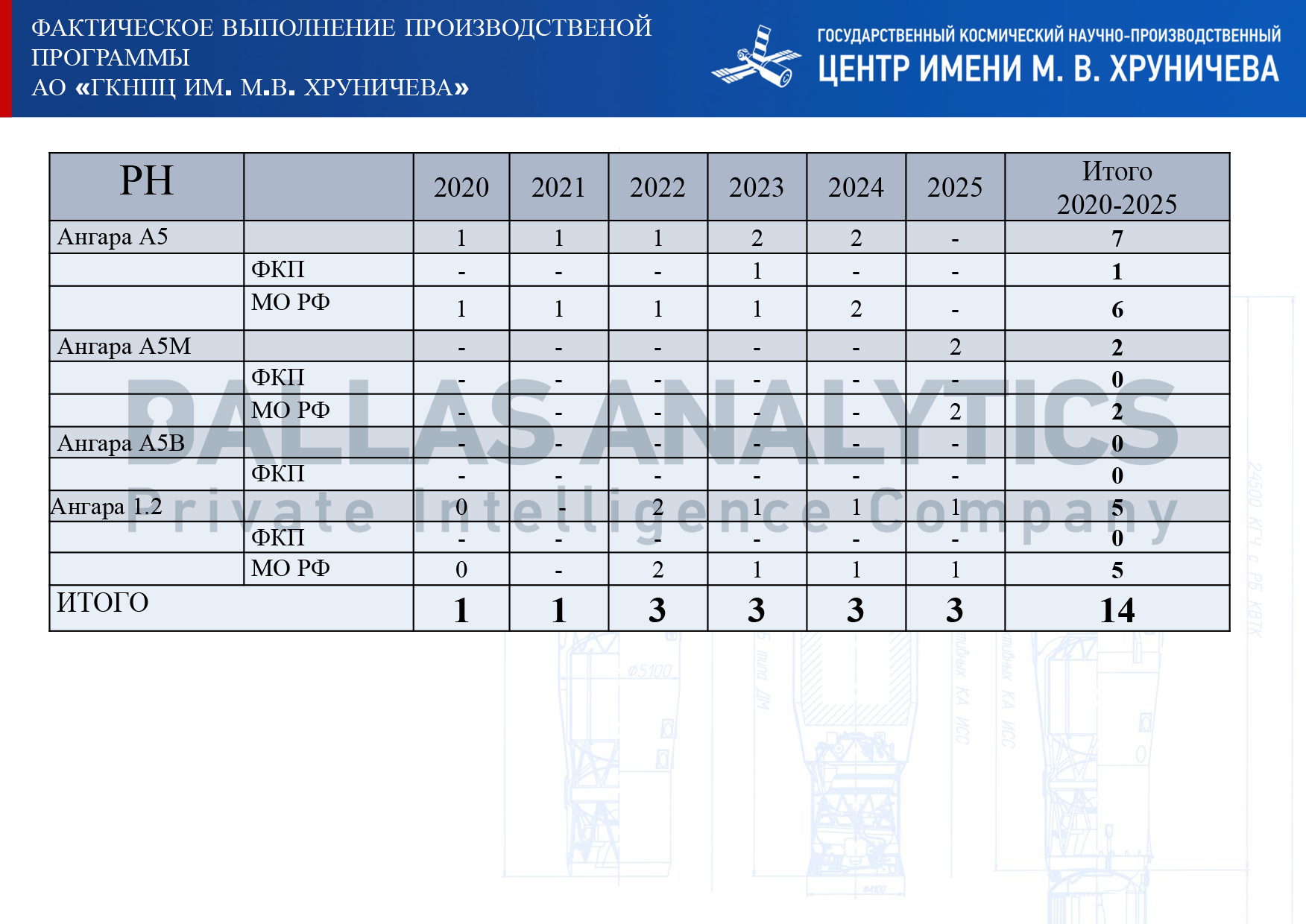
The Khrunichev Centre currently produces one Angara-1.2 launch vehicle a year. Under the project, annual output would increase to four. Production would also include four Angara-A5/A5M heavy-class launch vehicles a year.
Current production figures appear in a presentation prepared in 2026 to support the relocation of serial production of Angara launch vehicles to Omsk. We are publishing the full presentation alongside this investigation.
Roscosmos Director General Dmitry Bakanov publicly confirmed the project in April 2026 during a meeting of Russia’s Federation Council. The plan to relocate production had never been secret. What the internal documents reveal are the scale of the investment and the project’s detailed production targets.
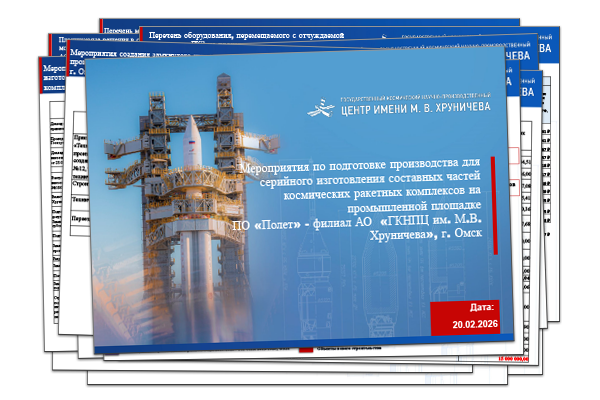
Original presentation
The presentation exists in several versions, making it possible to trace how the project’s budget evolved. In February, the first phase was estimated at 15 billion roubles. By May, that figure had risen to 17.5 billion roubles, or more than $220 million.
According to the documents, the Russian government is expected to amend Resolution No. 1867 by August, unlocking funding for the project’s first phase. The authors identify no other source of financing.
The internal documents also explain the project’s economic rationale. Their authors explicitly acknowledge that Angara production is currently unprofitable. According to their calculations, the programme will become profitable only after receiving state funding and increasing annual output to the “4+4” model over the next decade.
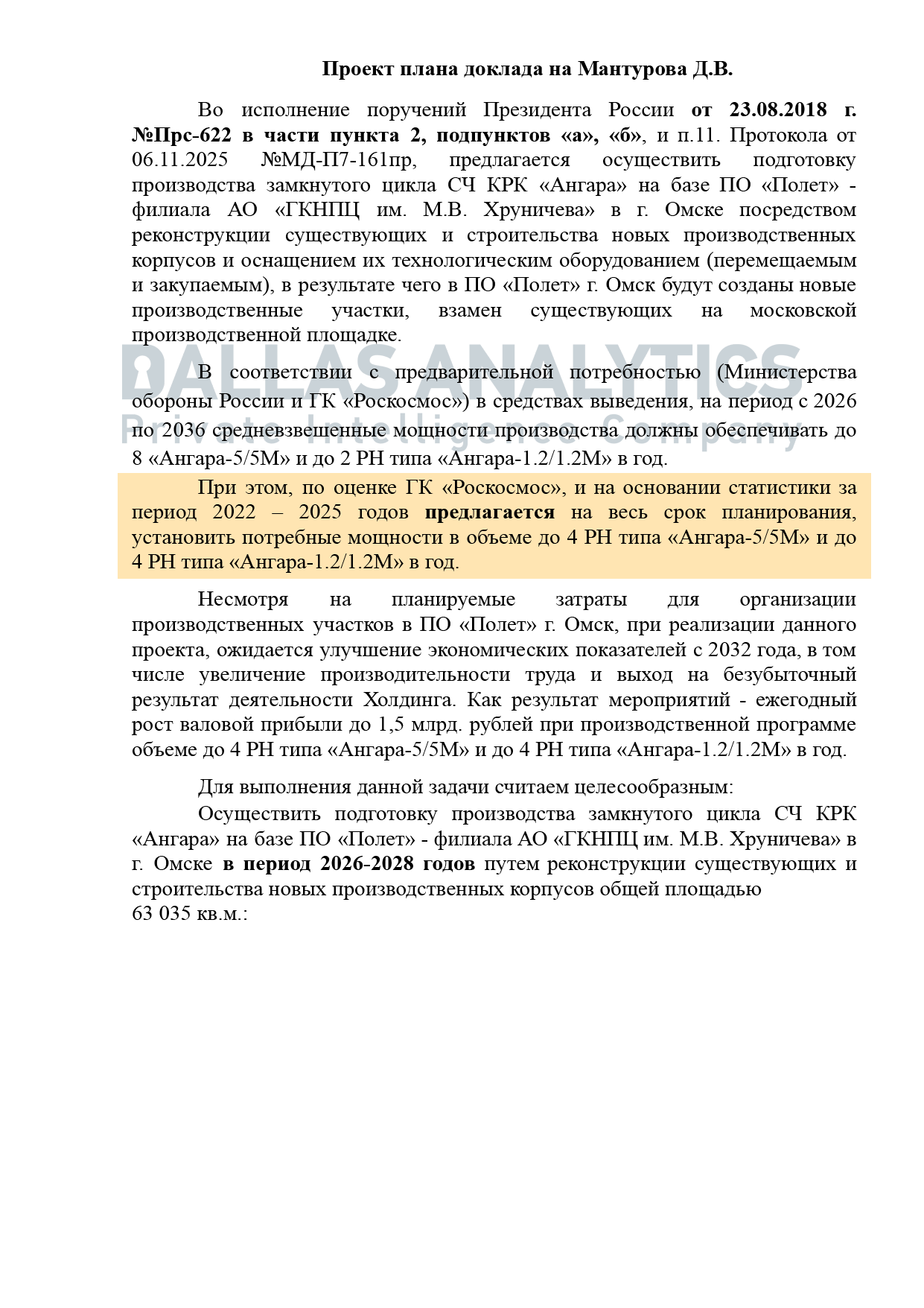
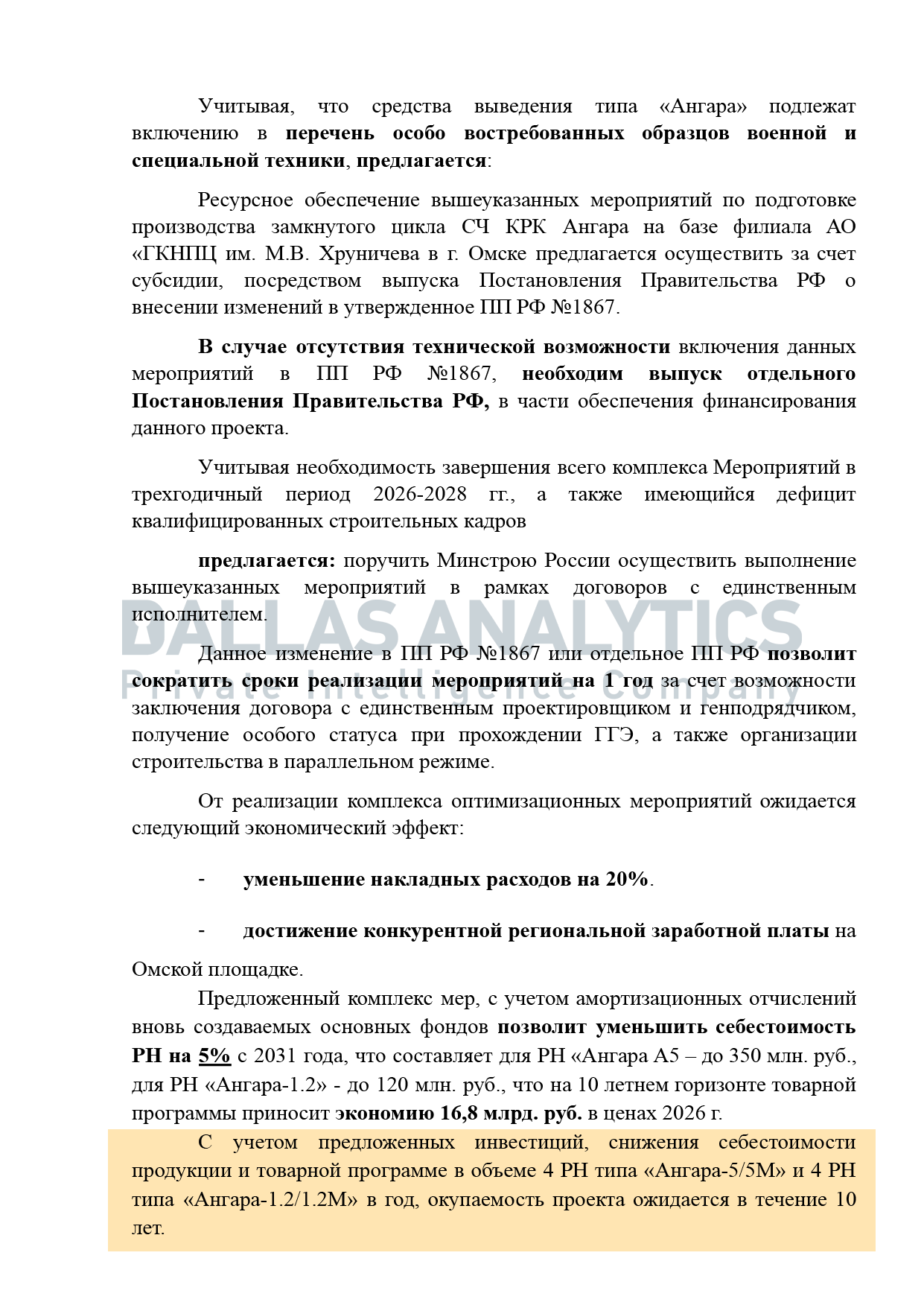
Report to Denis Manturov, Deputy Prime Minister of the Russian Federation
“Impact on Product Quality”
In May 2026, the Khrunichev Centre prepared a package of three detailed documents explaining how it planned to spend the 17.5 billion roubles allocated through a state subsidy. The documents also provide a rare glimpse into the current condition of the Centre’s manufacturing facilities.
All three passed through Viktor Alimov, a procurement specialist who had previously overseen the acquisition of new equipment for the Centre’s Omsk branch.
Two of the documents, the “Project Passport” (Паспорт объекта) and the “Expenditure Justification” (Обоснование затрат), make it possible to examine the future factory workshop by workshop. They show not only what the company plans to build, but also why the existing production system is loss-making and incapable of delivering the planned output.
According to the documents, the enterprise is expected to lose around 3 billion roubles a year under current production conditions.
Together, the documents amount to a highly detailed blueprint of the future plant. They include:
- the buildings scheduled for reconstruction;
- new production buildings to be constructed;
- assessments of the existing equipment;
- the production “bottlenecks” identified in each workshop and the measures proposed to eliminate them.
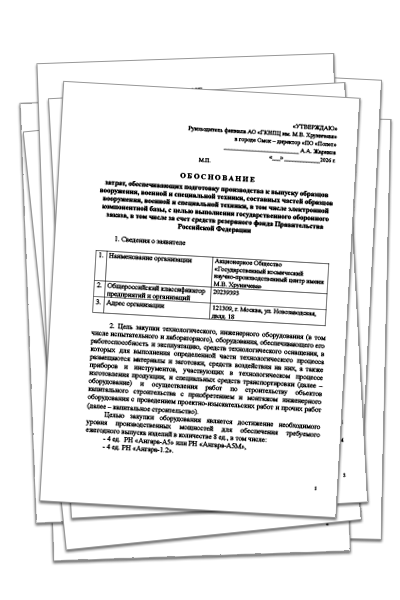
Expenditure Justification
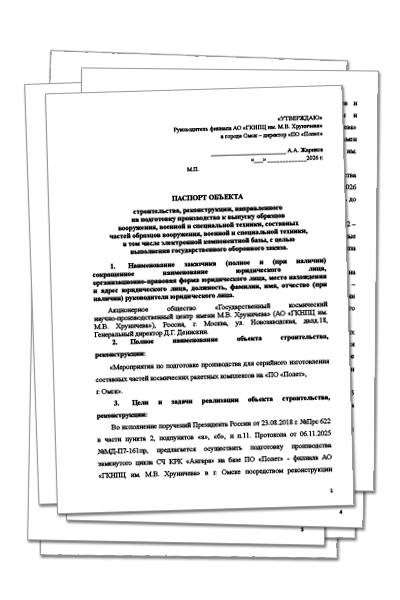
Project Passport
The documents show that Omsk is effectively getting a new factory. The project calls for the reconstruction of five production lines and the construction of five more from scratch. It also includes a locomotive depot for internal logistics. Power demand at the site is expected to increase by 100 megawatts.
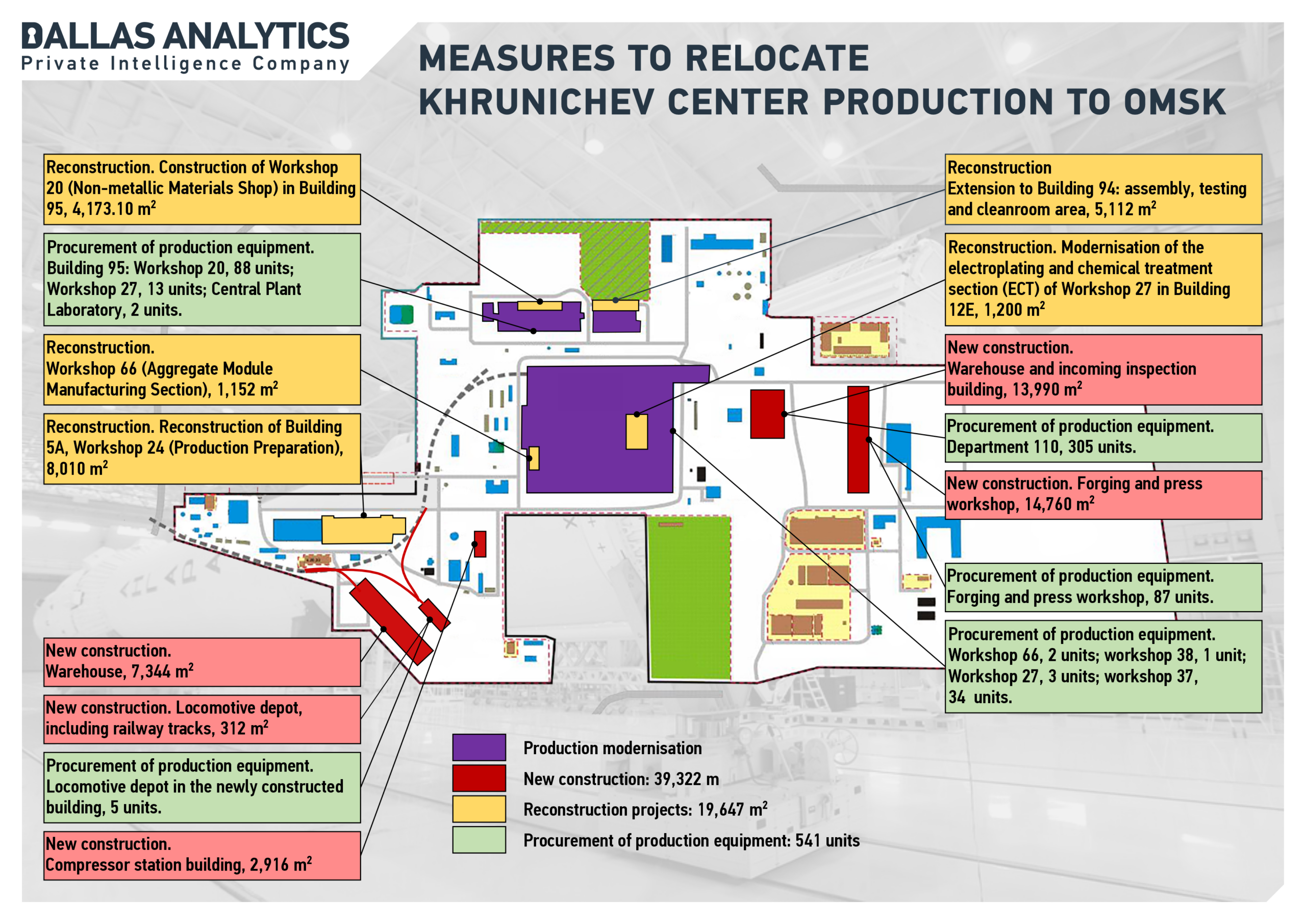
The second document, the “Expenditure Justification”, adds another critical layer. It identifies the technological equipment required to fill the new production facilities.
In total, the procurement plan covers 541 pieces of equipment worth 3.62 billion roubles, or more than $46 million.
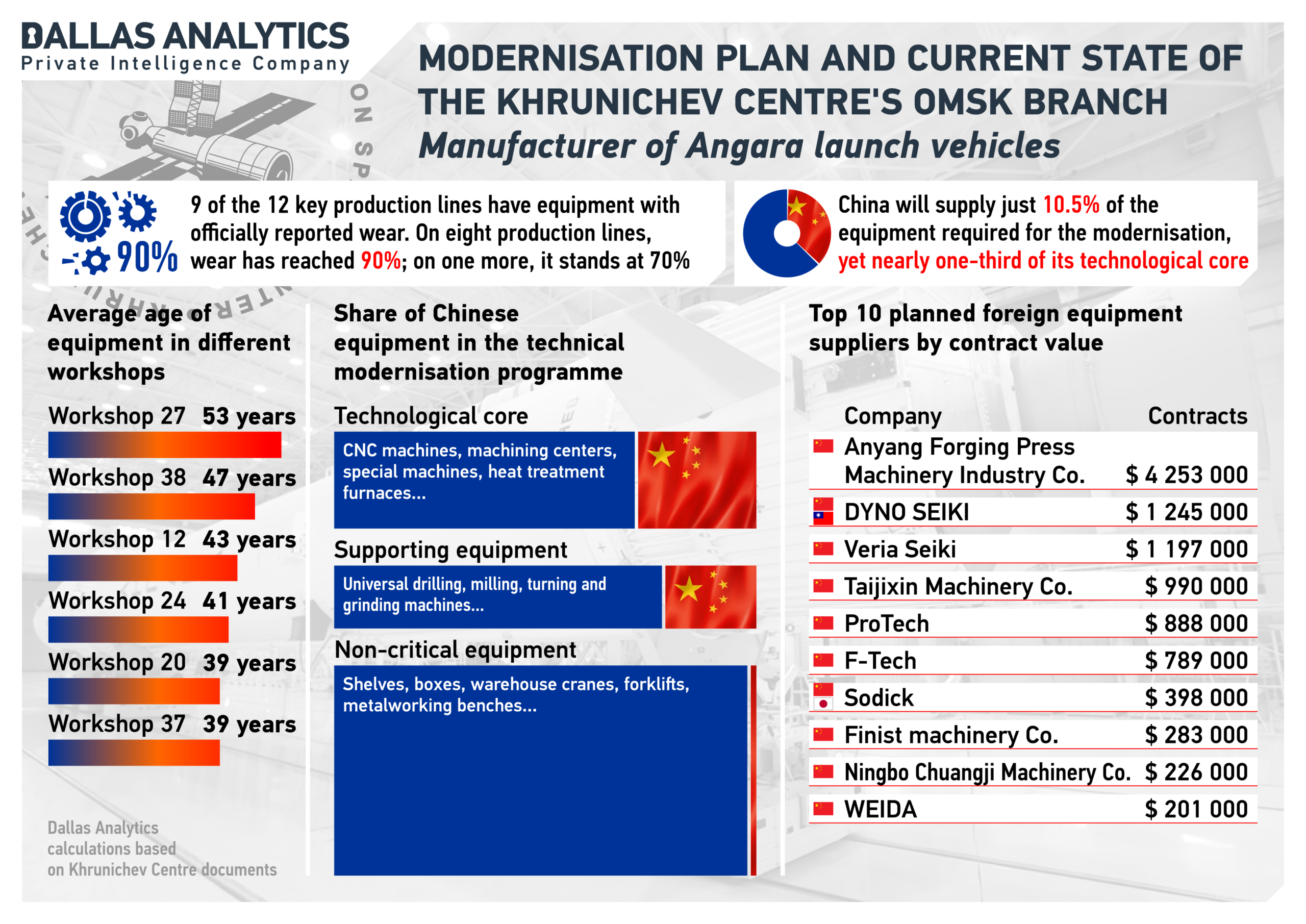
We are publishing the full documents for readers who wish to examine them in detail. Their main findings are summarised in the infographic below.
The figures paint a clear picture. The existing manufacturing base falls well short of the project’s ambitions. Across most key workshops, equipment has reached 90% physical wear. Some production areas have been in operation for more than half a century.
The documents explicitly acknowledge that this has a “negative impact on product quality”. In this case, “products” means launch vehicles, whose annual output the Russian government plans to increase several-fold.
Bottlenecks
A third document, titled “Cost Estimate” (Расчет стоимости), explains exactly what is included in the list of 541 planned equipment purchases. More importantly, it offers the clearest picture yet of the Russian space industry’s dependence on imported industrial equipment.
At first glance, imports appear to play only a limited role. Of the 541 planned purchases, 477 are listed as Russian-made. Only 57 are identified as Chinese. Another two were manufactured in Bulgaria under the Rezon brand.
That comparison, however, is misleading.
A warehouse rack and a CNC machining centre each count as a single item of equipment. Their importance to rocket production, however, is fundamentally different. Once the equipment is classified according to its technological importance, the picture changes dramatically. Chinese manufacturers account for almost one-third of the project’s technological core, or 28.2%.
The documents reveal another pattern. Looking only at the equipment intended to eliminate existing production bottlenecks, China’s role becomes even more pronounced. In the metalworking shop, Chinese suppliers account for more than 47% of the required equipment. In the composites and rubber-products workshop, their share falls to 15.9%. Yet the only CNC machining centre planned for that workshop is also Chinese-made.
Russian manufacturers provide quantity. Chinese suppliers provide technological capability.
Chinese and “Chinese” Companies
The picture becomes even more revealing when measured in monetary rather than numerical terms. More than 84% of the project’s 3.62-billion-rouble equipment budget is allocated to the technological core. The remainder will be spent on items such as workbenches, shelving and other auxiliary equipment.
The concentration is even greater for Chinese purchases. More than 91.5% of the planned spending on Chinese-made equipment is allocated to the technological core.
Overall, the Khrunichev Centre plans to purchase nearly 900 million rouble worth of equipment from Chinese suppliers. Most of that spending is concentrated among just ten manufacturers.
Several of these companies warrant closer examination. Some openly operate in Russia, Europe and the United States at the same time. Others raise questions about the true origins of their brands.
The largest planned Chinese supplier by contract value is Anyang Forging Press Machinery Industry Co., Ltd. (Anyang FPM). The company is expected to supply eight forging and press machines. Although these are not the most technologically sophisticated machines in the project, they form the backbone of any heavy engineering plant.
The documents state explicitly that no forging and press workshop currently exists at the Omsk site. In effect, the project involves building an entirely new production line.
The company’s website boasts that it sells its products to the United States, Germany, Japan and more than 80 other countries, while also offering a Russian-language version of the site.

Anyang FPM Website
Anyang FPM illustrates a broader pattern that has emerged among Chinese manufacturers since Russia’s full-scale invasion of Ukraine. Heavy forging hammers and hydraulic presses are subject to EU export restrictions when destined for Russia. The United States has also imposed sanctions on Russian manufacturers of heavy hydraulic presses, including Pressmash in 2023.
Manufacturers in Europe, the United States and other Western countries are therefore required to strengthen end-user controls and comply with export restrictions. Chinese manufacturers, by contrast, have generally shown little evidence of making comparable efforts.
In 2025, EU imports of Chinese machine tools classified under HS code 8462, which includes hydraulic presses and forging hammers, totalled €207 million. During the first half of 2026, imports increased by 17.6% compared with the same period a year earlier.
The result is a striking paradox. The same manufacturers continue to profit both from markets in countries that support Ukraine and from the modernisation of Russia’s military-industrial base.
The Angara launch vehicles to be produced with this equipment will place Russian Ministry of Defence satellites into orbit. Those satellites, in turn, may threaten European assets both in space and on the ground.
The only factor likely to influence these Chinese manufacturers is the genuine risk of losing access to European markets. More broadly, doing business with Russia should carry the cost of losing access to the West.
China’s approach to intellectual property creates another challenge. The C41 forging hammer that the Khrunichev Centre plans to purchase from Anyang FPM is a standardised design. Identical or nearly identical machines can be found from other Chinese suppliers.
Sanctioning a single legal entity may therefore be justified, but it is unlikely to eliminate supplies of this type of equipment. The Khrunichev documents also suggest how short-lived brands may be created in China specifically for the Russian market.
Very little information is available about VERIA SEIKI, from which the Centre plans to purchase two CNC turning centres worth a combined $1.2 million. No product catalogues appear to exist in the public domain, while the model designation, VC52-500SMCY, resembles the standardised naming conventions used by multiple manufacturers.
Even more questions surround the DYNO SEIKI brand. In the Khrunichev Centre’s documents, two large vertical gantry CNC machining centres, models DSM-2218 and VP-2012, are listed under that brand, with a combined value of more than $1.2 million.
For the DSM-2218, the documents reference a commercial quotation dated 10 June 2025. This suggests that, by the time the budget was prepared, either the machine had already reached Russia or an established procurement channel was already in place.
In Russia, DYNO SEIKI machine tools are marketed, among others, by Weber Comechanics. The company has even created a dedicated website for the brand. There, the machines are presented as Taiwanese-made.

“Machines from reliable Taiwanese manufacturers,” – they write in the advertisement
Until recently, Weber Comechanics was better known as a distributor of Taiwanese-made GOODWAY machine tools. GOODWAY is part of a broader network of Taiwanese machine tool manufacturers that also includes the AWEA, EXTRON and YAMA SEIKI brands. YAMA SEIKI, in particular, was developed for the North American market.
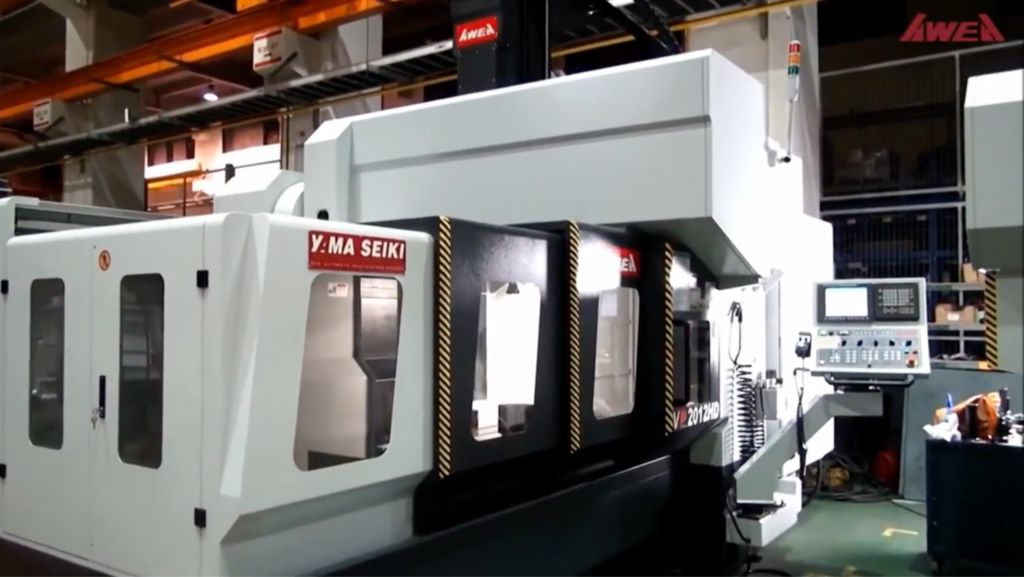
One of the models listed in the Khrunichev Centre’s documents, the VP-2012, is sold under both the AWEA and YAMA SEIKI brands. The photograph below gives an idea of the scale of this equipment.
Sodick machine on the company’s website
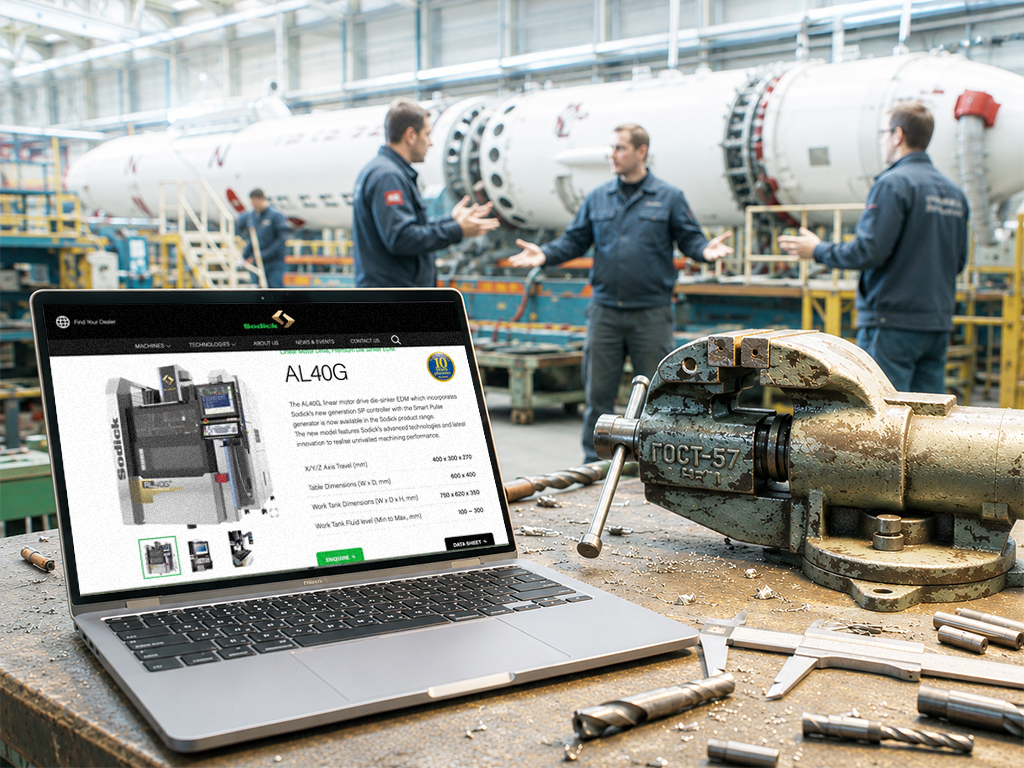
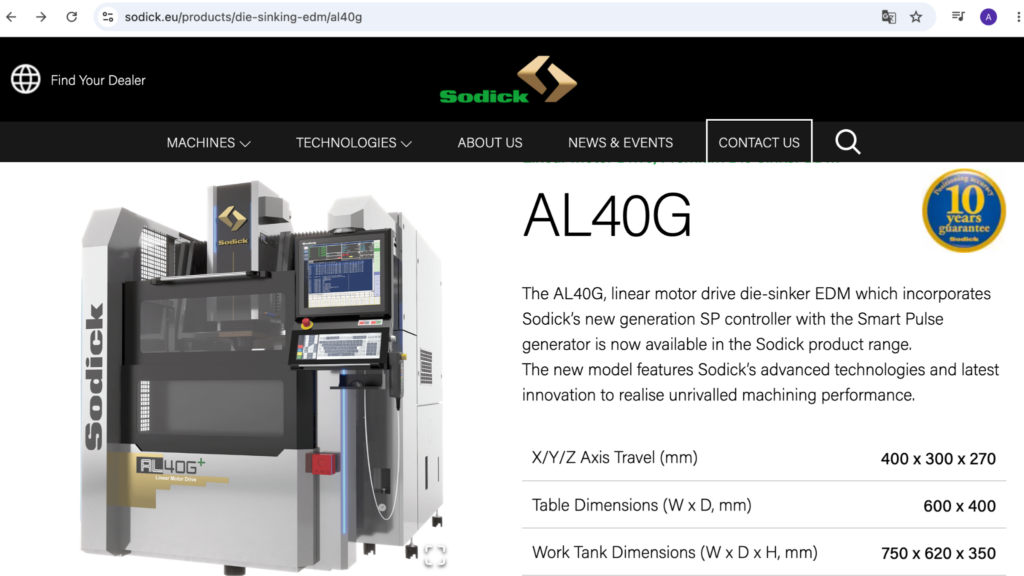
A similar situation exists with Sodick. In the documents, the AL-40Gs machine is classified as Chinese equipment. In fact, Sodick is one of Japan’s best-known manufacturers of electrical discharge machining (EDM) equipment, although it also has manufacturing facilities in China. For example, the company continues to market the AL-40G model in the European market.
Dallas Analytics is ready to publish the official position of the companies mentioned in this investigation regarding the facts presented herein. Requests for comment have been sent to the official contact addresses of these companies. Their representatives may also contact us via the form on our website or through our social media pages.