


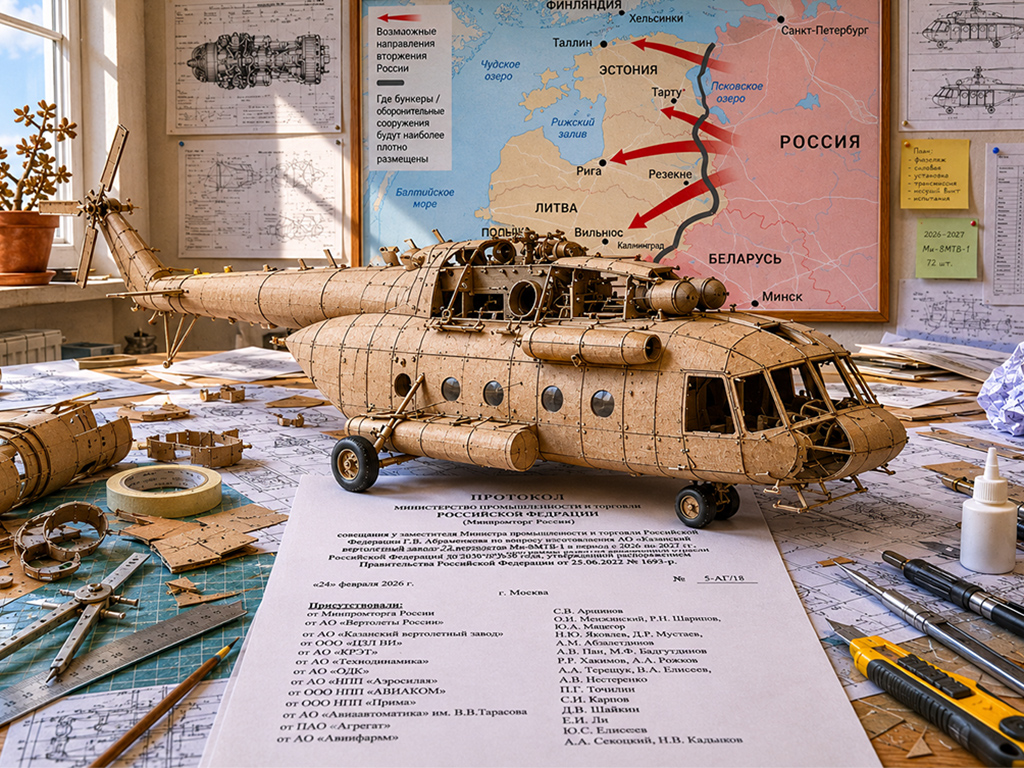
Private company Dallas Analytics has obtained documents revealing Russia’s plans to manufacture 72 Mi-8 multi-purpose helicopters at the Kazan Helicopter Plant during 2026–2027. This figure is nearly twice as high as previous estimates of Russia’s production capacity and output rates for this type of helicopter. What threat do these aircraft pose, and could they affect the course of the war? Read more in our new investigation.
Dallas Analytics obtained minutes from a meeting involving Russian Deputy Minister of Industry and Trade Gennady Abramenkov concerning the production of Mi-8MTV-1 helicopters by JSC “Kazan Helicopter Plant.” The meeting, attended by more than 40 representatives of Russian defense enterprises and state institutions, took place on February 24, 2026 – the anniversary of Russia’s full-scale invasion of Ukraine.
The document outlines Russia’s plans to organize the production of 72 Mi-8MTV-1 helicopters over the next two years under the framework of the Russian state defense order. At least 37 helicopters are scheduled to be produced in 2026 alone. The document also details financing and advance payment mechanisms for component manufacturers, as well as coordination between Russian Helicopters, the United Engine Corporation, the Radio-Electronic Technologies Concern (KRET), and other suppliers.
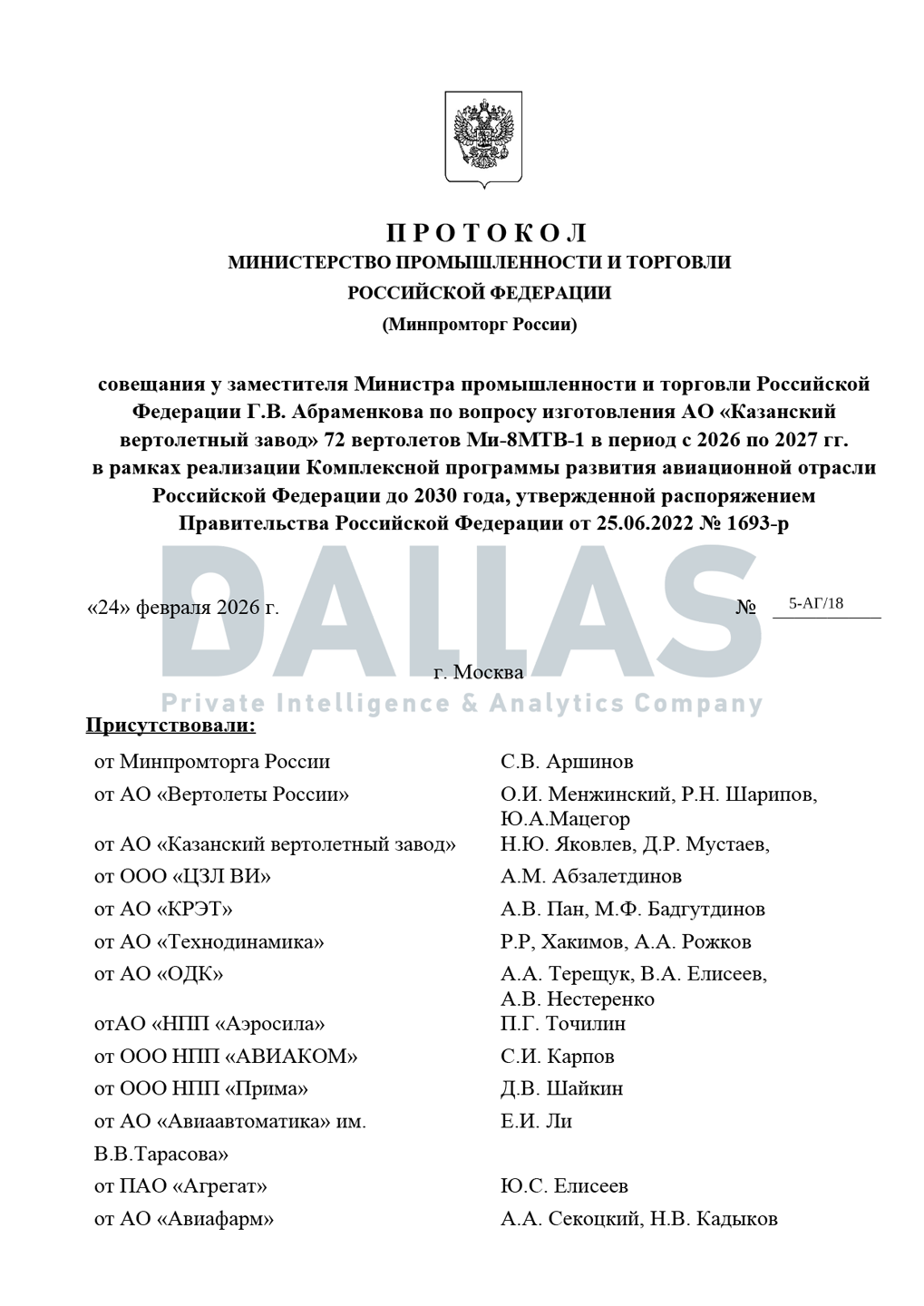
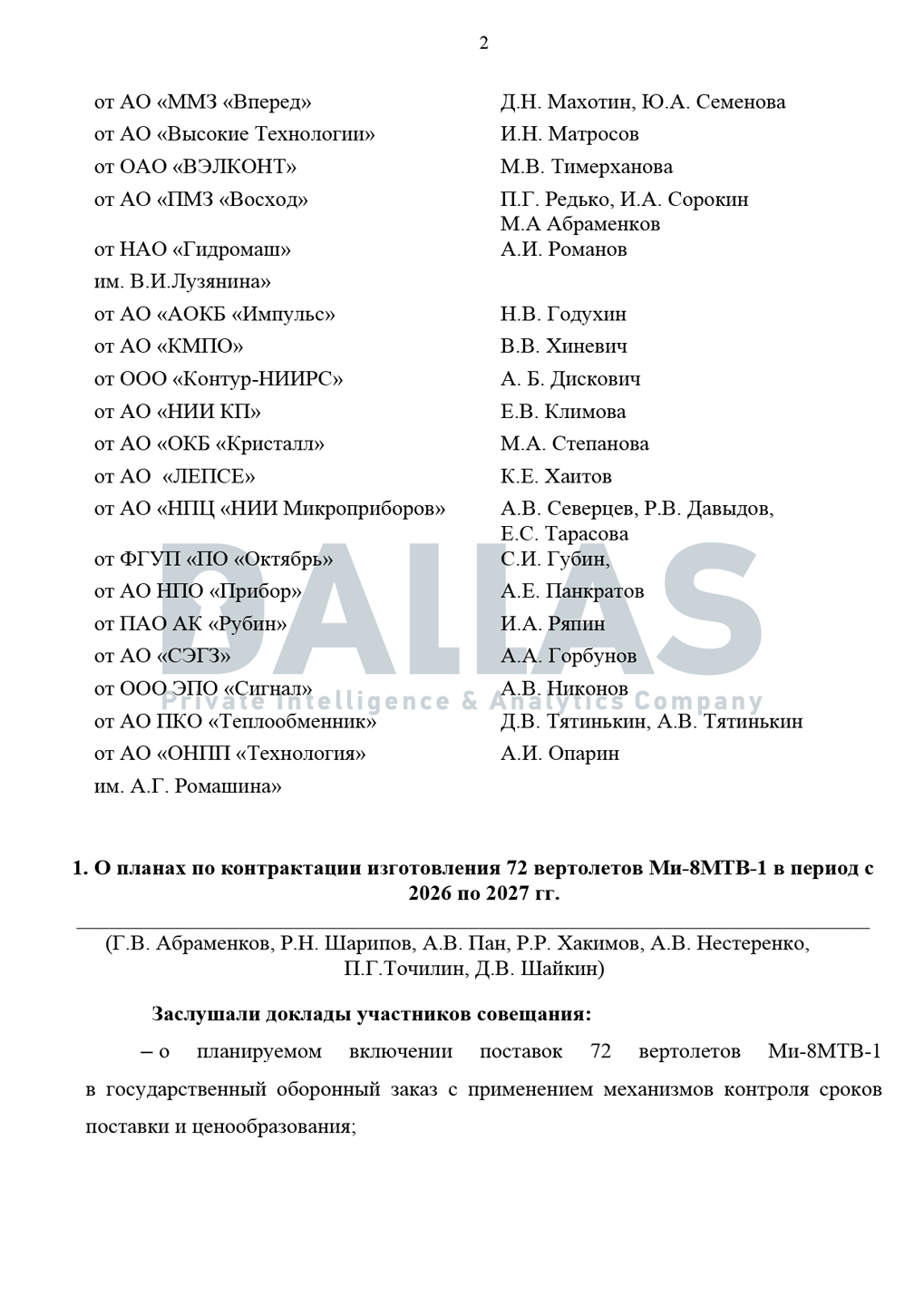
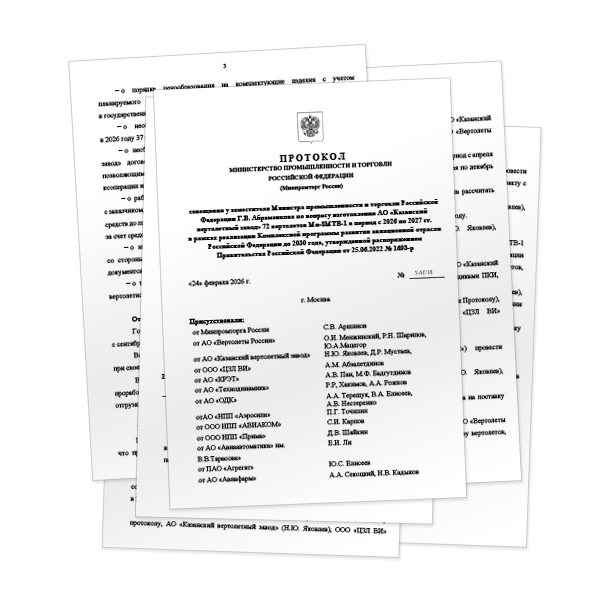
Протокол
Министерство промышленности и торговли Российской Федерации (Минпромторг России)
February 24, 2026
Expanding Capabilities
In December 2025, the independent analytical project Frontelligence Insight concluded that Russia is capable of sustaining and even increasing the pace of rebuilding its aviation fleet despite significant losses in the war against Ukraine.
The authors of the study analyzed leaked procurement documentation related to Russian aircraft plants in Kazan and Ulan-Ude, where Mi-8 family helicopters are produced. Based on contracts for component supplies, they concluded that Russia could manufacture approximately 20 military Mi-8 helicopters per year solely for the Russian Ministry of Defense. At the same time, overall production capabilities could be significantly higher, as the plants also fulfill orders for civilian structures and other government agencies.
The new documents obtained by Dallas indicate that Russia may be capable of producing nearly twice as many helicopters as previously estimated. According to Rostec, in 2024 the State Transport Leasing Company (GTLK) received 40 Mi-8MTV-1 helicopters manufactured jointly at the two main production sites in Kazan and Ulan-Ude.
However, according to the minutes from the Russian Ministry of Industry and Trade meeting, the Kazan plant alone plans to produce 37 helicopters in 2026 and another 35 in 2027. There is currently no precise data regarding production volumes at the Ulan-Ude plant. Nevertheless, Frontelligence Insight’s analysis indicates that components for Mi-8 production are typically distributed roughly equally between the two factories. Accordingly, it can be assumed that over the next two years both enterprises could potentially manufacture up to 80 helicopters each.
Threat of Air Assault Operations
The Mi-8 remains one of the key multi-purpose helicopters in the Russian military. At the beginning of the full-scale war against Ukraine, these aircraft were actively used in airborne assault operations, particularly around Kyiv and Hostomel. Following heavy losses, their role shifted toward evacuation, search-and-rescue missions, indirect rocket strikes, and countering drones and naval unmanned systems.
According to the leaked protocol obtained by Dallas Analytics, the production of 72 Mi-8 helicopters is being carried out under the framework of Russia’s “Comprehensive Program for the Development of the Aviation Industry Through 2030.” Even if only the Kazan plant fulfills its production targets by the end of 2027, the number of helicopters produced would effectively compensate for Russia’s wartime losses in this segment of aviation during the war against Ukraine. This would mean restoring Russia’s capability to conduct large-scale airborne assault operations at levels close to those seen before the invasion.
Russia’s full-scale invasion of Ukraine began with precisely such operations. However, without significant changes on the battlefield, Russia is unlikely to fully utilize large helicopter formations directly along the front line.
At the same time, numerous assessments by European politicians and intelligence agencies regarding Russia’s potential readiness for aggression against NATO countries should be taken into account. Such forecasts range between 2027 and 2030. For example, Inspector General of the Bundeswehr Carsten Breuer has stated that Russia could be ready to attack NATO territory by 2029 – or even earlier.
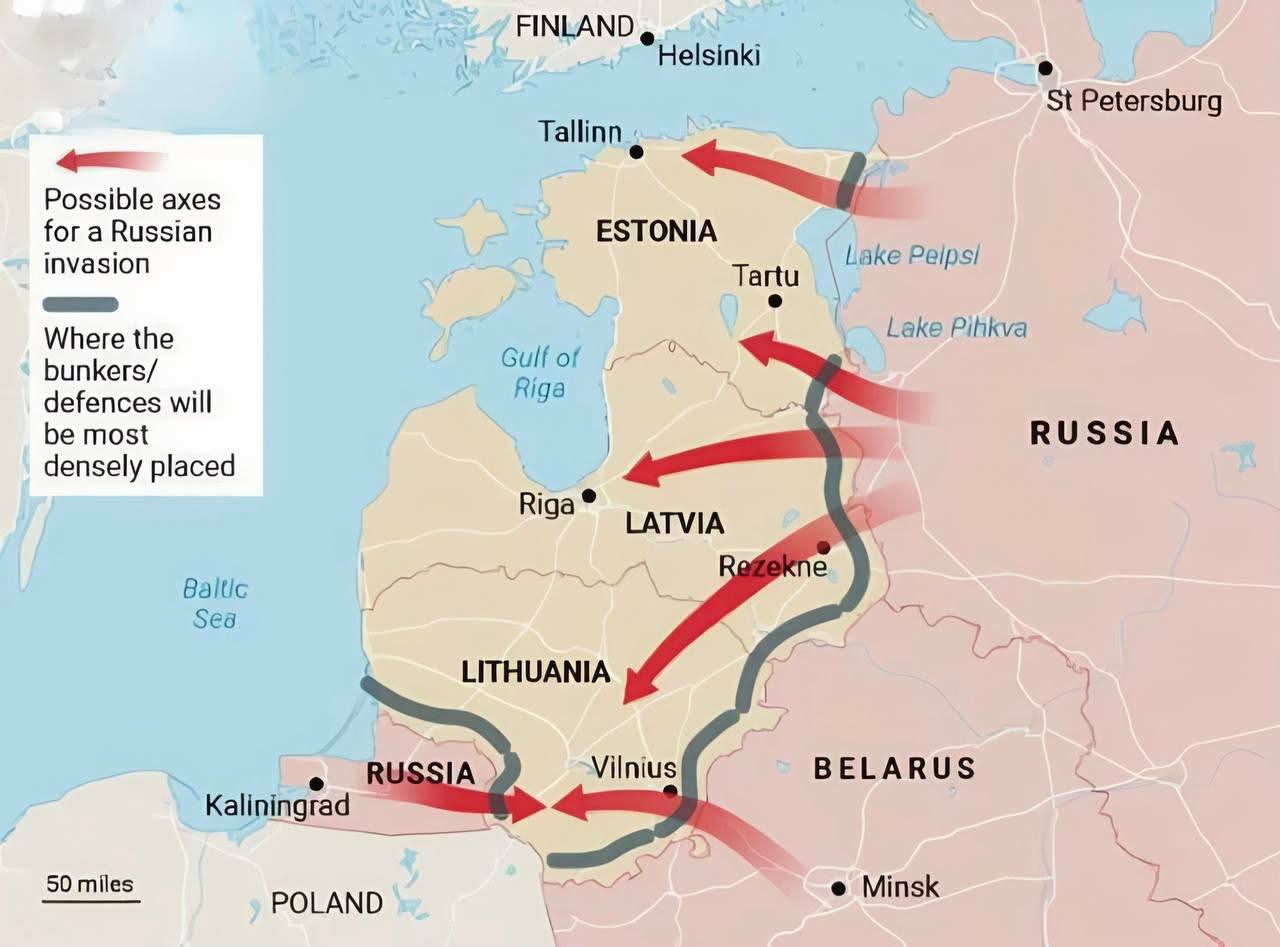
Thus, Russia’s growing airborne assault capabilities may pose a threat primarily to NATO countries, particularly the Baltic region. Given the geography of the area and its proximity to Russia, any potential ground invasion would almost certainly include a substantial airborne component.
More Does Not Necessarily Mean Better
Despite the ambitious plans outlined in the protocol, Russia’s defense-industrial complex faces serious structural problems. Some of these issues are directly acknowledged in the document itself, allowing us to speak not only about potential threats to NATO countries but also about the internal weaknesses of Russia’s defense industry.
It is difficult to disagree with the experts’ previous conclusions: the Russian military command considers helicopter losses significant and seeks to replenish them as quickly as possible. The document also signals preparations for a prolonged war and possibly for the expansion of the theater of military operations.
At the same time, the protocol directly points to problems within the Russian defense-industrial complex, including the absence of finalized contracts, shortages of advance financing, and risks of supply disruptions caused by lengthy production cycles. In addition, dependence on cooperation among dozens of enterprises makes the system vulnerable to external pressure. This is precisely why increasing sanctions against the Russian defense industry remains one of the key tools for containing Russia, alongside strengthening air defense systems.
Particular attention should be paid to a section of the protocol stating that the United Engine Corporation will only be able to supply engines for the Mi-8 beginning in September 2026. This may indicate a critical bottleneck in the production chain.
The document also demonstrates a high degree of dependence on the Radio-Electronic Technologies Concern (KRET), which manufactures onboard electronics and avionics. Deliveries are only possible with timely advance payments, highlighting financial strain within the defense production network.
Another telling detail is Clause 6.3 of the protocol, which specifically calls for “calculating the number of helicopters that can actually be built in 2026.” In other words, even after announcing plans for 37 aircraft, the real production figures remain uncertain.
Special attention should also be paid to references to Russia’s National Wealth Fund, whose resources are effectively being redirected to support the wartime economy. Among the issues discussed during the meeting was the activity of Russian Helicopters JSC before contracts are formally signed with customers – specifically, the advance financing of component suppliers through borrowed funds, followed by additional financing from the National Wealth Fund.
In practice, this means that Russia’s reserve state funds are being directed not toward infrastructure, social development, or healthcare, but toward sustaining defense production and continuing the war.
The obtained documents point to two parallel trends. On the one hand, Russia is attempting to restore and expand its airborne assault and transport aviation capabilities in preparation for a prolonged military confrontation. On the other hand, even the Kremlin’s ambitious plans remain critically dependent on financing, cooperation among dozens of enterprises, and access to components. This is why sanctions pressure, restrictions on technological imports, and strengthening air defense systems in both Ukraine and NATO allied countries remain key factors in containing Russia’s military machine.
At the same time, the very tactics of warfare have changed significantly since 2022. Unmanned systems now effectively determine success both on the ground and in the air. As demonstrated by the Ukrainian Defense Forces, a significantly cheaper drone is capable of destroying a multimillion-dollar helicopter. It is currently known that efforts are underway to develop automated drone systems capable of engaging helicopters.
Therefore, another way in which NATO countries can counter the Russian threat is through deeper cooperation with the Ukrainian defense industry. Just as the assistance and experience of Ukrainian specialists proved valuable in the Middle East, cooperation in this field could also provide an effective response to the threat posed by Russian airborne assault operations and ultimately nullify these efforts.