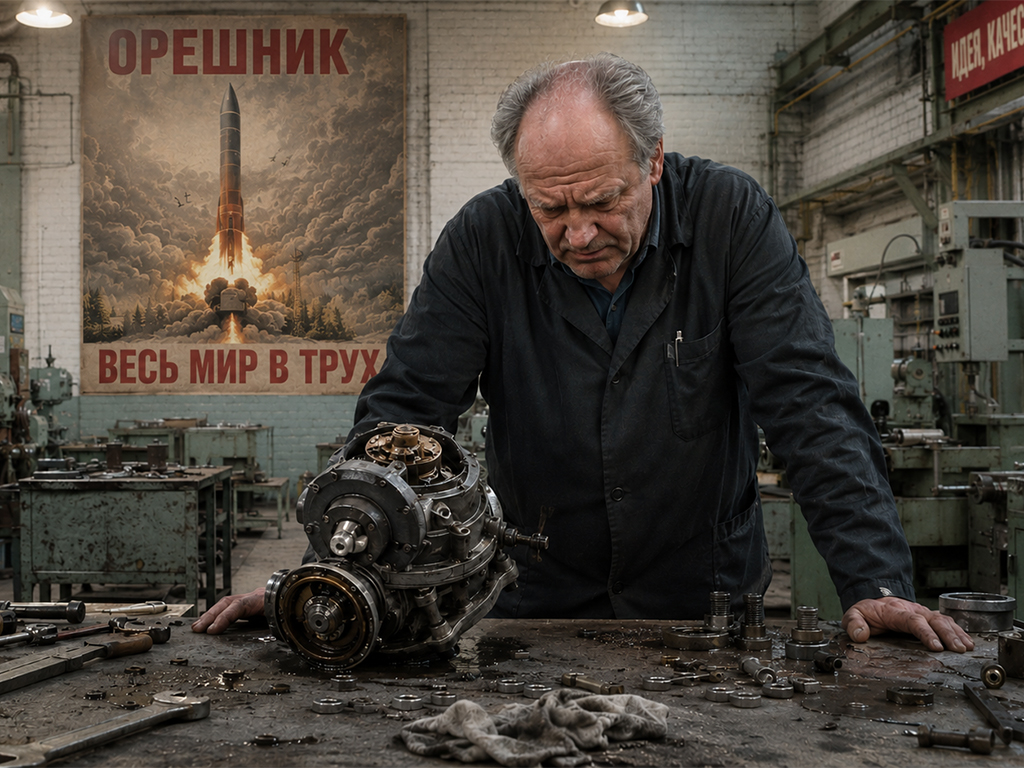



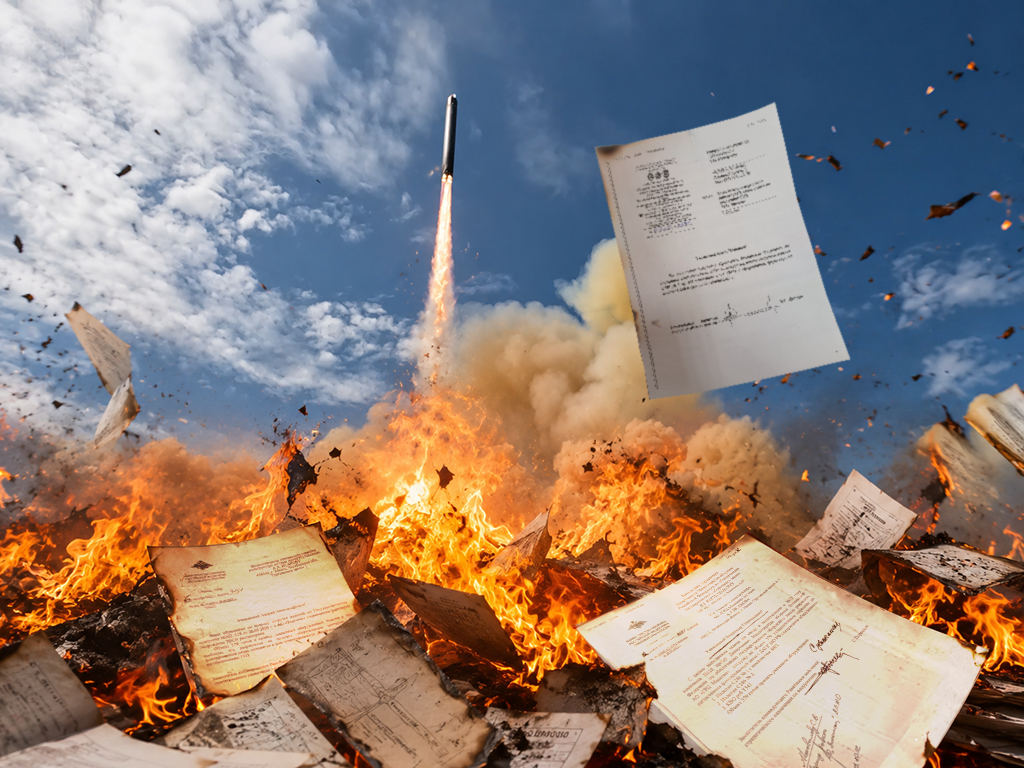
Internal Russian defence-industry documents obtained by Dallas Analytics show the RS-28 Sarmat shipped without its paperwork and unpriced for three years – while the Kremlin announced it on combat duty.
When the head of Roscosmos announced in September 2023 that Russia’s new RS-28 “Sarmat” heavy intercontinental ballistic missile (ICBM) had “been put on combat duty”, Moscow offered the West a headline and nothing to verify it against. The claim was neither the first nor the last of its kind: Vladimir Putin had promised the first Sarmat regiment on alert “by late 2022” as far back as April 2021, and again pledged deployment “this year” in February 2023.
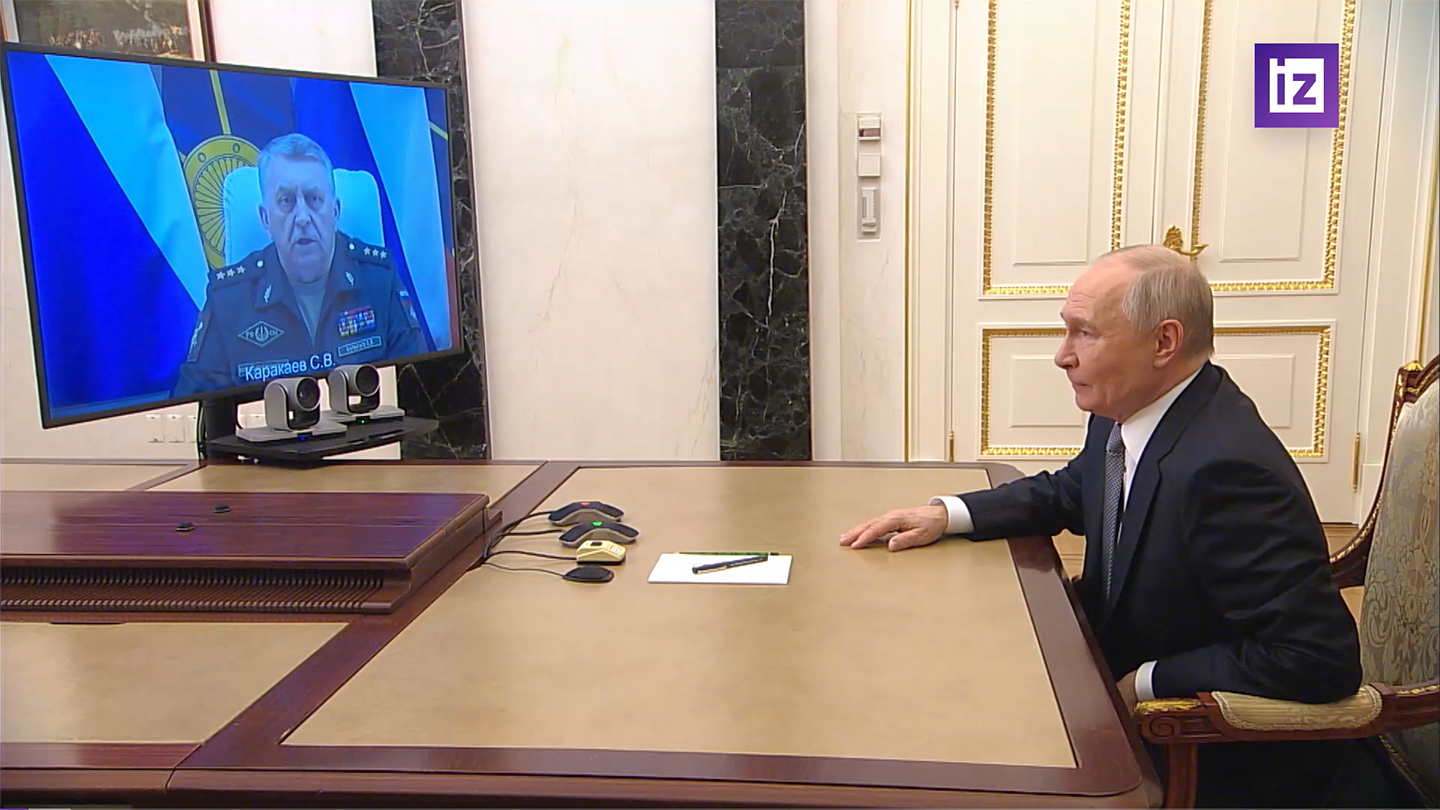
Nor did the story end there: more than two and a half years on, a claimed successful test on 12 May 2026 was presented by the Kremlin not as confirmation of a fielded weapon but as clearing the way to place the first Sarmat regiment on combat duty at Uzhur “by the end of 2026”. A system declared operational in 2023 was, in 2026, still being test-fired towards acceptance.
A cache of internal Russian defence-industry correspondence obtained by Dallas Analytics – routine shipping orders, a plant status report and price-audit findings – now shows what those statements concealed: a strategic weapon declared operational faster than its own manufacturers could document, price, ship or pay for it. Sarmat’s fielding is the story of a strategic programme defeated not by sanctions or engineering but by its own bureaucracy – a chain where every link depends on a single qualified supplier with no substitute, so that a single funding delay can bring the whole line to a halt. It is also the story of a Russian state that has shut off every external means of verifying what it claims.
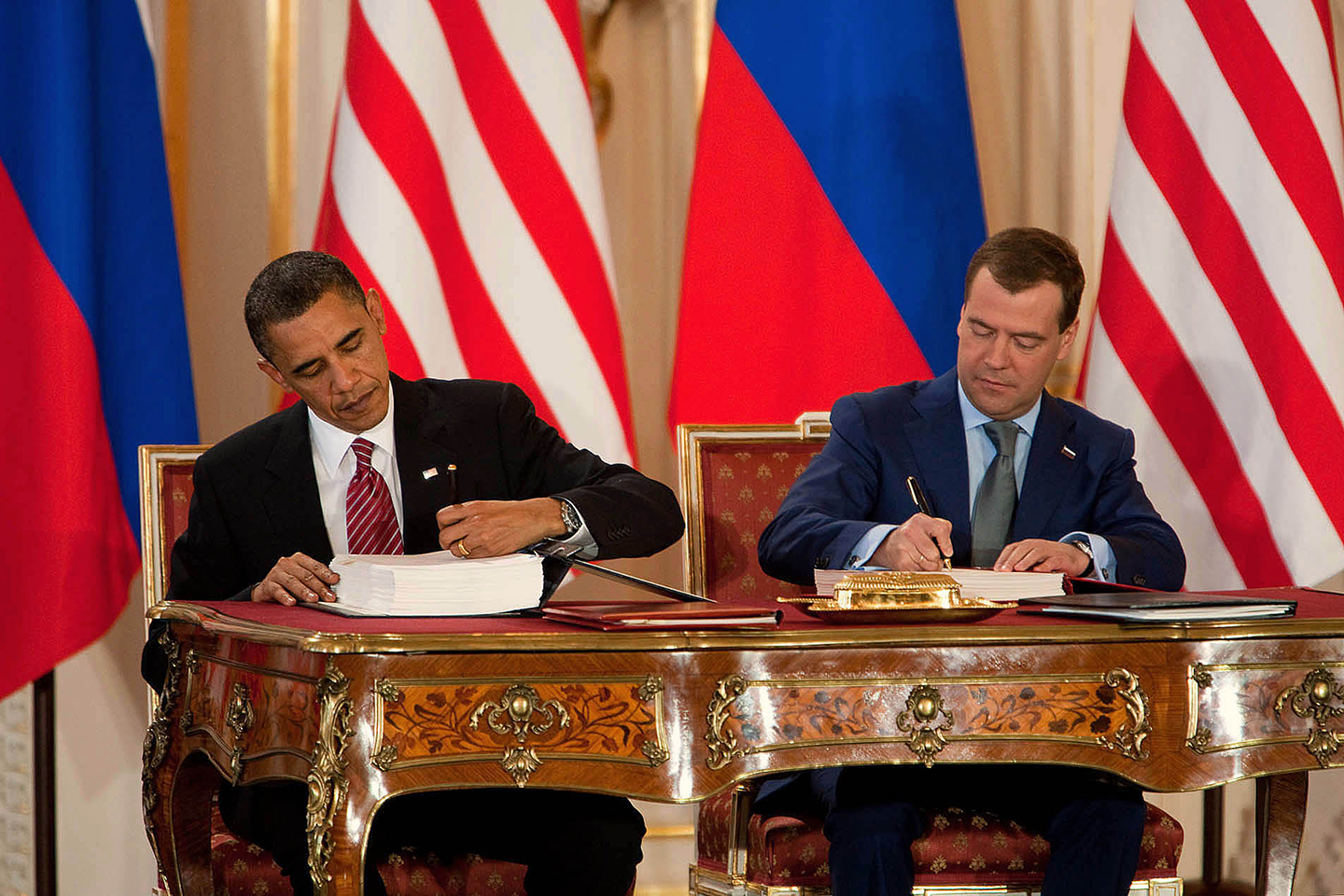
For fifteen years, the New START treaty gave Washington a verified window into Russia’s strategic forces: on-site inspections, data exchanges and advance notifications covering exactly the kind of silo conversions and article deliveries described in these documents. That window is gone. Russia halted inspections in 2020, suspended its participation in the treaty in February 2023, and let the agreement lapse on 5 February 2026 with no successor and no negotiations in prospect. For the first time in over half a century, no binding limits or verification measures constrain the two largest nuclear arsenals.
That is the context in which these documents matter. They are the transparency Moscow refuses to provide – internal proof that the “combat duty” declarations outran the industrial reality, at a moment when the West can no longer confirm or deny such narratives through any legitimate treaty channel. The failing is not any single build or launch, but the deliberate blackout around all of them – the withdrawal of the notifications and inspections that once made such activity legible. These documents are what verification used to deliver, arriving now only through Dallas Analytics’ exposure.
The paper trail versus the political calendar
On 12 October 2022, the Makeyev Rocket Design Bureau ordered Zlatmash (the Zlatoust Machine-Building Plant) to ship article С286 №1 to military unit 32441 – the 62nd Missile Division at Uzhur, in Krasnoyarsk Krai – complete with its service logbook, by 21 October. The order carried out a presidential instruction to place the “theme 001” complex on combat duty.
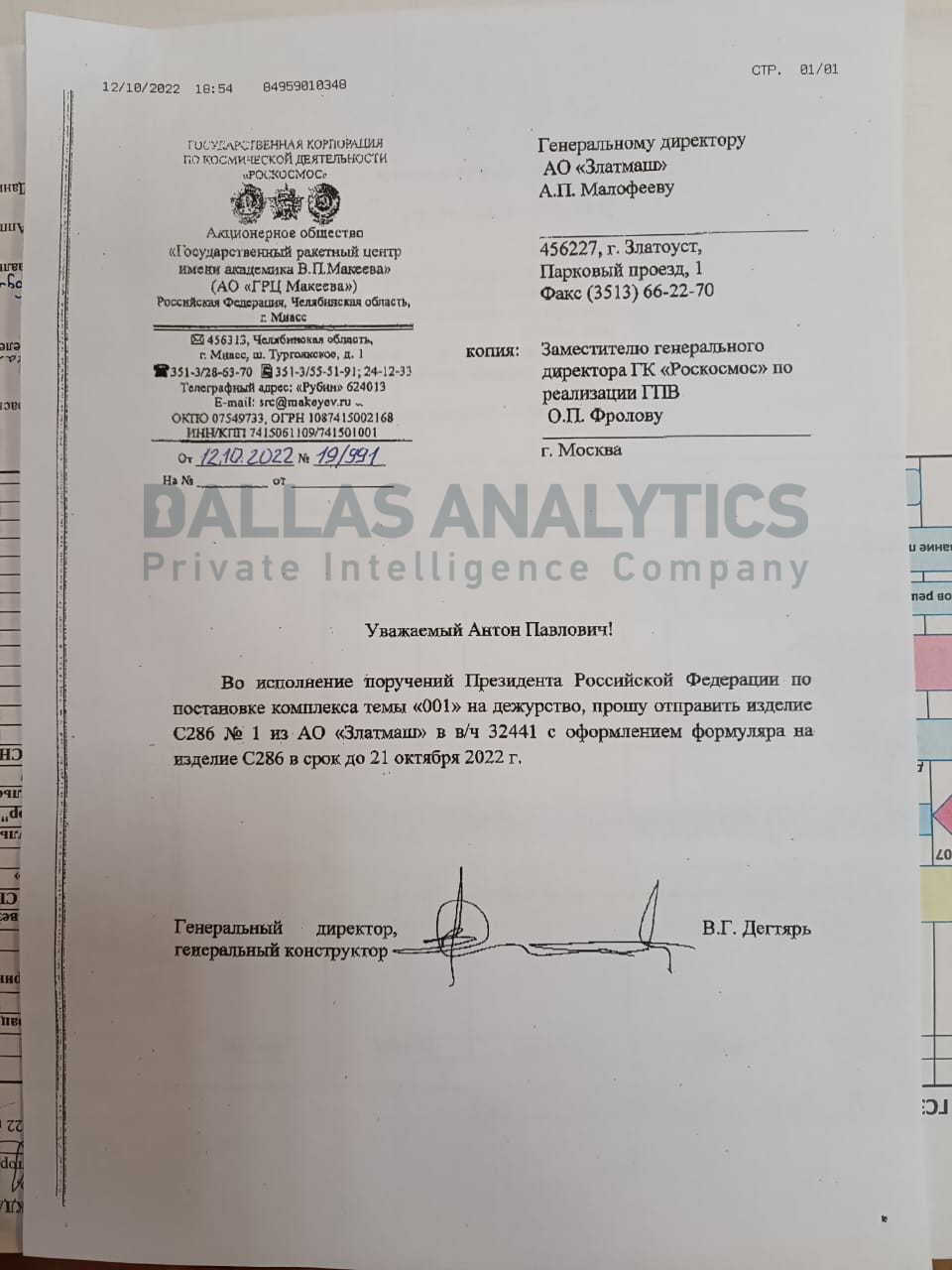
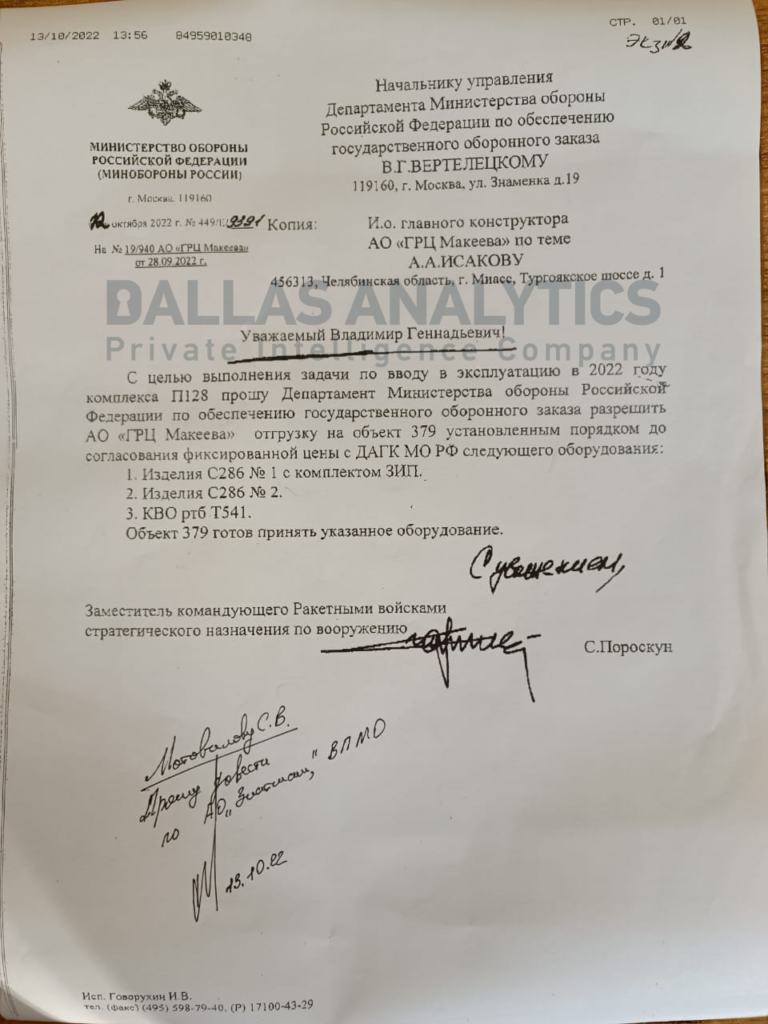
A companion letter that month, from the Strategic Rocket Forces (RVSN) deputy commander for armament, Sergei Poroskun, named the receiving site as object 379 – an internal Russian military designation for a facility within the 62nd Division’s positional area at Uzhur, the deployment district independently identified by the Federation of American Scientists as Sarmat’s first basing site. The letter was addressed to Vladimir Verteletsky, then head of the Ministry of Defence’s Department for State Defence Order (GOZ) provision. What “379” designates inside that district – a silo, a technical facility, a command post – the documents do not say, and the open record does not resolve.
The letter also lists the consignment: С286 №1 with its spares kit, С286 №2, and a set designated КВО ртб Т541. The last is equipment for a repair-technical base – the divisional formation that stores and services nuclear warheads, which Russian military usage calls “special munitions”. Dallas Analytics assesses Т541 as auxiliary equipment for warhead installation, carrying measurement sensors for the payload; its “repair” designation understates that role. What was being delivered to object 379, in other words, was the apparatus of arming – though the documents stop there, and cannot go further: Russian warheads move through Rosatom and the 12th Main Directorate, a chain that appears nowhere in these files.
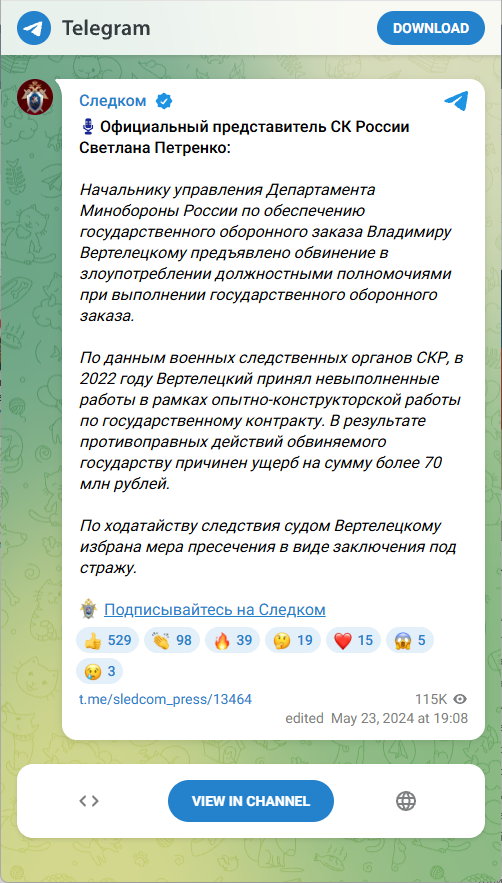
Official spokesperson of the Investigative Committee of Russia (ICR), Svetlana Petrenko:
Vladimir Verteletsky, Head of Directorate within the Department of the Russian Ministry of Defence (MoD) for State Defence Order, has been charged with abuse of official powers in the execution of the state defence order.
According to the ICR’s military investigative bodies, in 2022 Verteletsky signed off on work that had not actually been completed under a research and development contract awarded as part of a state contract. As a result of the accused’s unlawful actions, the state sustained damage exceeding 70 million roubles (approximately $775,000 at the time).
At the investigation’s request, the court has ordered Verteletsky to be remanded in custody (pre-trial detention) as a preventive measure.
Verteletsky’s later fate is itself a marker of the programme’s troubles. In May 2024 he was arrested; Russian investigators alleged that in 2022 he had signed off on unfulfilled work under a state contract for a research-and-development effort. The official responsible for accepting defence-order deliverables, in other words, was accused of certifying work that had not been done – precisely the gap between paper and reality this correspondence documents.
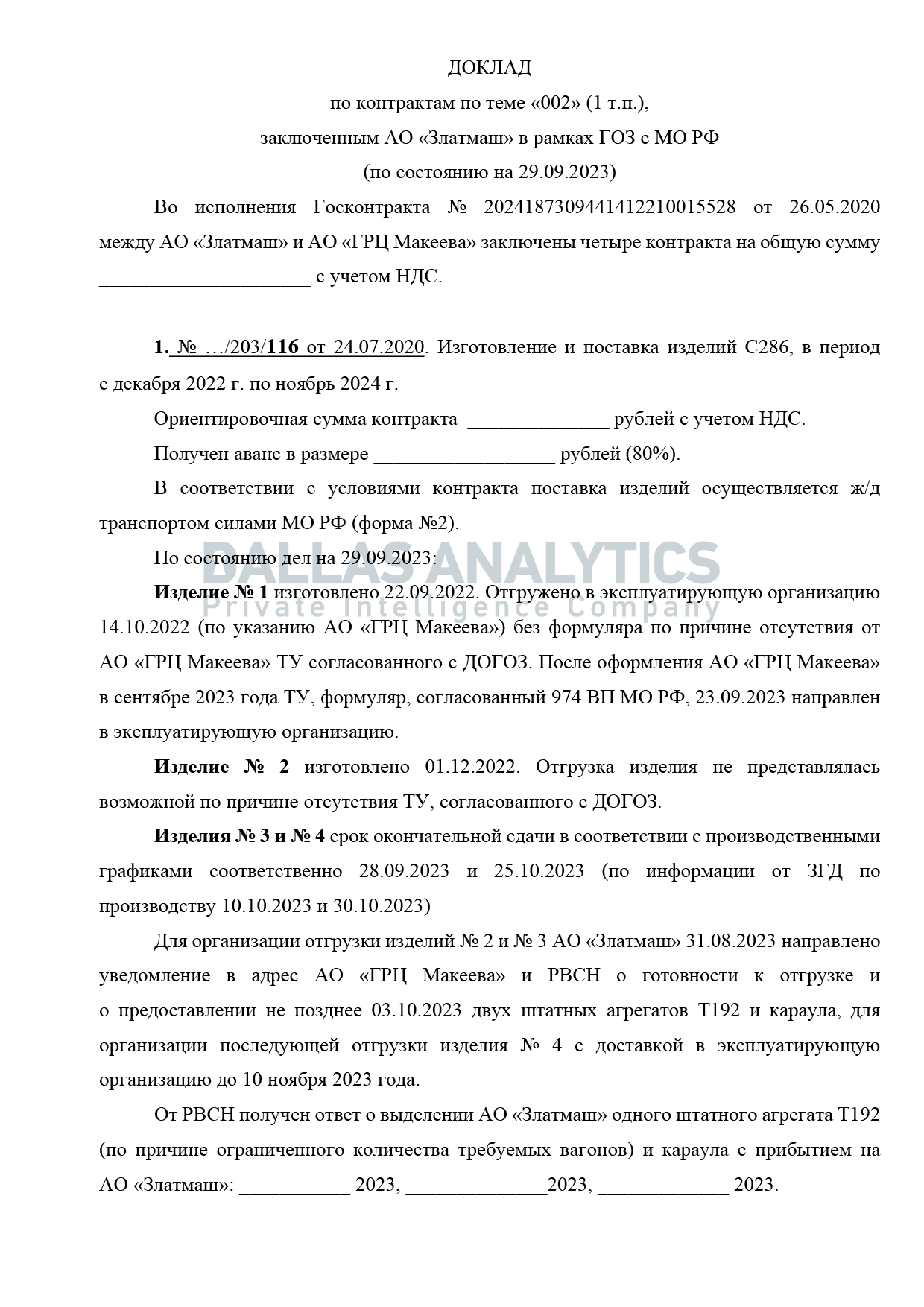
Zlatmash’s own report on the theme “002” contracts.
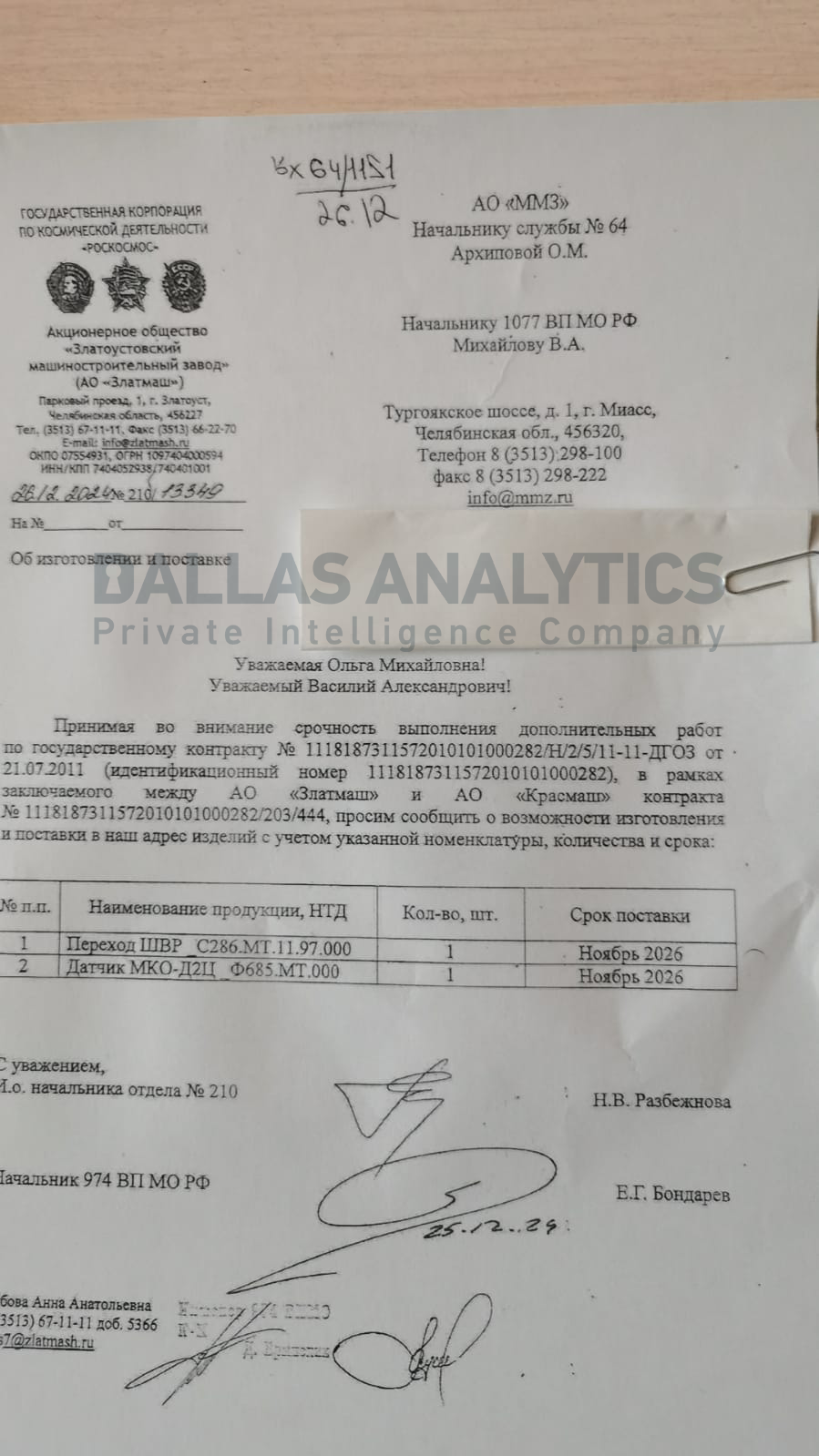
Our reading of С286 is that it is the Sarmat’s payload fairing – the composite nose shroud that encloses the missile’s payload section, engineered for both heat resistance and radio-transparency. The documents do not name the article’s function, but a Zlatmash letter to the Miass Machine-Building Plant of 26 December 2024 points firmly in that direction: it orders manufacture – through the cooperation contract with Krasmash, the missile’s airframe assembler – of a detail part of С286, a transition or adapter fitting under drawing С286.МТ.11.97.000, for delivery in late 2026. С286 – a structured, multi-part assembly with its own drawing tree, produced through the airframe-maker’s cooperation and carrying internal fittings of the kind that mate a nose structure to the rocket body – is a flight article, not support gear.
Within a year of the 2022 shipment order, Moscow would declare the system on combat duty. The internal record shows what that claim omitted.
Three failures recur across the correspondence, and none is about engineering. Each is administrative – documentation, logistics, price – and each alone was enough to stall delivery of a weapon the Kremlin had declared operational.
The article shipped undocumented. By Zlatmash’s own status report of 29 September 2023, С286 №1 was built on 22 September 2022 and shipped on 14 October 2022 – but without a formulyar, the logbook that makes it officially accountable, because the Makeyev Rocket Design Bureau had never agreed the governing technical conditions with the MoD’s defence-order directorate. The logbook followed only on 23 September 2023, almost a year later. Its twin, С286 №2, finished on 1 December 2022, could not be shipped at all, for want of the same paperwork.
The state could not move what it built. Asked for two rail transporters and guard details to send further articles, the Strategic Rocket Forces supplied one, pleading a shortage of wagons – which Zlatmash recorded as guaranteeing a missed delivery date.
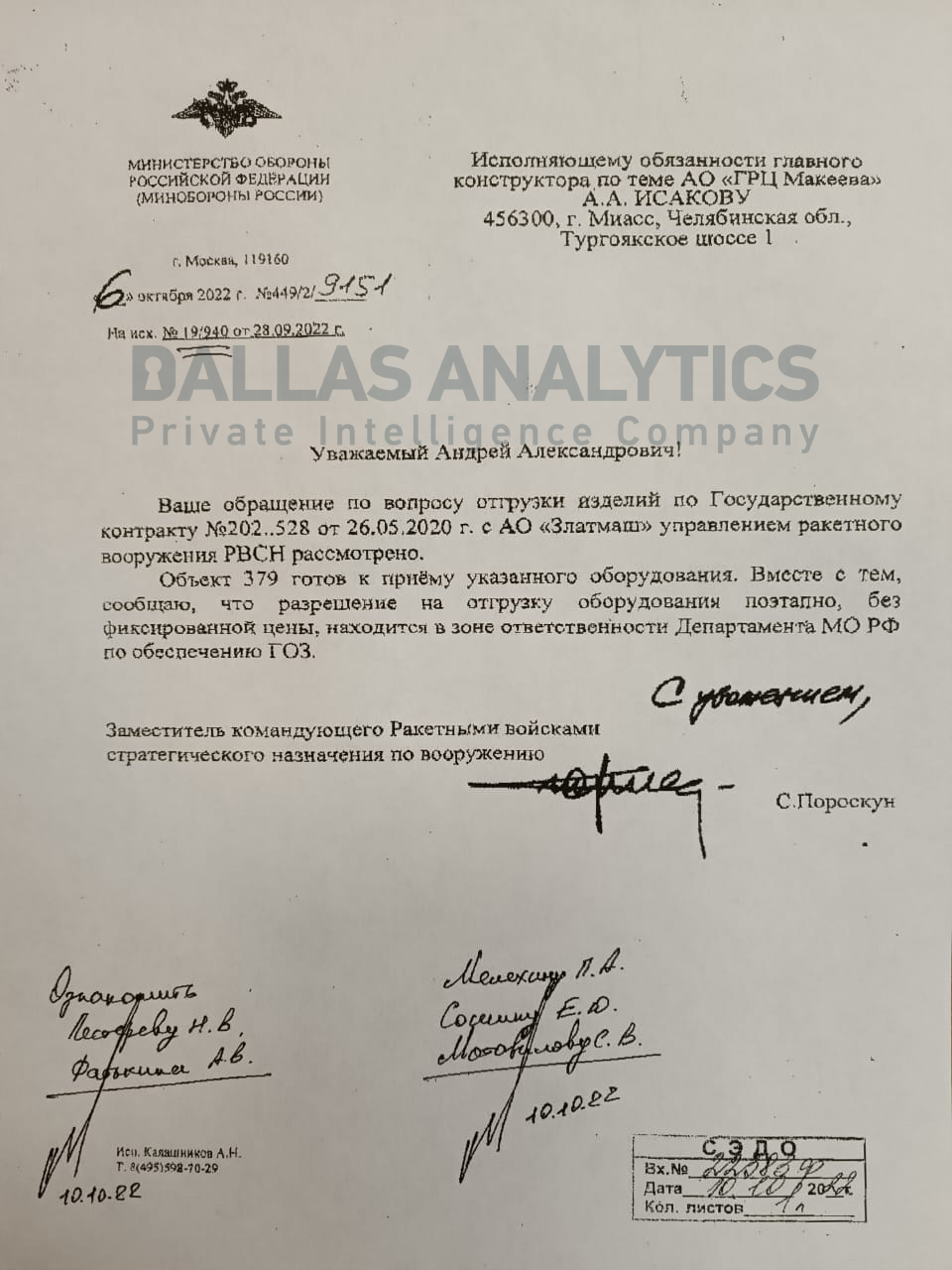
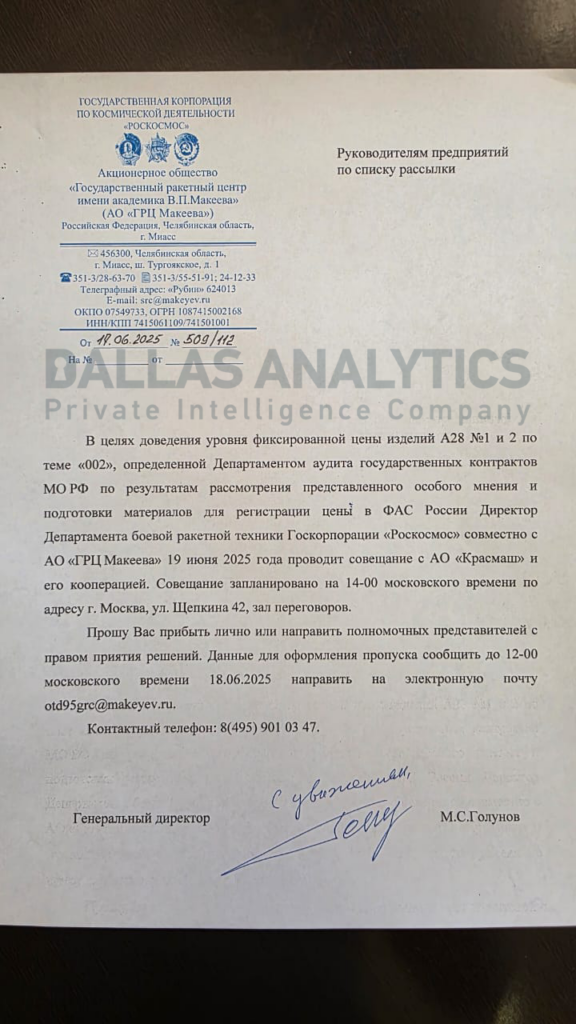
No price was ever agreed. Every delivery hung on a fixed price the parties never set. On 6 October 2022 the Strategic Rocket Forces told the Makeyev Rocket Design Bureau that object 379 stood ready to receive the equipment — but that authorising a phased shipment without a fixed price was not its decision to make: that lay with the Defence Ministry’s GOZ department. The first article shipped eight days later regardless. A 2023 Krasmash audit then sent the costings back full of gaps. The problem was still live in mid-2025 — a letter of 18 June 2025 convened Krasmash and its suppliers to finalise the fixed price of “theme 002” articles and register it with the Federal Antimonopoly Service, nearly three years after the first units shipped.
A chain with no second source
Earlier investigative work by StateWatch and UNITED24 Media mapped who supplies Sarmat and flagged that parts of the network remain unsanctioned; the documents here carry the question one layer down — to whether that network can deliver and be paid. Zlatmash’s own cooperation register for head contract 5528, current to 28 September 2023, shows why any single failure propagates.
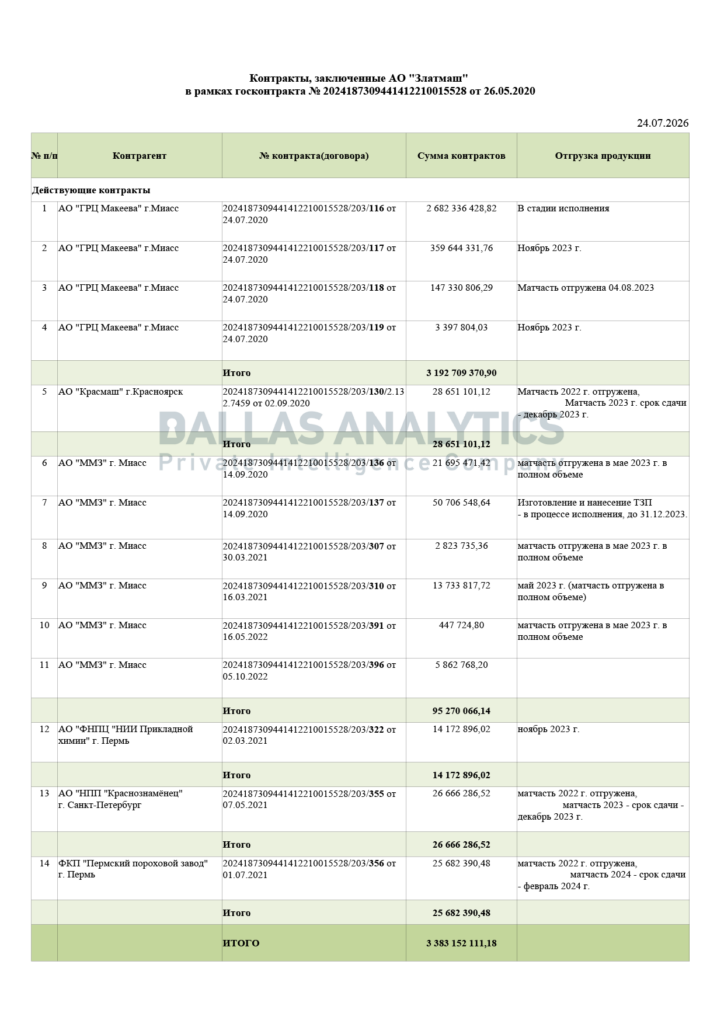
Zlatmash’s cooperation register for contract 5528, 28 September 2023
Most of the register’s value sits in the core С286-family cooperation; the remainder is a thin tail of specialist inputs – thermal-protective coating, propellant, initiators, chemistry – each from a single plant with no second source. In a chain this concentrated and this sole-sourced, the administrative failures above are not survivable inconveniences: a stalled document or an unpaid invoice at any one node halts the whole.
So what: the levers that remain
Two conclusions follow for Western analysts and decision-makers. With inspections gone, these documents are the kind of ground-level insight the verification regime once supplied – and what they show is a gap between declaration and delivery that Russian statements alone conceal.
On leverage, the evidence points somewhere less obvious than sanctions. Nothing in this correspondence shows Sarmat held up by an embargoed part or a blocked import. What stalled it was an unsigned technical condition and a price that went unfixed for three years – from the first shipment in October 2022 to at least mid-2025, when Makeyev was still convening its suppliers to settle it. Whether it was ever settled is, like most things in this programme, not something outsiders can check. That does not mean export controls are idle: their effects sit further upstream, in tooling and componentry. But the programme’s most immediate vulnerability is one Western policy has not tried to reach – an administrative machine that cannot keep pace with its own political deadlines, running a chain where every link has a single supplier and no substitute.
P.S. The second part of this investigation follows in the coming weeks. It examines the production architecture behind Russia’s premier tactical missiles, including the Iskander-M, maps the cooperation network and the financial flows that sustain it, and identifies the chokepoints where external pressure would bite hardest. Subscribe to our Substack and social channels to follow it.
Media, think tanks and institutional partners interested in this work are welcome to contact the Dallas Analytics team via the Expert Resources section of our website.