


Dallas Analytics has uncovered a possible mechanism for servicing Russian Ka-32 helicopters operated in South Korea. The country is the largest operator of this type of helicopter outside Russia. Documents obtained from the Korean company HeliKorea show how private actors continue to maintain contacts with Russian aircraft repair facilities despite sanctions.
The Ka-32 is a multi-purpose, twin-engine transport helicopter developed by the Soviet-era Kamov Design Bureau and based on the naval Ka-27. Its main design feature is a coaxial rotor system: two three-bladed rotors rotate in opposite directions, eliminating the need for a conventional tail rotor. This configuration provides high maneuverability, precise hovering, and good controllability when operating with loads, particularly in confined spaces and mountainous or urban environments.
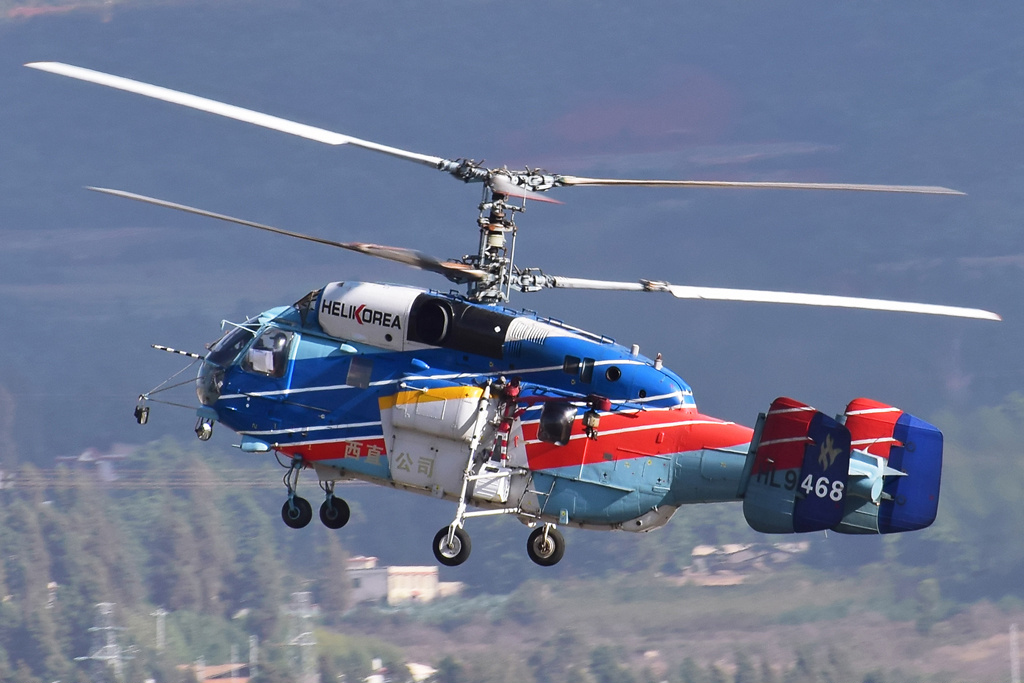
The Ka-32 belongs to the class of heavy multi-purpose helicopters. Depending on the modification, it can carry up to 3.7 tonnes of cargo inside the cabin or up to 5 tonnes on an external sling, while its maximum takeoff weight with an external load is approximately 12.7 tonnes.
Thanks to its combination of payload capacity and precise handling, the Ka-32 is suited to a wide range of specialized tasks, including forest firefighting, search-and-rescue operations, cargo transportation, installation and construction work, logging, medical evacuation, and operations in hard-to-reach areas.
The Ka-32 has proved particularly effective as a firefighting helicopter. It can be equipped with underslung water systems and tanks with a capacity of up to 5,000 liters. This is precisely why the type has become extremely important in Korea. Its high payload capacity, stability while hovering, and precise handling make the Ka-32 particularly well suited to South Korea’s mountainous and forested terrain.
The Korea Forest Service primarily uses the helicopter to combat forest fires, where it can repeatedly collect water and accurately release it directly onto the fire.
The Russian “Bear” in Korea
In 1991, South Korea provided the Soviet Union with loans totaling approximately $1.47 billion. Following the collapse of the Soviet Union, Russia did not have sufficient cash to repay the debt, so the two sides agreed on a barter arrangement. As a result, the countries launched an intergovernmental program known as the “Brown Bear” Project, under which Russia settled Soviet-era debts to South Korea by supplying military equipment and weapons.
The project was implemented in several phases throughout the 1990s and 2000s. Seoul received T-80U tanks, BMP-3 infantry fighting vehicles, Metis-M anti-tank systems, and Igla man-portable air-defense systems. This was an unprecedented case in which a U.S. ally – South Korea – became the first NATO/allied Western-oriented country to officially introduce large quantities of advanced Soviet and Russian armored vehicles into its regular armed forces.
Helicopters were also among the equipment transferred. Deliveries began in 1993. The first Ka-32s were imported by the Korean company LG International. According to aviation reference sources, 36 helicopters were imported between 1993 and 2000 for the forestry service, maritime police, and regional firefighting services.
The fleet subsequently continued to expand rapidly, and new Ka-32A11BC helicopters appeared in Korea. Estimates of the total number vary considerably. According to the highest estimates, more than 60 helicopters of this type are currently in Korea, seven of which are operated by the country’s Air Force.
Thus, equipment that once served as a means of settling the Soviet debt to Seoul has, decades later, become a source of South Korea’s dependence on a Russian manufacturer.
Today, the Ka-32 remains one of the most important helicopter types in South Korea. For example, the Korea Forest Service operates 29 of them, making the type one of the country’s key medium firefighting helicopters.
However, some of the aircraft have been withdrawn from service because of problems with the supply of Russian spare parts. Following the outbreak of Russia’s full-scale war against Ukraine, the situation deteriorated sharply. Before the war, South Korea was able to support its fleet through the Russian manufacturer and its own MRO system.
In March 2025, the Korean publication The Asia Business Daily reported that Russia had ceased normal supplies of spare parts to South Korea, leaving 14 Ka-32 helicopters grounded because of problems with components and maintenance.
Cooperation with Russia and Sanctions Evasion
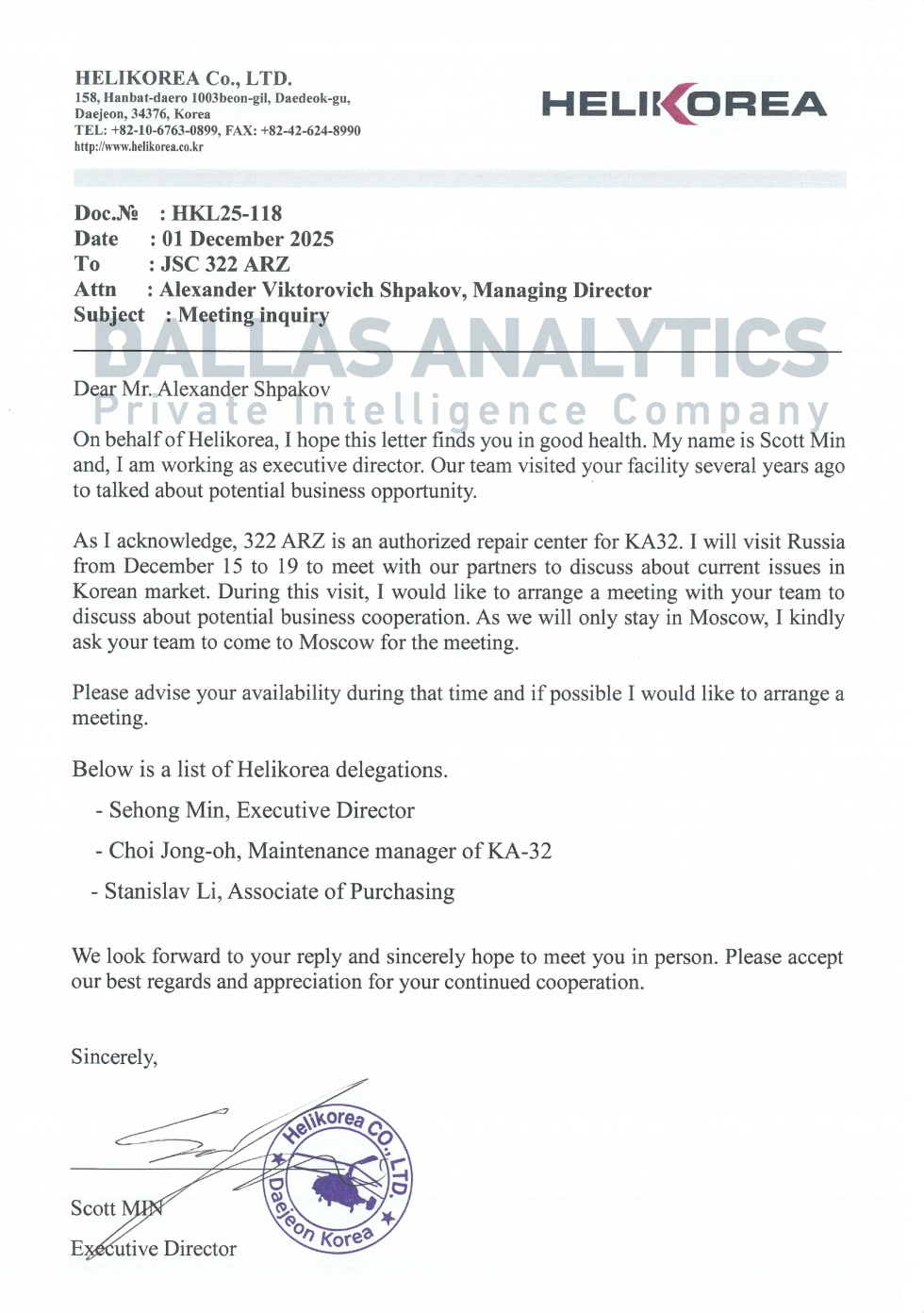
As part of its investigation, Dallas Analytics obtained a copy of a letter dated December 1, 2025 (document No. HKL25-118), sent by the Korean company HeliKorea Co., Ltd. to JSC “322 ARZ” (“322 Aircraft Repair Plant,” Vozdvizhenka, Primorsky Krai, Russia), addressed to its CEO, Alexander Shpakov.
In the document, HeliKorea states its intention to visit Russia from December 15 to 19, 2025, to meet with representatives of JSC “322 ARZ” and other partners. The stated purpose of the visit was to discuss current issues on the Korean market and potential business cooperation.
The letter also states that JSC “322 ARZ” is an authorized repair center for the Ka-32 helicopter. The document also lists the members of the HeliKorea delegation:
- Sehong Min, Executive Director;
- Choi Jong-oh, Maintenance manager of KA-32;
- Stanislav Lee, Associate of Purchasing.
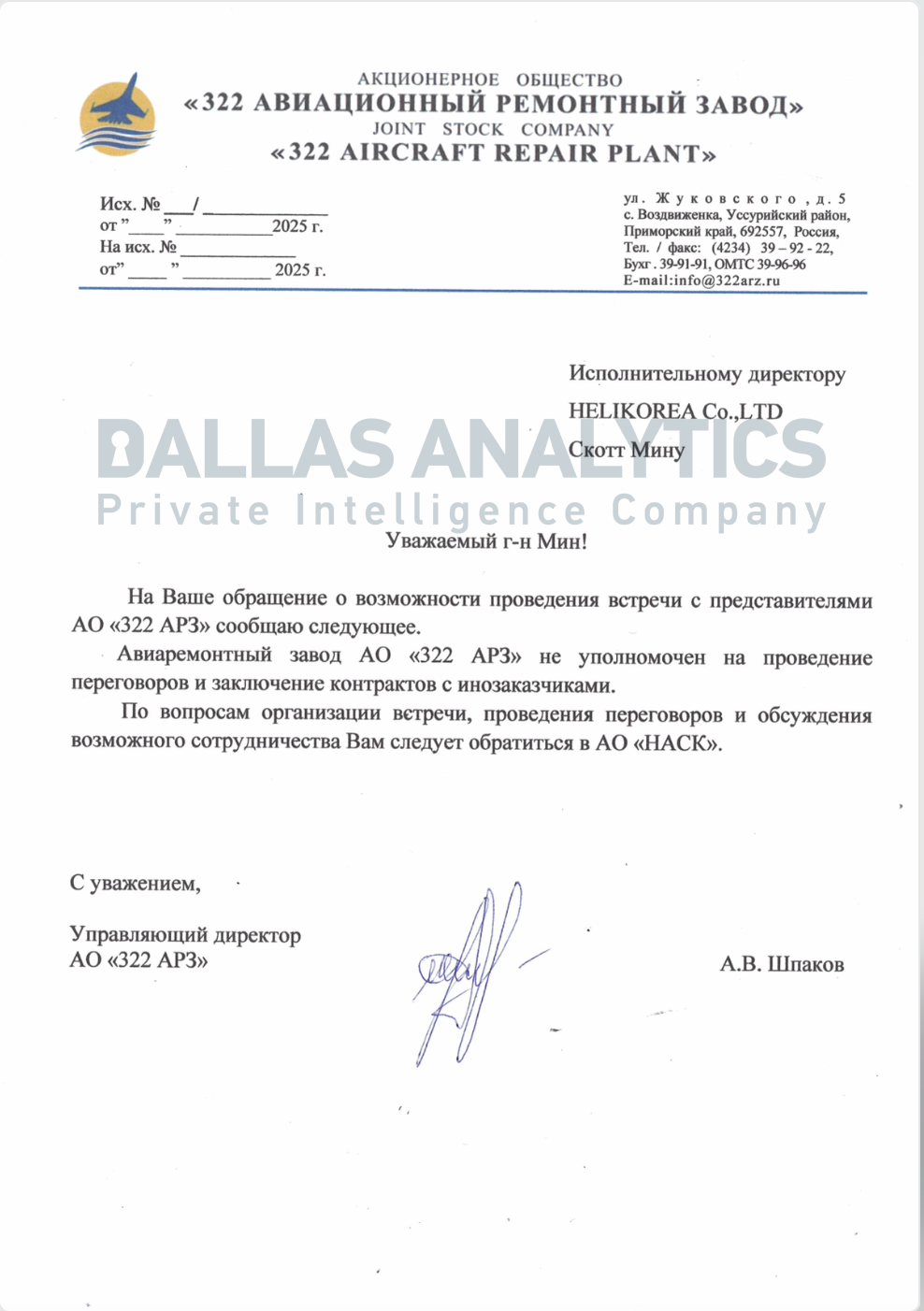
In response to the letter, the management of “322 ARZ” stated that it was not authorized to conduct negotiations or conclude contracts with foreign customers. HeliKorea’s management was advised to contact JSC “NASC” regarding the organization of the meeting, negotiations, and discussion of possible cooperation.
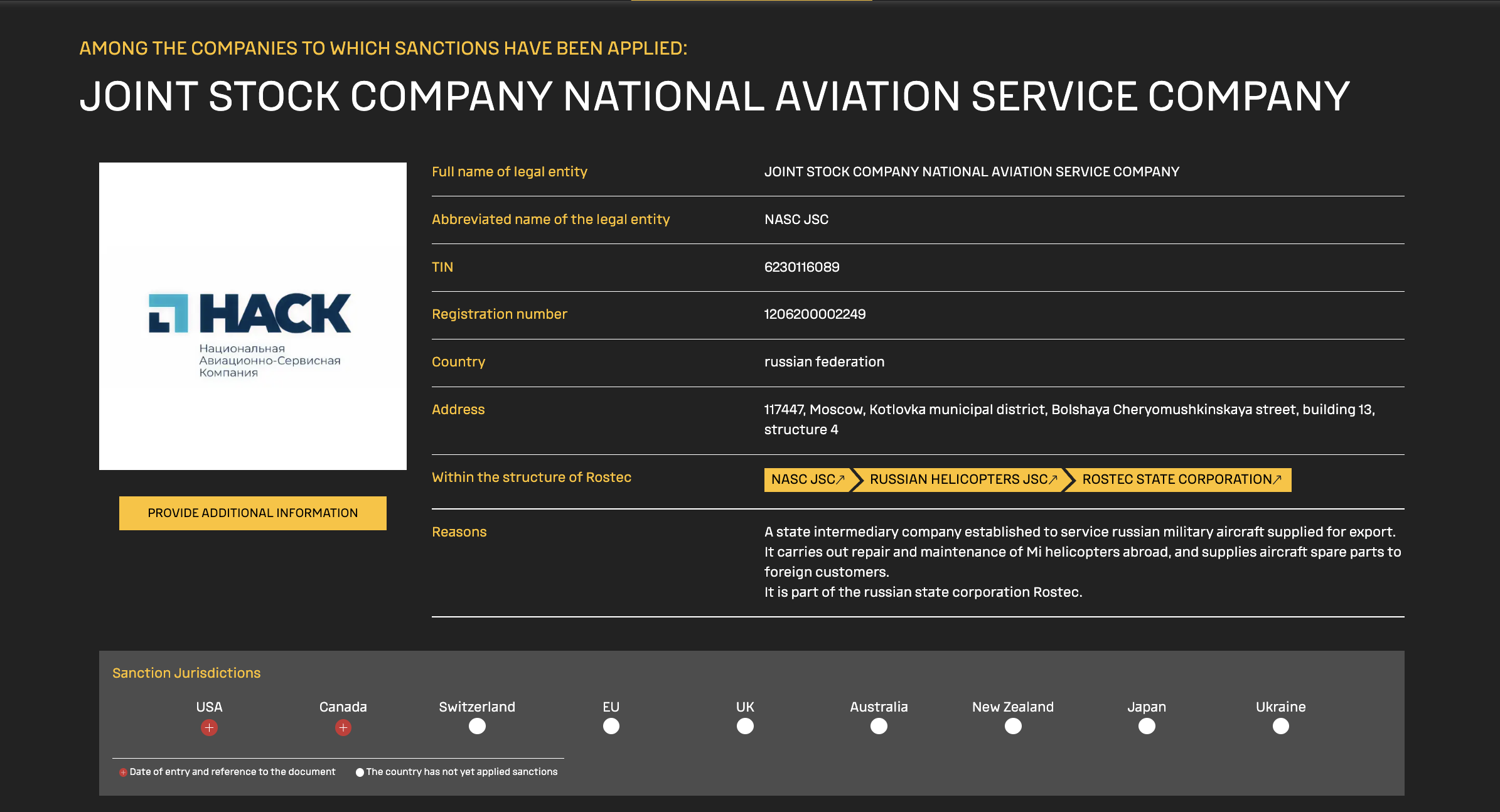
JSC “NASC” (Joint Stock Company “National Aviation Service Company”) is a Russian state intermediary in the field of military-technical cooperation, established to provide comprehensive servicing and after-sales repair of Russian-made military aviation equipment supplied for export.
Since 2023, the company has been under U.S. and Canadian sanctions. Moreover, it is part of the sanctioned “Russian Helicopters” corporation, which in turn is controlled by the state-owned Rostec corporation.
Dallas Analytics formally approached HeliKorea Co., Ltd., seeking clarification on the nature of its commercial interactions with sanctioned Russian state aerospace entities – specifically JSC 322 Aircraft Repair Plant and Rostec subsidiary JSC NASC. We requested details regarding whether the firm maintains counterparty screening protocols or internal compliance procedures to align with export controls and sanctions imposed by the Republic of Korea, the United States, the European Union, and allied jurisdictions. HeliKorea did not respond.
Concurrently, Dallas Analytics lodged a detailed inquiry with South Korea’s Ministry of Trade, Industry and Energy (MOTIE), the principal regulatory body overseeing strategic trade controls and dual-use compliance. The submission addressed three key policy areas:
• Compliance Scrutiny: Whether the Ministry is monitoring or investigating domestic MRO operators utilising third-country procurement networks to engage with sanctioned Russian defence intermediaries such as JSC NASC.
• Regulatory Enforcement: What mandatory due-diligence mechanisms MOTIE enforces to prevent domestic aerospace firms from breaching ROK trade regulations or exposing themselves to foreign secondary sanctions.
• Strategic Mitigation: How MOTIE co-ordinates with state end-users, such as the Korea Forest Service, to address severe Ka-32 spare-part shortages without encouraging reliance on non-compliant supply chains.
MOTIE provided the following statement in response:
“We understand that this issue pertains to the import of parts for the maintenance of Ka-32 helicopters, and it is not related to the MOTIR’s export control regulatory framework. Regarding the matter you mentioned, please reach out to the Korea Forest Service (KFS), which is currently managing these helicopters.”
This response highlights a fragmented regulatory approach within South Korea’s trade compliance architecture. By treating the procurement of dual-use aviation components as a localised operational issue for the Korea Forest Service, trade authorities effectively disclaim oversight of secondary sanctions risks associated with Russian state aerospace conglomerates. Relegating compliance monitoring to line agencies overlooks the systemic legal exposures domestic private operators face when interacting with Rostec subsidiaries, while inadvertently undermining the efficacy of Seoul’s strategic export control regime.
Despite corporate silence and the government’s reluctance to intervene, Dallas Analytics confirmed through a source familiar with HeliKorea’s operations that the December 2025 delegation to Russia did take place, and that the company continues to source components via third-party intermediaries.
This outreach follows an established pattern. In March 2023, the Russian aviation portal Aviaport reported that a HeliKorea delegation visited the V.I. Luzyanin Hydromash plant in Nizhny Novgorod – a major Russian manufacturer of aircraft landing gear and hydraulic systems – to initiate pre-contractual negotiations for Ka-32 MRO support. This was clearly not the company’s first contact with the Russian side since the beginning of Russia’s full-scale war against Ukraine.
HeliKorea
HeliKorea was founded in 1996, is headquartered in Daejeon, and has operational sites in the Seoul/Gimpo area and elsewhere. The company has grown into one of South Korea’s largest private helicopter operators. As of 2017, its fleet was estimated at 26 aircraft.
Its range of operations is extensive: forest firefighting, forestry work, cargo operations, offshore transportation, work for the Korea National Oil Corporation, work for the Korea Electric Power Corporation, HEMS/medical aviation, MRO and maintenance of other helicopters, training, and simulators.
HeliKorea states on its website that it has seven Russian helicopters at its disposal. However, an analysis of open sources, including aviation registries, shows that the company has historically operated at least six different Ka-32s (registrations HL9299, HL9289, HL9401, HL9475, HL9468, and HL9491), with five of them simultaneously forming part of the fleet in 2012–2014.
As of today, open photographic sources confirm the operation of at least four aircraft – HL9289, HL9401, HL9475, and HL9672 – while the current status of HL9468 remains unclear.
At the same time, it is important that the company does indeed state that it provides helicopter maintenance services. In 2015, HeliKorea, together with South Korean aviation authorities, visited Aircraft Repair Plant No. 150 in Russia and continued certification for the maintenance of Ka-32 engines.
This suggests that the company had capabilities not only as an operator but also as a technical service provider for Russian equipment.
An analysis of customs data indicates that HeliKorea maintained established business ties with Russian aircraft repair companies during the first years of Russia’s full-scale war against Ukraine. Between July 2022 and August 2024, the South Korean company received shipments from five Russian enterprises: JSC St. Petersburg Aircraft Repair Company, JSC Ural Civil Aviation Plant, LLC Fly Avia, LLC Russkiy Dom Aviatsii, and LLC USB-Avia.
At the same time, as sanctions against Russian companies were tightened, HeliKorea likely sought to continue servicing aviation equipment through suppliers that were not subject to the relevant export control restrictions. In particular, customs data indicate shipments from the Ukrainian company Motor Sich in 2025.
However, no further shipments from this Ukrainian company have been recorded in customs databases after August 2025. This may indicate that this supply channel was discontinued.
Given that a letter we obtained concerning cooperation with the Russian 332nd Aircraft Repair Plant (332 ARZ) is dated December 2025, it can be assumed that the South Korean company was forced to return to Russian suppliers despite the sanctions.
Conclusions
Russian Ka-32 helicopters have become a genuine burden for the Republic of Korea. On the one hand, these aircraft are used in extremely important areas, including search-and-rescue operations and firefighting in hard-to-reach locations. On the other hand, most of these aircraft have been in service for a long time. Some are more than 30 years old, and maintaining them under sanctions presents operators with a serious challenge.
At this stage, Dallas Analytics has grounds to believe that a mechanism may have been established through HeliKorea for obtaining Russian components manufactured by sanctioned enterprises of Russia’s military-industrial complex. The question is: for which helicopters has this mechanism been established – exclusively those operated by HeliKorea, or dozens of others operating in South Korea as well?
At present, we do not have documentary evidence regarding the scale or intensity of such operations. Accordingly, we cannot claim that sanctions evasion is being carried out on behalf of other players interested in operating Ka-32 helicopters. What we can state unequivocally is that sanctions evasion benefits Russia alone. A state that has embarked on a war of aggression against Ukraine, while drawing critical military support from the autocratic leadership in Pyongyang.
In exchange for assistance from Kim Jong Un, Russia has significantly strengthened North Korea in recent years – a country with which Seoul still has no peace treaty. North Korean soldiers already have experience of modern warfare, having been used to repel the Ukrainian offensive in Russia’s Kursk region. According to Ukrainian intelligence, approximately 25,000 North Koreans have already either been part of Russian forces deployed on Russian territory or passed through the Russian armed forces. Russia may subsequently request that up to another 50,000 troops be sent during a meeting between Kremlin leader Vladimir Putin and North Korean leader Kim Jong Un in September this year.
Sanctions evasion does not strengthen South Korea, which will ultimately have to replace its Russian helicopter fleet with more modern alternatives. Instead, it perpetuates dependence on the Russian aviation industry and gives Russia an opportunity to benefit from keeping this fleet operational.
Ultimately, sanctions pressure is weakened precisely where it should be imposing additional costs on Russia.