



Following the 26 September strike on the Azov Optical-Mechanical Plant, Dallas Analytics is publishing new detail on the enterprise’s role in Russian missile production — material that has not previously been in the public domain. Internal documentation places the plant inside the production chains of at least seven Russian missile programmes: from the Kh-101 strategic cruise missile and the R-37M long-range air-to-air missile to the Oreshnik intermediate-range ballistic missile and other ballistic systems. The plant’s public billing as a supplier of tank sights, rangefinders and thermal imagers no longer survives any contact with its own paperwork.
The documents
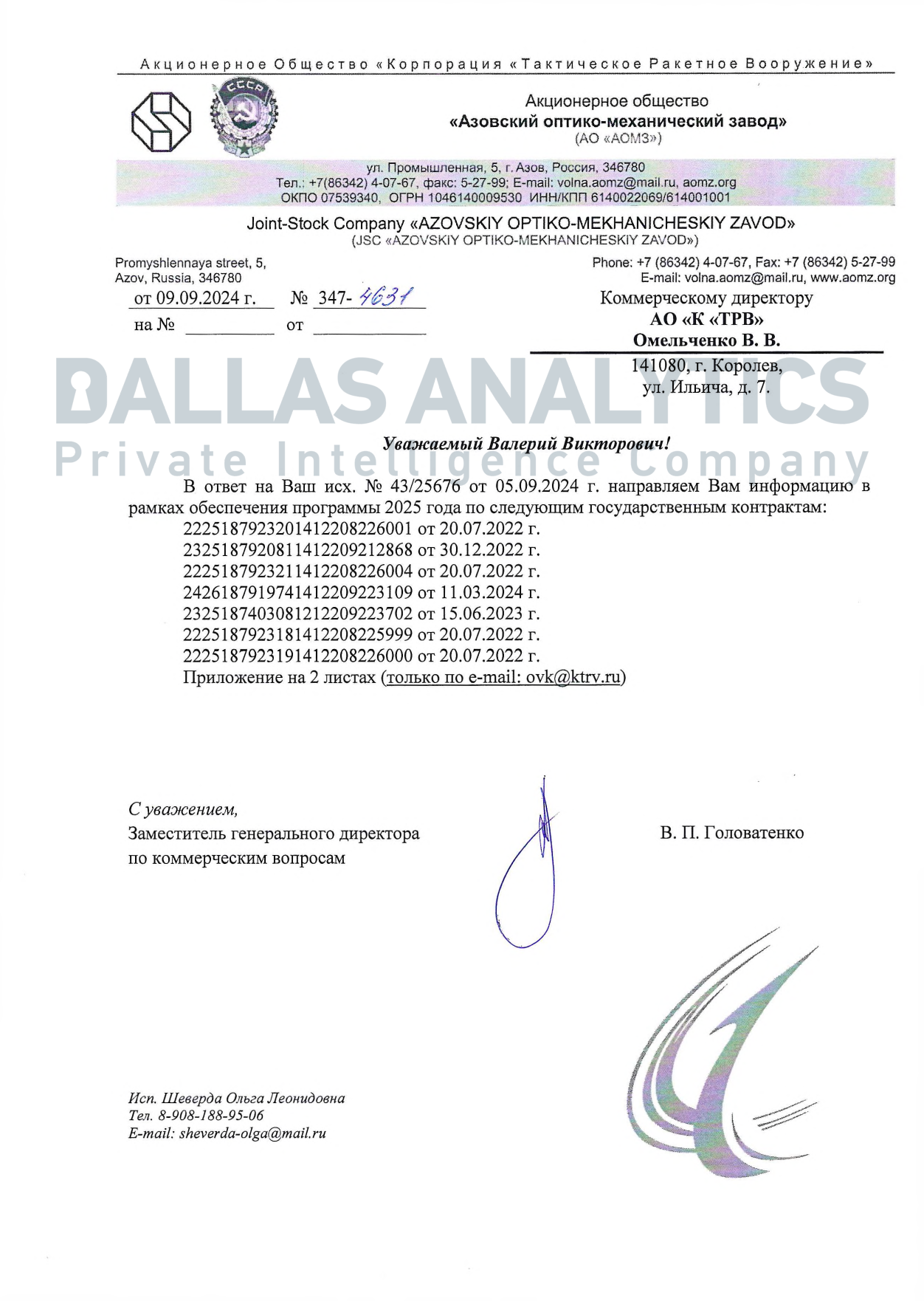
The material obtained by Dallas Analytics comprises internal correspondence, state contract records and cooperation schedules belonging to JSC Azov Optical-Mechanical Plant, registered at 5 Promyshlennaya Street, Azov. It runs from April 2023 to March 2025 and carries the letterheads of four enterprises: AOMZ itself; the Tactical Missiles Corporation (KTRV), the state holding that owns the plant and designs most of Russia’s tactical missiles; the Michurinsk Plant Progress; and the Kurganpribor design bureau. With it comes a component-supply schedule running to more than seventy line items.
Correspondence of this class moves under continuous state oversight. KTRV’s letters are addressed jointly to the plant’s general director and to the head of the 549 Military Representation Office — the Russian Ministry of Defence officer stationed inside AOMZ to accept finished output. This is state defence order traffic, not commercial business.
The anchor document is dated 9 September 2024. AOMZ’s deputy general director for commercial affairs writes to Valery Omelchenko, commercial director of KTRV, supplying information “within the framework of ensuring the 2025 programme” against seven state contracts. Five were signed in 2022, in the first year of the full-scale invasion, and still governed the plant’s workload two and a half years later.
The production plan
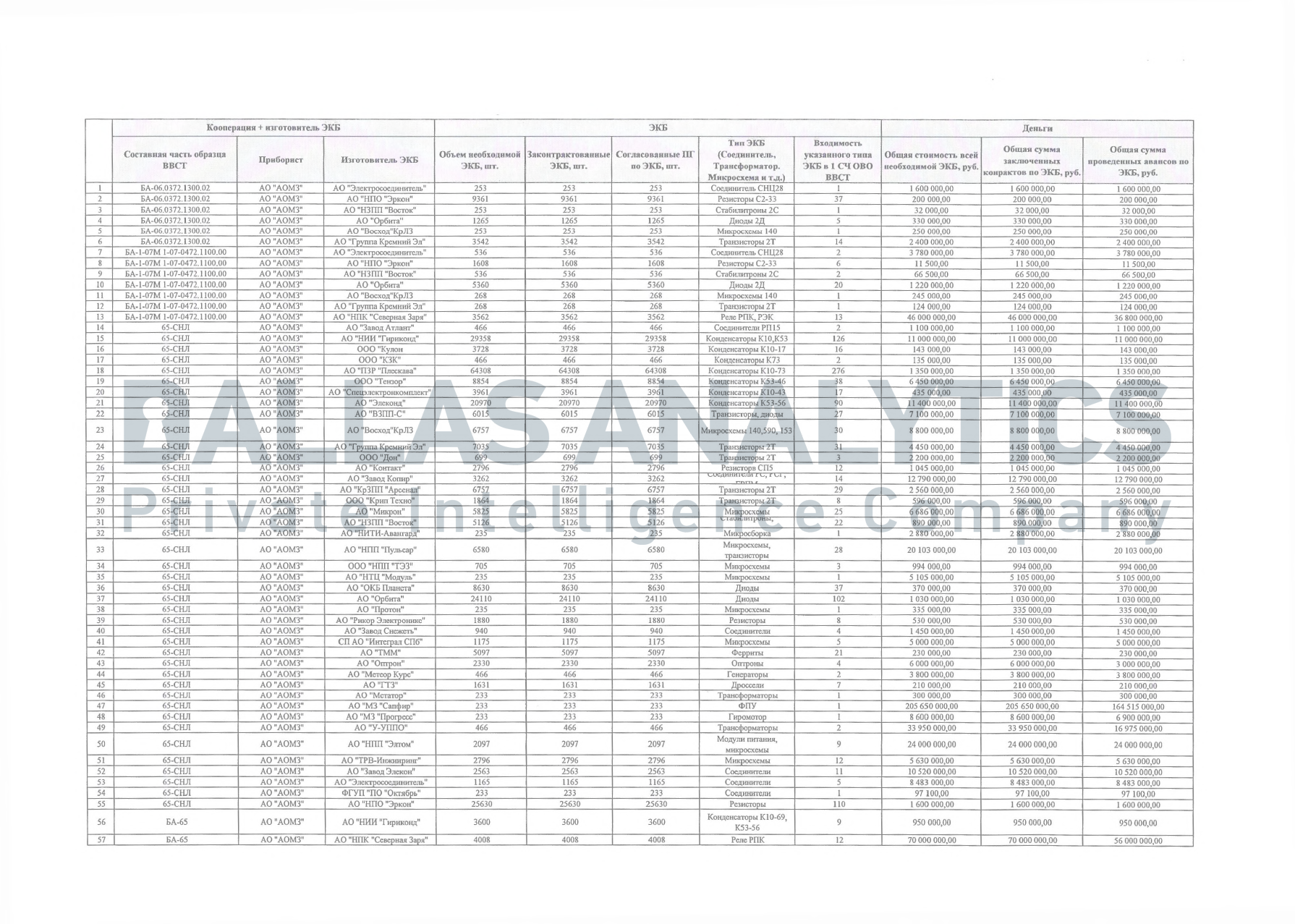

The substance sits in a two-page annex. Seventy-one lines tie each AOMZ-built assembly to the enterprise supplying its electronic components, with quantities, per-unit fitment and money. The component base for the 2025 programme runs to 583.6m roubles, of which 497.6m had already been paid out in advances.
The annex also gives away real production volumes for the flight automation blocks of the Kh-101, the Kh-35U and the Kh-59/Kh-69 line. This is the plant’s production plan, reconstructed from its own bill of materials.
Take the Kh-101, now the mainstay of Russian strategic aviation: designed by MKB Raduga, carried by Tu-95MS and Tu-160 bombers, and fired in volume at Ukrainian cities and energy infrastructure. AOMZ builds two critical assemblies for it. The first is the “Otblesk” navigation lidar, an active optical sensor that holds the missile on course when Ukrainian electronic warfare has suppressed satellite navigation. The second is the flight automation block, which governs the logic of the missile’s systems and drives its control surfaces. The anti-jam navigation element and the autopilot come off the same plant’s lines, and there is no alternative supplier for either.
The annex names forty-four suppliers, and together they map the structure of the Russian electronics industry: Girikond, Elekond and Pleskava for capacitors; Erkon for resistors; Mikron, Pulsar, Proton and Kremniy El for semiconductors; Elektrosoedinitel, Elekon and Kopir for connectors; Severnaya Zarya for relays; Optron for optocouplers; and Sapfir, Progress and U-UPPO covering the precision segment.
One entry is not a manufacturer at all. TRV-Engineering — the procurement arm of the KTRV holding itself, which has appeared repeatedly in previous investigations as a channel for importing foreign microelectronics — is listed as a supplier of microcircuits for the Kh-101’s navigation set. The grey import channel is not somewhere in the background here. It is written directly into the plant’s bill of materials.
The Su-57 line
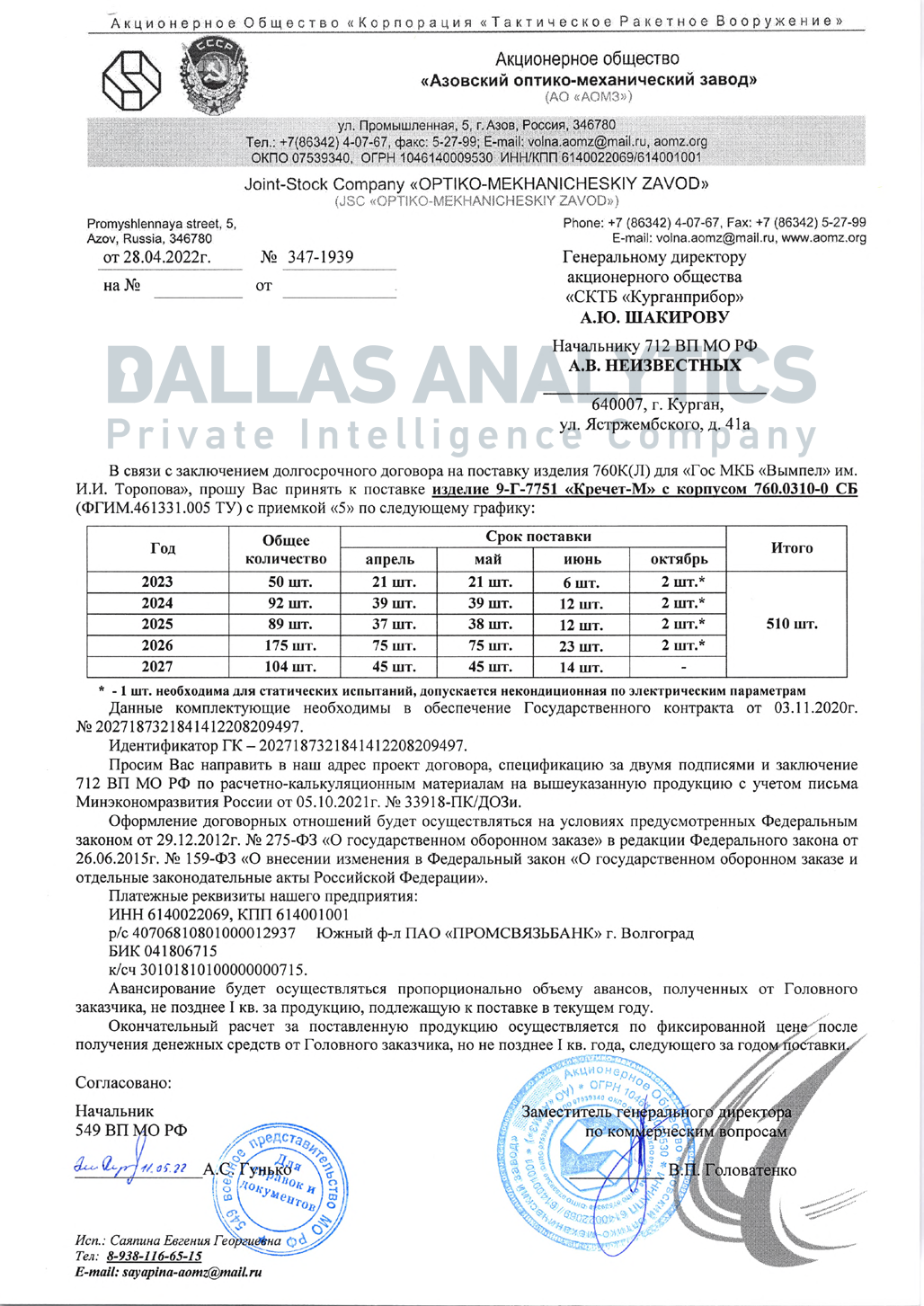
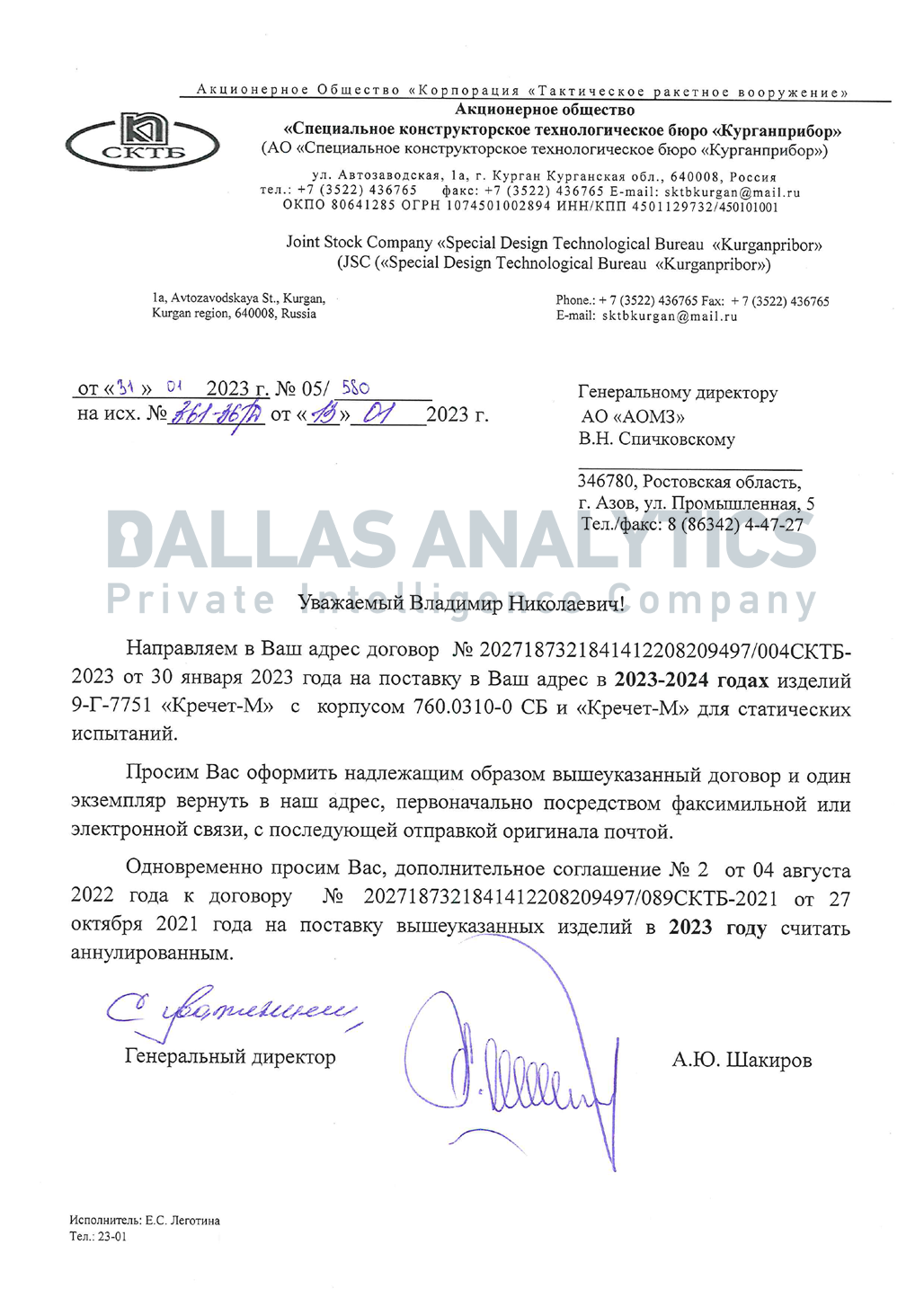
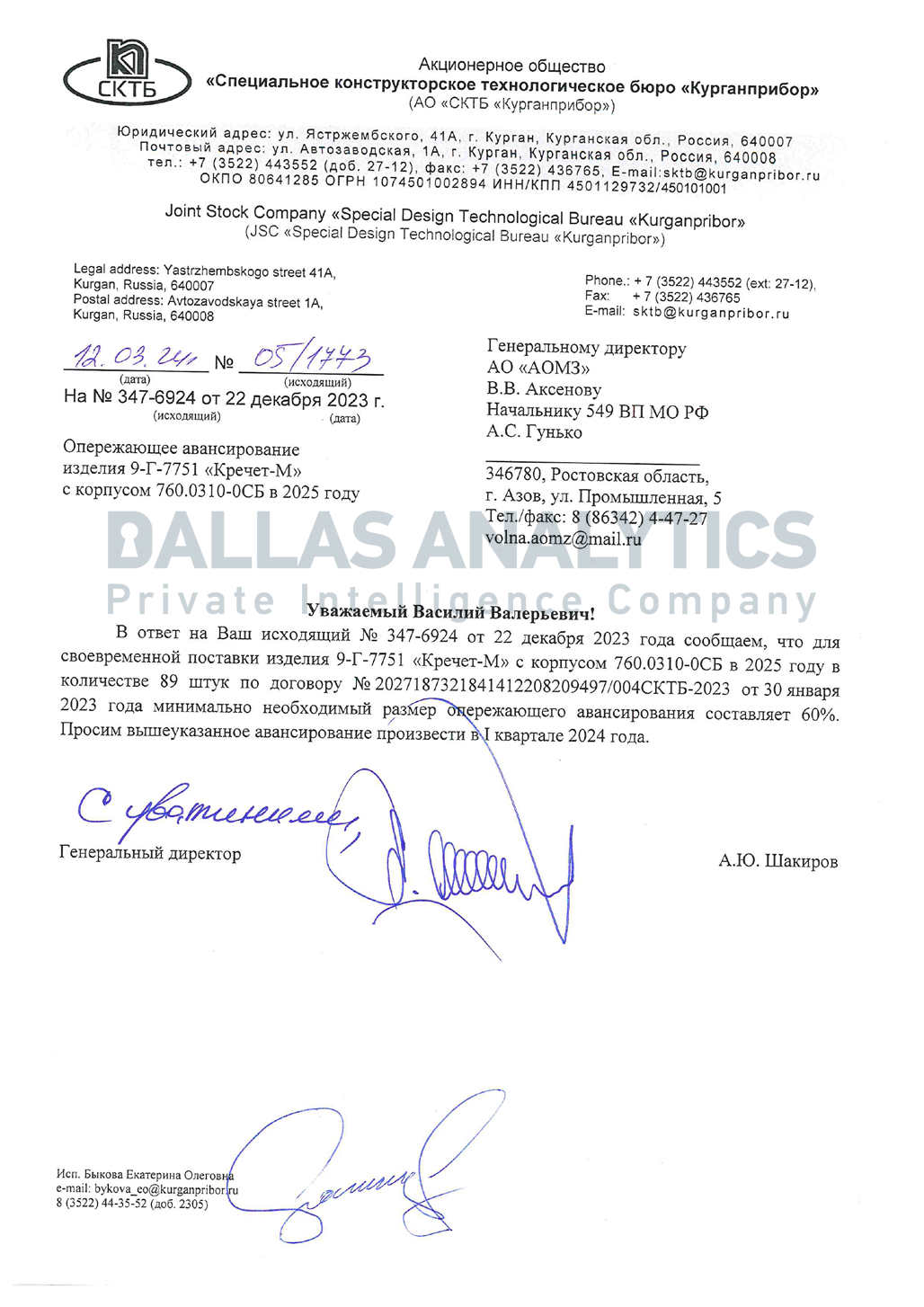
A separate body of correspondence identifies AOMZ as assembler and supplier of key assemblies for izdeliye 760K(L). The documents identify it as a modification within the R-74 family of air-to-air missiles developed by the Vympel design bureau, Russia’s principal designer of air-launched weapons, and part of the weapons fit of the fifth-generation Su-57 fighter.
IRBM Oreshnik
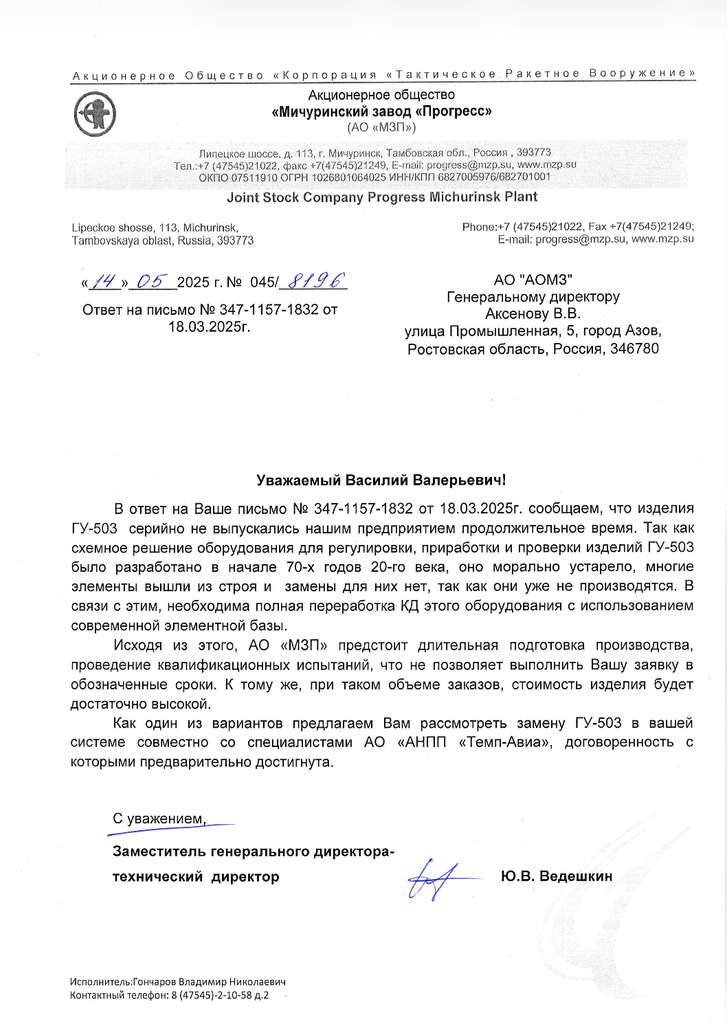
The same internal documents give Azov a place in the guidance chain of the Oreshnik ballistic missile — a nuclear-capable intermediate-range system that Putin uses as a political signal to NATO rather than as a battlefield weapon. Dallas Analytics has previously reported on its GU-503 gyroscopic unit and on the reasons the missile misses.
Five hundred a year
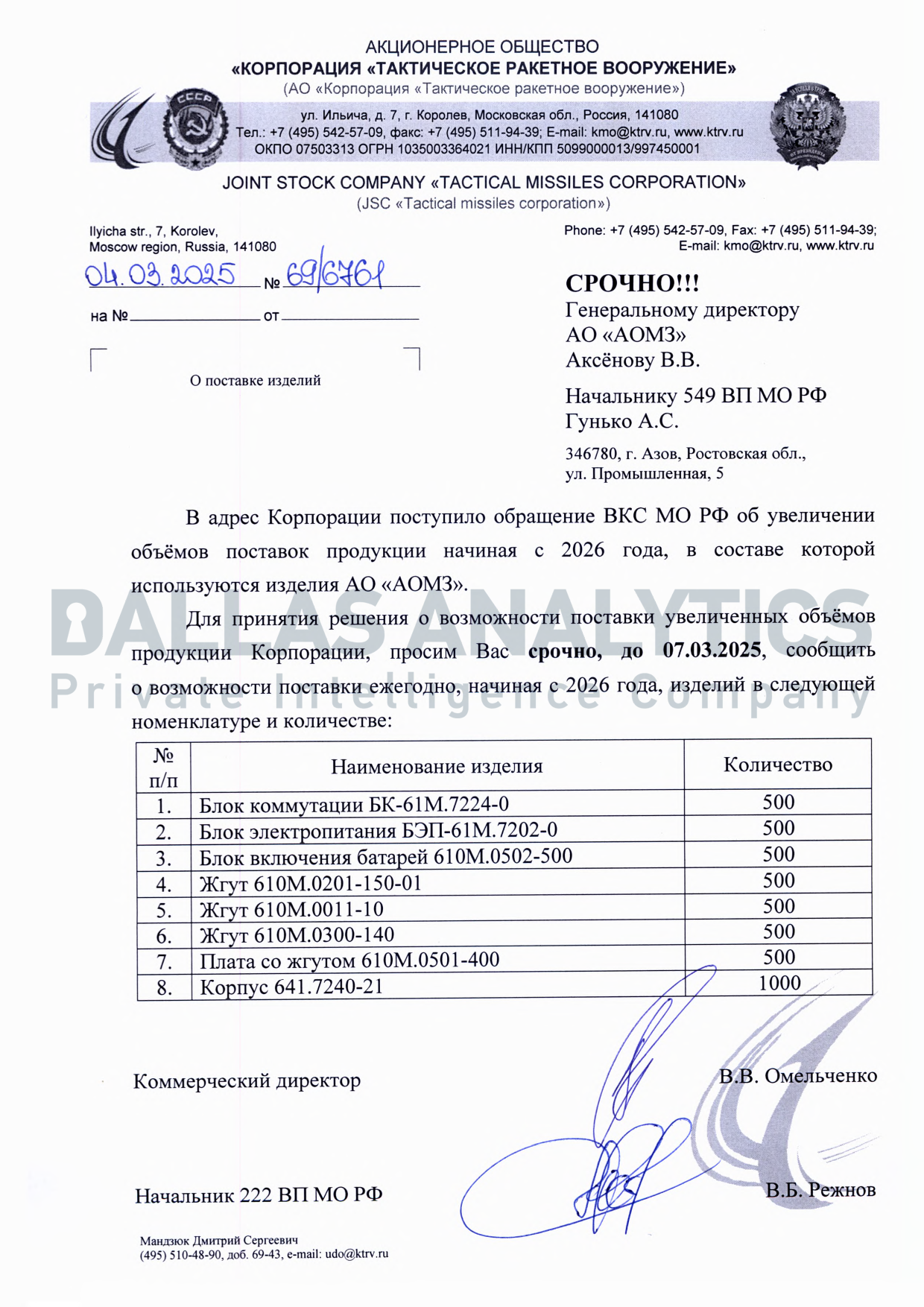
KTRV letter 69/6761 of 4 March 2025, marked “URGENT!!!”, informs AOMZ management that the Russian Aerospace Forces have demanded an increase from 2026 in deliveries of products containing Azov-built components. The plant was given seventy-two hours, until 7 March, to answer whether it could meet the requirement.
The volumes are annual and systemic: 500 each of the switching block, the power supply block, the battery activation block, three types of harness and a board assembly, plus 1,000 housings for the R-37M missile, every year from 2026.
The letter is addressed to the plant’s director and to the resident military representative at AOMZ, and signed by KTRV’s commercial director and the head of the 222 Military Representation Office of the Russian Ministry of Defence. This is a hard demand from the military customer, countersigned by the defence ministry at both ends of the production chain, with a three-day deadline to assess industrial capacity eighteen months out.
The list is not a set of spare parts. It is the missile’s entire electrical architecture — power distribution, signal routing and combat battery activation, without which an R-37M is an inert slug on the pylon. On one set per missile, with two housings, the corporation is asking a single plant in Rostov region whether it can supply the electronics for five hundred long-range air-to-air missiles a year on a standing basis.
That figure is the decisive one. The R-37M, with a reach of roughly 300 km after modernisation, is precisely the weapon that has forced Ukrainian tactical aviation down to low level and sharply narrowed where it can operate. Five hundred a year is the rate at which Russia intends to hold that advantage.
Sanctioned since 2022, and still delivering
The common assumption is that the West was slow to notice AOMZ. The record refutes it. The plant went onto the US Entity List in April 2022, in an entry naming it as a Tactical Missiles Corporation facility. It has since been designated by the European Union, the United Kingdom, Canada, Japan, Switzerland, Australia, New Zealand and Ukraine. There is nowhere left to add it: the plant has been under maximum restriction for four years.
The failure is not in identifying the target. It is in the architecture of enforcement. Listing an end user that buys nothing directly abroad does not stop procurement organised through intermediary shell firms.
Those intermediaries can be reached. TRV-Engineering, NPP Variant Group, Microlab-ICS and Integra are all designatable, as are the Chinese and European distributors filling their orders and the banks clearing their payments. So is the second tier the annex exposes: forty-four Russian component suppliers, named line by line. Most depend on imports themselves and sit under far lighter sanctions than AOMZ. Sanctioning the end plant while leaving the procurement chain intact has produced exactly the result now visible in Russia’s output figures.
Likely consequences
Were AOMZ to stop working, the effects would appear immediately along three axes.
Strategic strike. The Kh-101 would lose both its anti-jam navigation module and its flight automation block — not one supplier among several, but two irreplaceable assemblies from a single site. The Kh-35U and Kh-59/Kh-69 lines would lose their automation blocks. Since these are the principal weapons of the winter campaigns against Ukrainian energy infrastructure, any sustained pause in production means a directly less damaging heating season.
Air superiority. The R-37M would lose its communications and power architecture at the exact moment the Aerospace Forces are demanding a step change in volume. A ceiling on output of that missile changes the situation in the air, not merely the figures in a report.
Suppression of air defence. Losing production of seeker heads for the Kh-31P degrades Russia’s ability to hunt Ukrainian radars, which raises the survival rate of every other system in the engagement zone.
Direct industrial losses run to hundreds of millions of dollars, even before accounting for the missiles that will not be built.
One qualification matters. Taking out a single node buys a delay measured in months, not an irreversible loss of capability — unless it is accompanied by systematic pressure on the supply chains that allow Russia to rebuild production. That is the part of the work Ukraine cannot do on its own.