


Confidential Russian defence-industry documents obtained by Dallas Analytics show that state-owned factories have been building specialised missile launch equipment for Iran, arming the country now strangling global energy transit through the Strait of Hormuz. These internal records flatly contradict Washington’s official line that Russia is not helping Tehran.
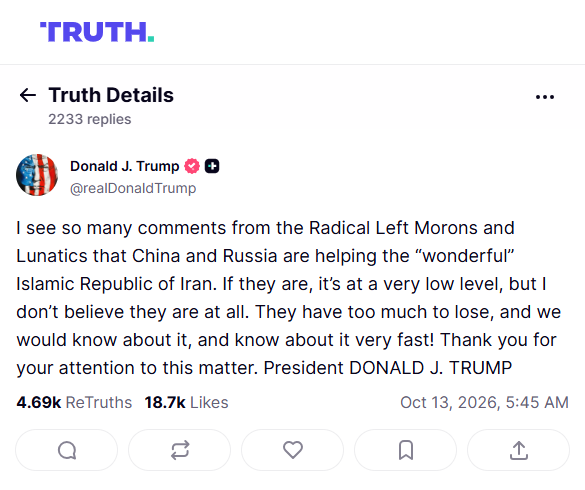
The US president’s post on Russian and Chinese involvement. Source: Truth Social
On 12 October President Donald Trump dismissed mounting warnings on Truth Social: any support from Moscow and Beijing to the Islamic Republic, he wrote, was “at a very low level, but I don’t believe they are at all”.
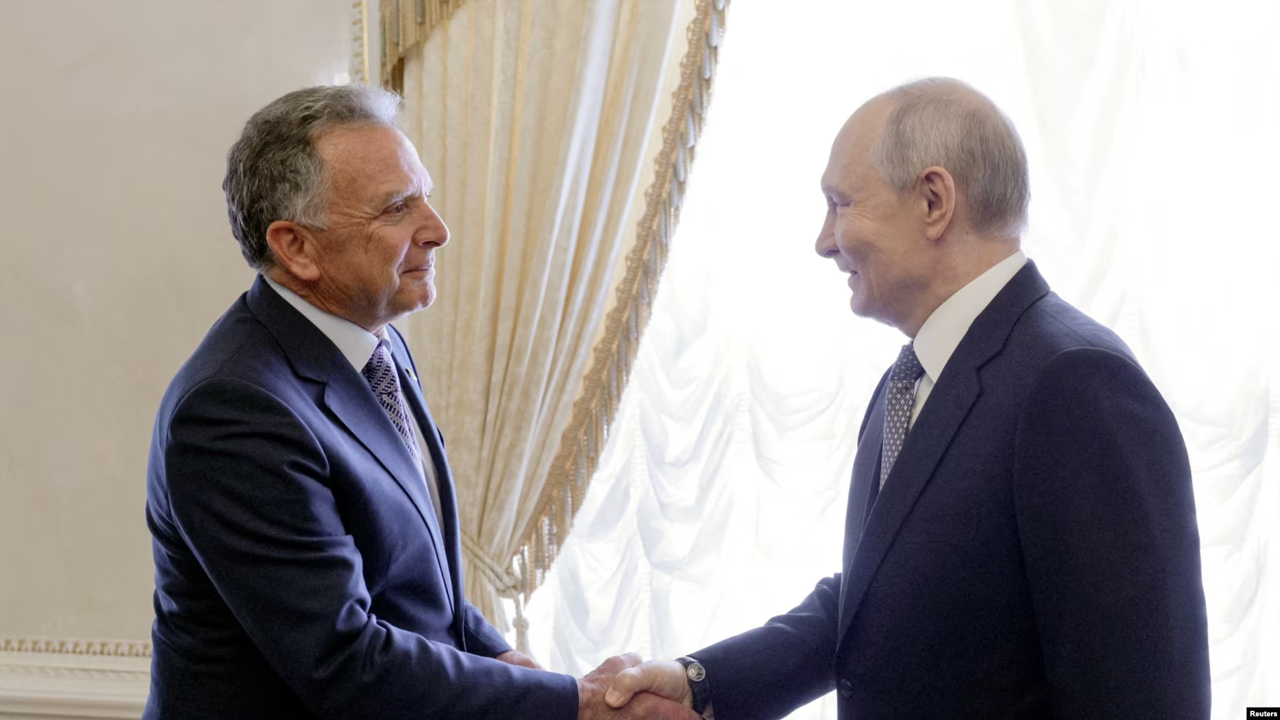
Days later, on 21 October, Vladimir Putin hosted the US special envoy, Steve Witkoff, in St Petersburg and struck a conciliatory pose, assuring Washington of the Kremlin’s benign intentions. “If we can do anything for settling this crisis [around Iran], we will be glad to help,” the Russian president said.
Assurances and peaceful statements from the Kremlin are not evidence. Paperwork from Russia’s missile plants is.
Earlier today the Financial Times published an investigation drawing on Dallas Analytics data. This article puts the underlying primary documents before a wider audience.
The documents originate from Russia’s Tactical Missiles Corporation (KTRV), the state-controlled conglomerate responsible for the bulk of the country’s air-launched missiles. Throughout 2024 and 2025, state-run plants worked to a strict delivery schedule for an export contract designated K-10. Russian paperwork writes the code both as K-10 and as K10, depending on the plant. It is the code Russia’s defence industry uses for Iran, as one of its own documents, published below, states in plain words.
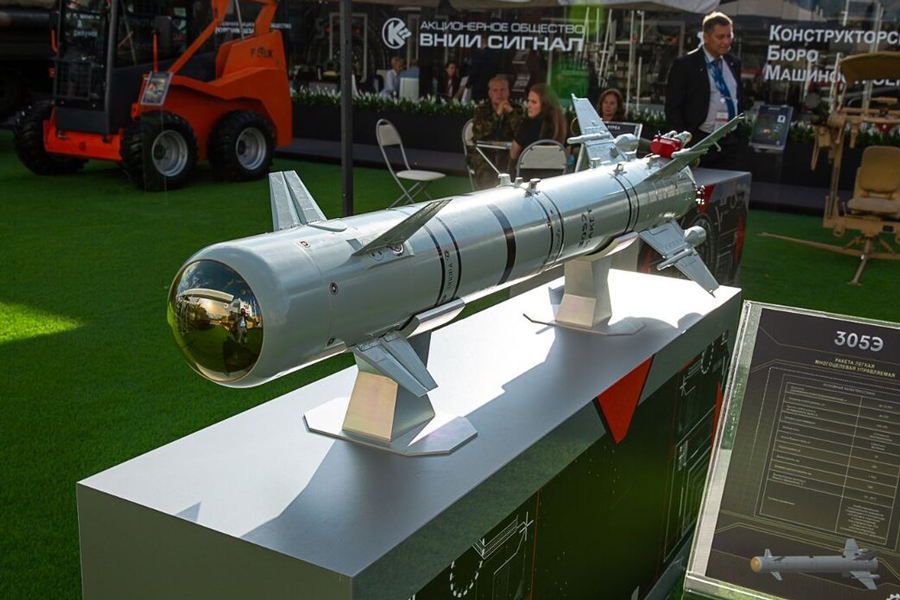
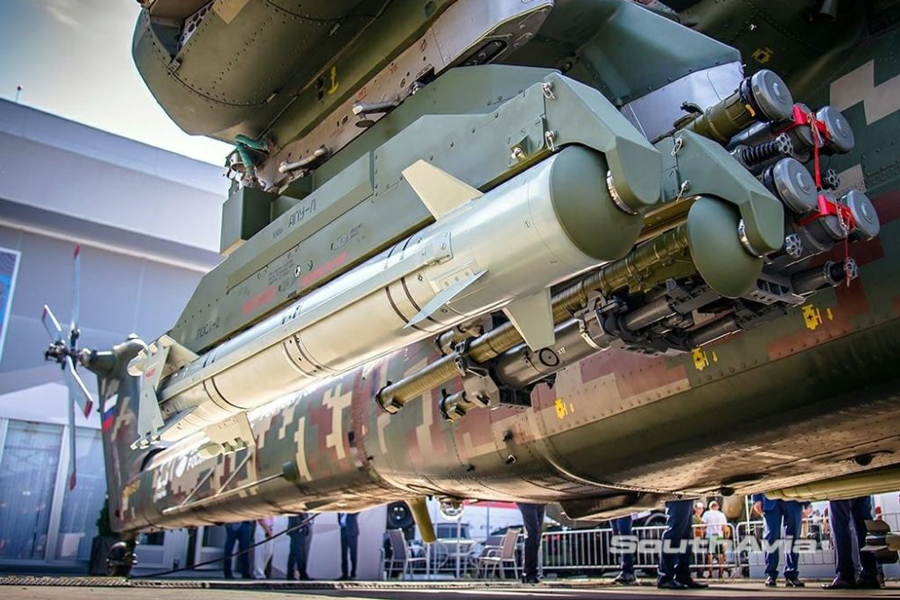
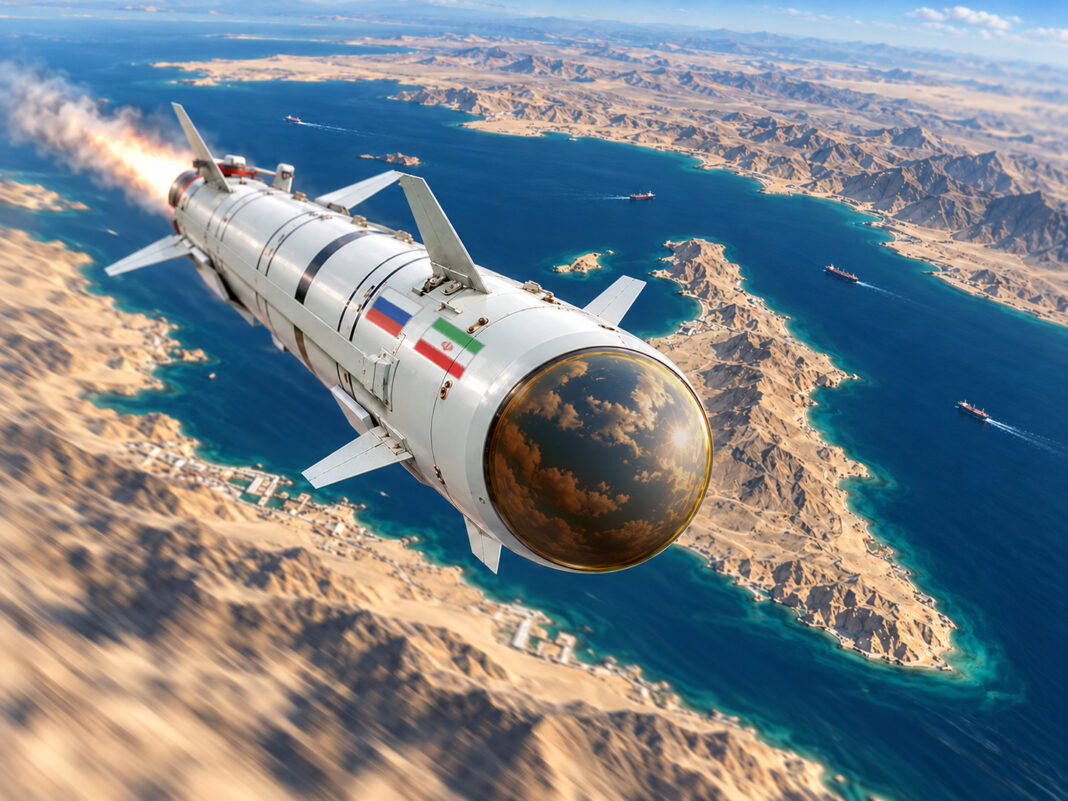
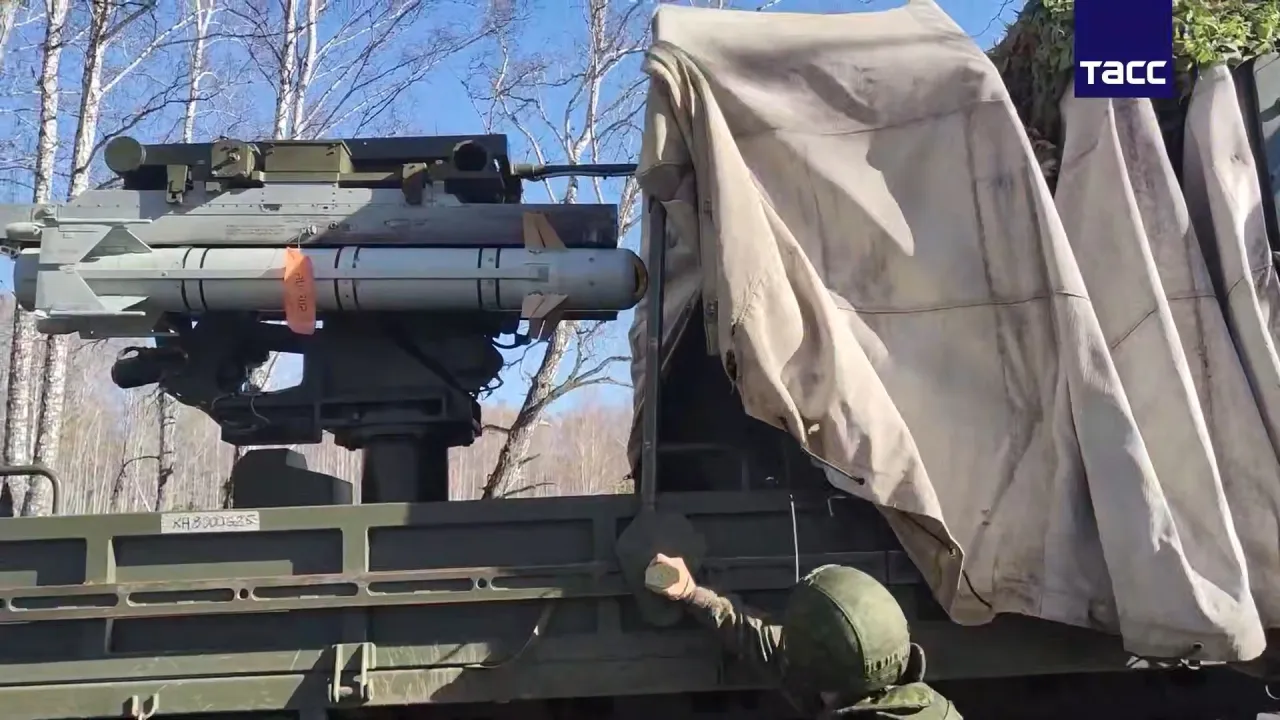
The hardware in question is launch equipment for LMUR (light multi-purpose guided missile), also known as Product 305 or the Kh-39. Originally carried by Russia’s Ka-52M and Mi-28NM attack helicopters, the LMUR weighs about 105 kg, carries a 25 kg warhead and uses an electro-optical seeker with a thermal-imaging channel, which lets an operator steer the missile in flight over a two-way radio link.
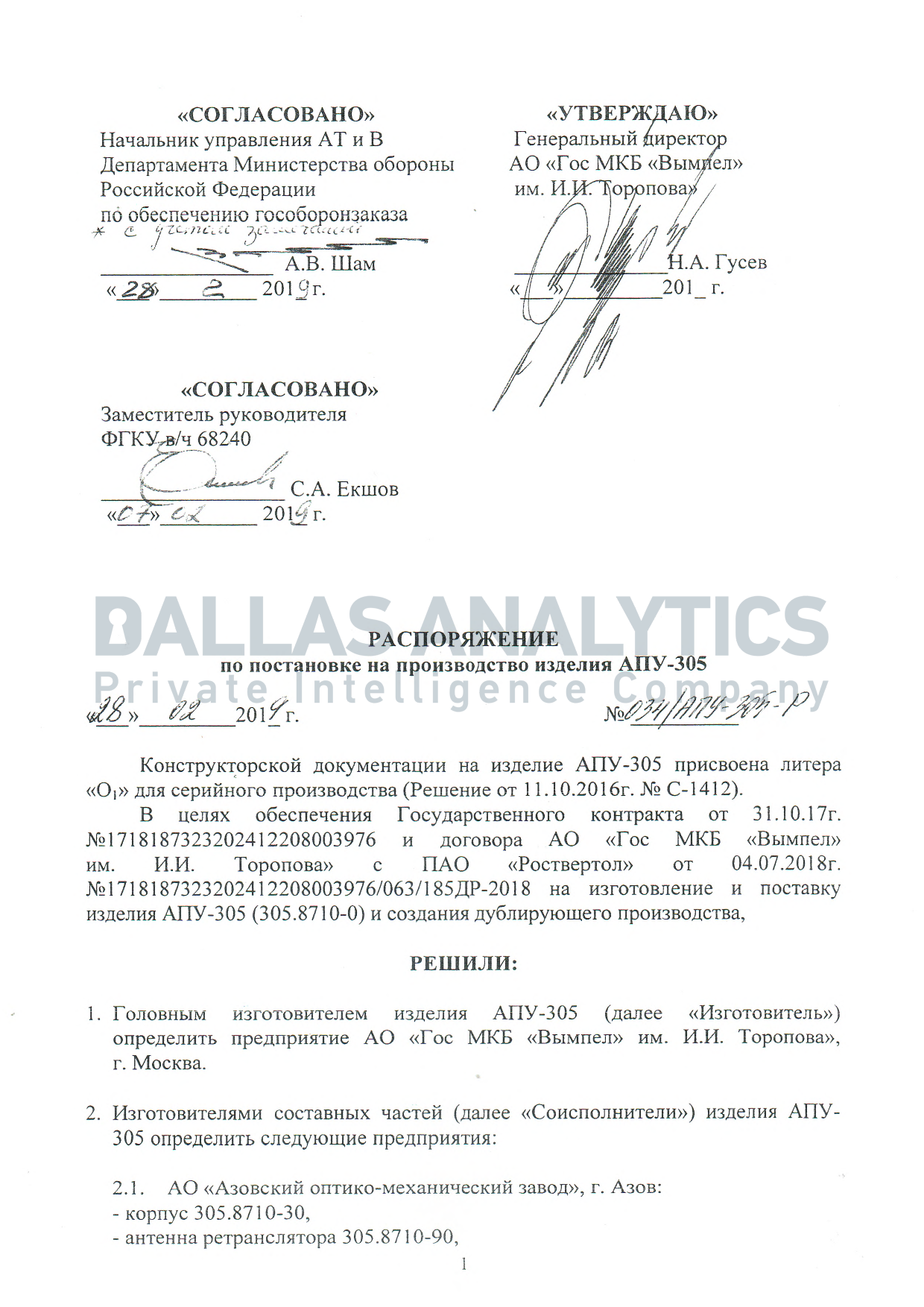
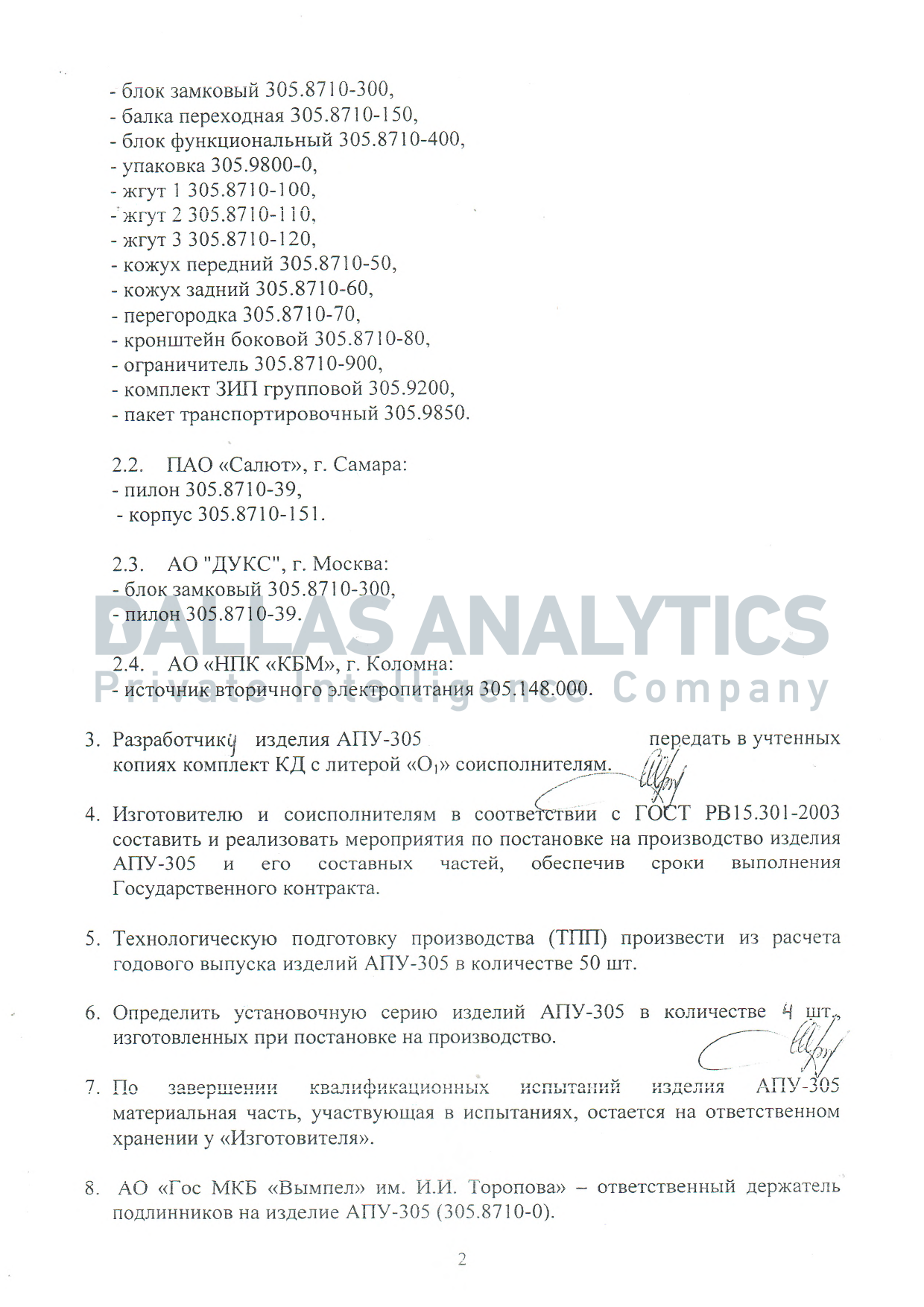
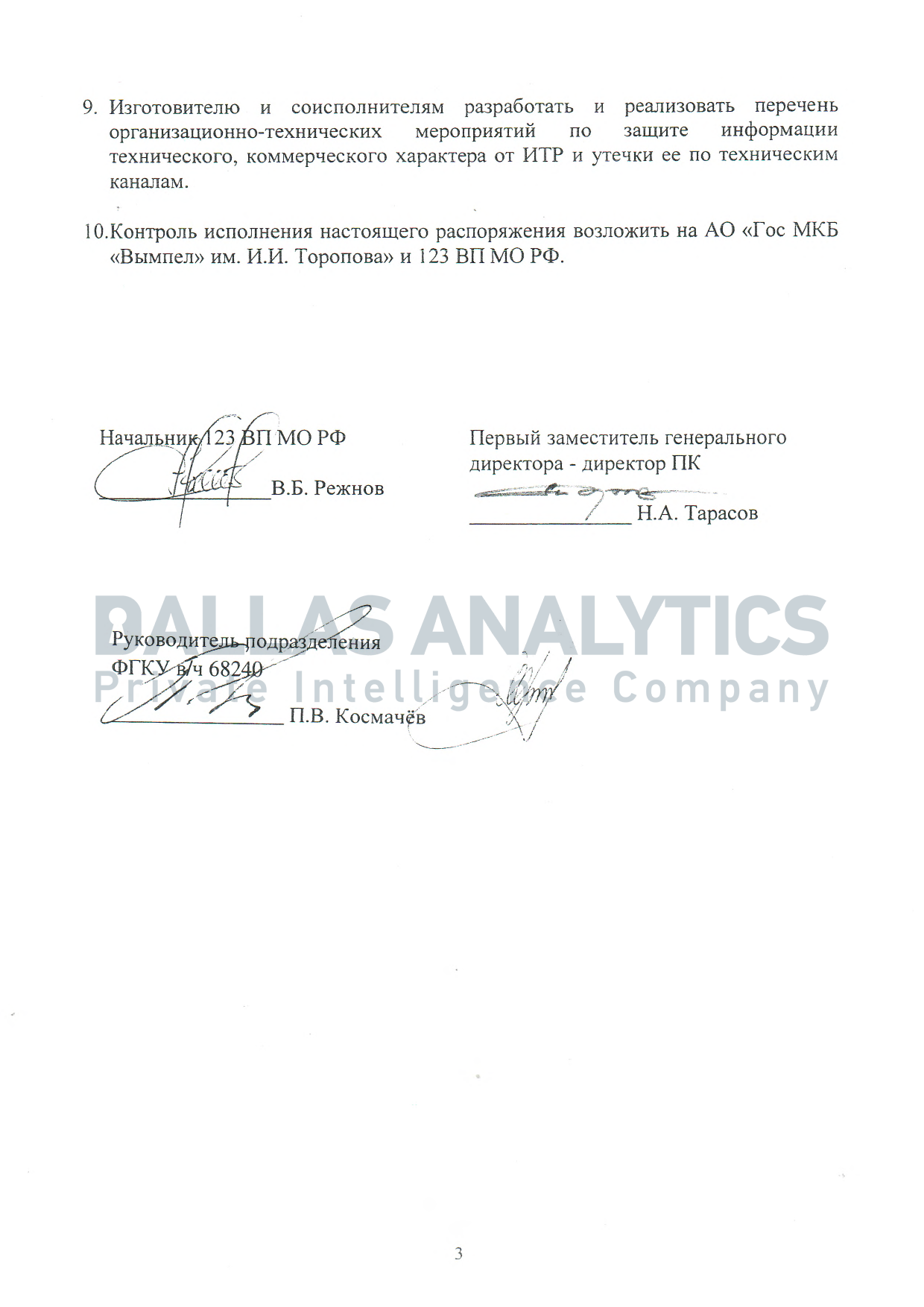
At the heart of this industrial network are internal records from the State Machine Building Design Bureau Vympel named after I.I. Toropov, a Moscow-based enterprise within KTRV, and its co-contractors. The foundational document is an order of 28 February 2019, agreed with the Russian Ministry of Defence, that cleared the APU-305 aircraft launch unit for series production. It names Vympel as lead manufacturer, alongside four co-contractors: Salyut in Samara, DUKS in Moscow, the Kolomna-based Research and Production Corporation Machine-Building Design Bureau (KBM) and the Azov Optical-Mechanical Plant (AOMZ) in the Rostov region.
AOMZ has by far the longest list. It makes 16 of the launcher’s parts, from the housing, the locking and functional units, the relay antenna and three wiring harnesses to the covers, brackets, a spare-parts kit and packaging. The plant, which Ukrainian forces struck overnight on 25-26 September, is no minor supplier: Dallas Analytics has previously linked it to at least seven Russian missile programmes.
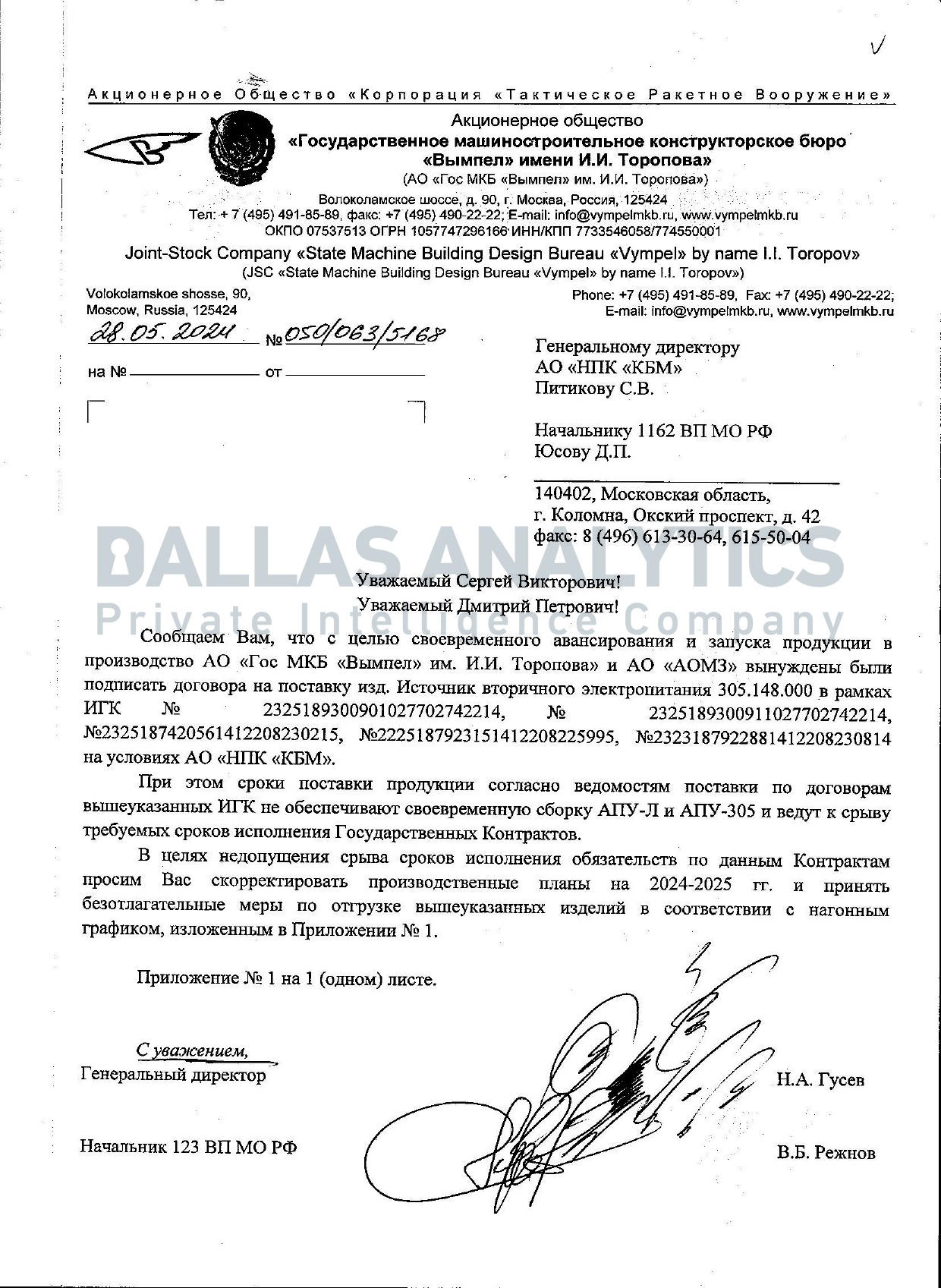
A May 2024 letter from Vympel’s leadership to KBM, co-signed by the head of the 123rd Military Representation, warned that late deliveries of power units threatened the timely assembly of both APU-L and APU-305 launchers.
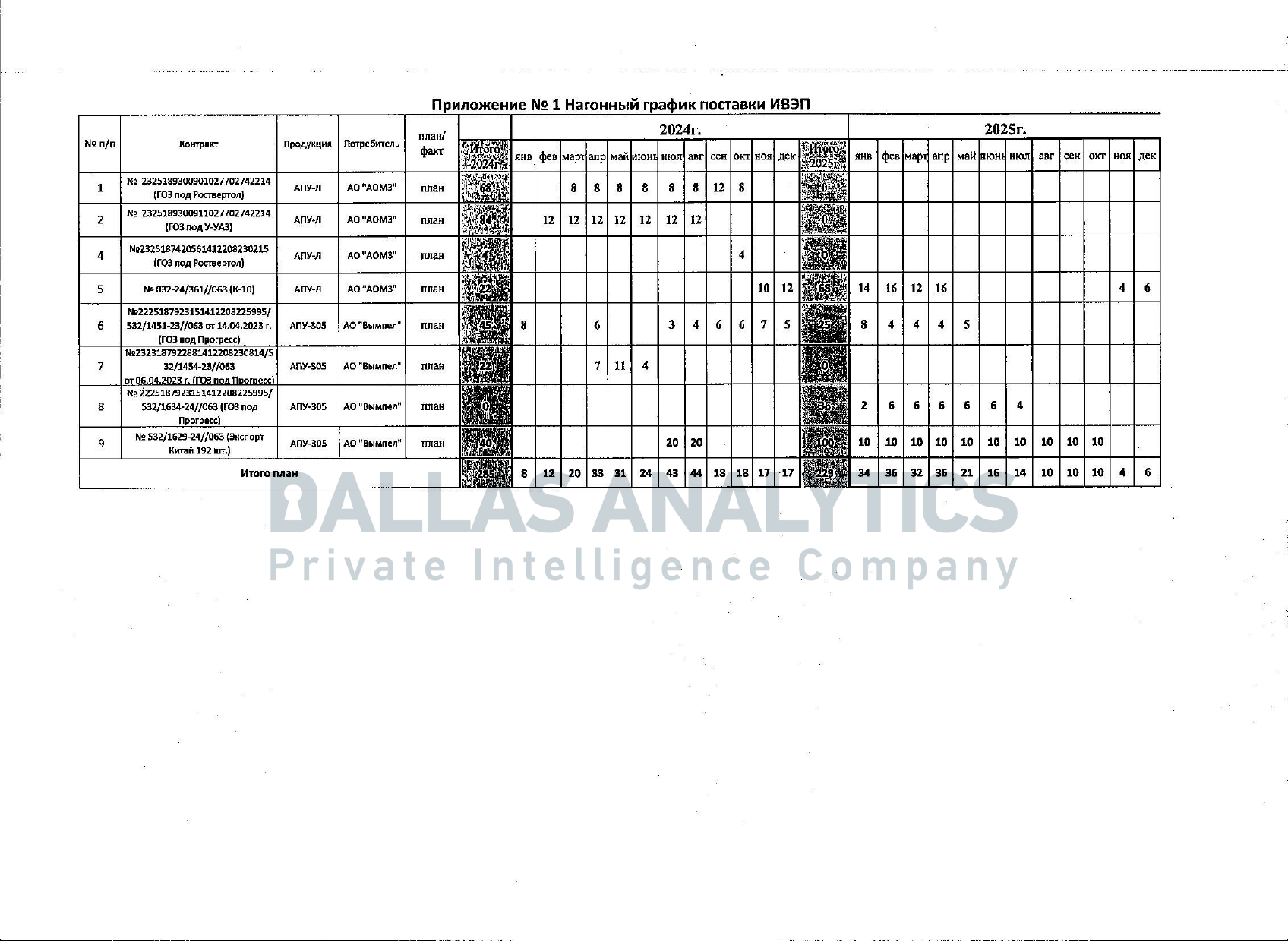
The delivery schedule attached to it contains distinct export rows. Six rows trace domestic state defence contracts tied to Russian helicopter plants: Rostvertol in Rostov-on-Don, the Ulan-Ude Aviation Plant and Progress in Arsenyev. Two rows stand apart, with no state defence contract identifier.
The Chinese export line
Contract No. 532/1629-24//063, marked “Export China 192 pcs”, schedules 140 power units for Vympel’s launchers between mid-2024 and late 2025. China operates neither the Ka-52M nor the Mi-28NM, the main carriers of LMUR, which points to integration on Chinese platforms and a possible role against shoreline strongpoints in an amphibious assault. In a war over Taiwan, a missile of this kind would let helicopters hit positions on the shore from outside the range of portable air-defence missiles, though not of Taiwan’s longer-range systems.
Tracing the K-10 supply chain
Row 5 of the schedule tracks contract No. 032-24/361//063, labelled simply K-10. It allocates power supply units for 90 APU-L twin-rail launchers to AOMZ, with shipments running from late 2024 to December 2025. The end customer is Iran. Two of the other APU-L rows feed Rostvertol, which builds the Mi-28 attack helicopter; a third feeds the Ulan-Ude Aviation Plant.
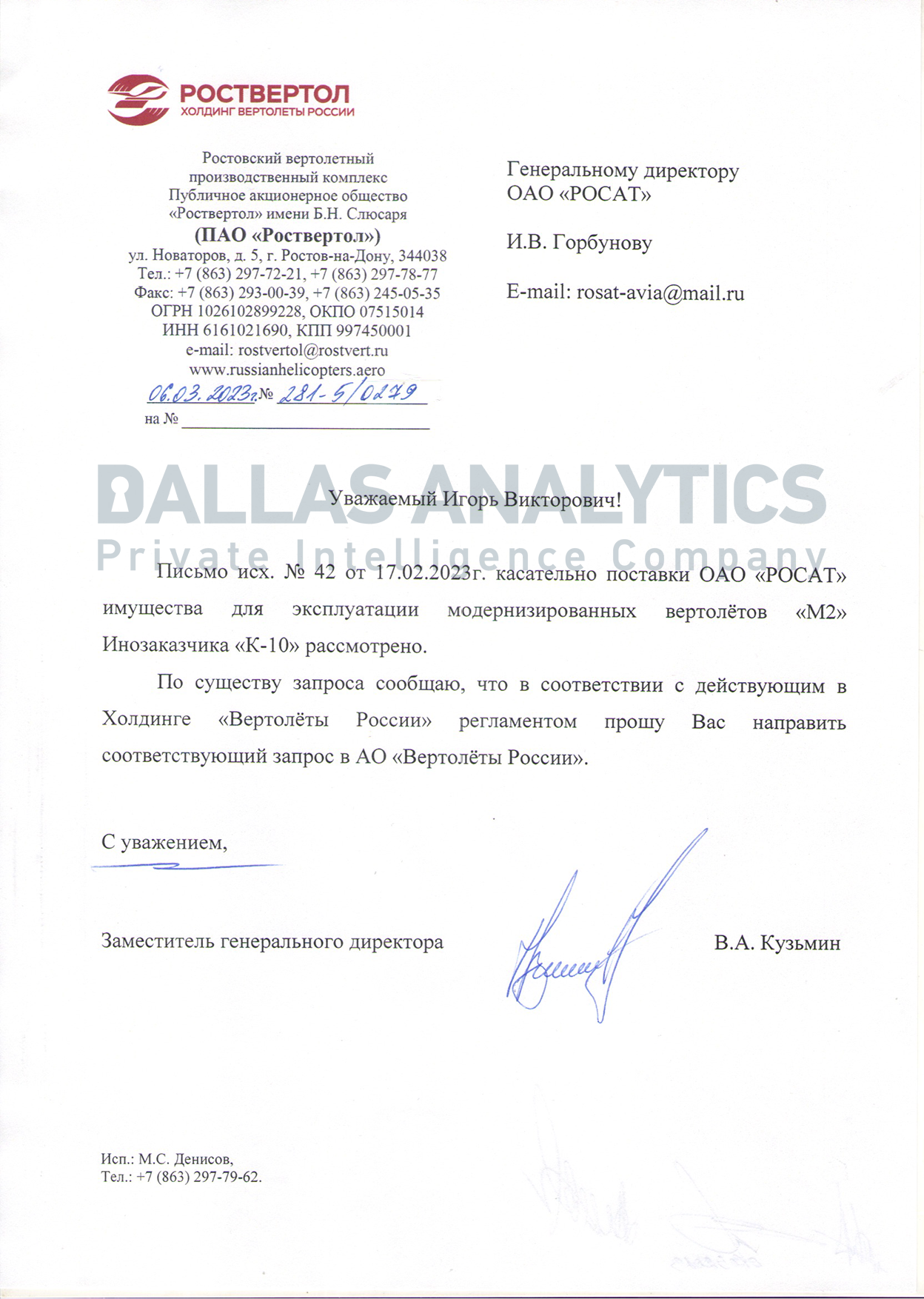
The K-10 label appeared well before the 2024 schedules were drawn up. A Rostvertol letter of 6 March 2023, obtained by Dallas Analytics, replies to a request from ROSAT about supplying equipment for operating the upgraded “M2” helicopters of foreign customer K-10, and refers ROSAT to the Russian Helicopters holding. The letter uses only the code and does not name the country. Another supplier’s paperwork, set out below, does.
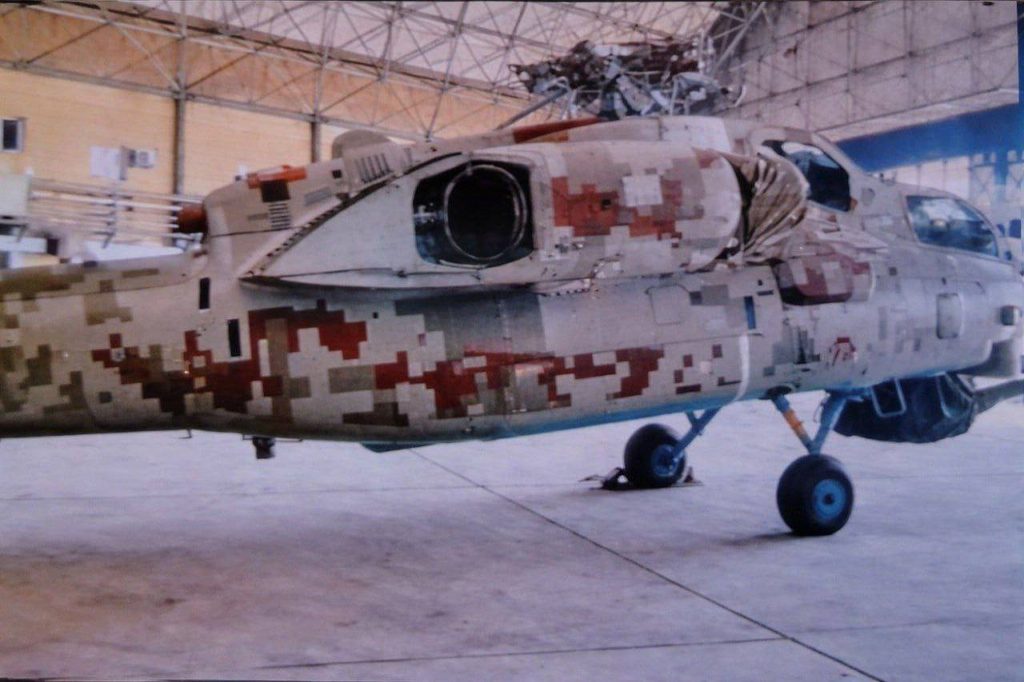
Iran’s own statements match broader procurement patterns. In November 2023 Iran’s deputy defence minister announced acquisitions of Mi-28 attack helicopters, Su-35 fighters and Yak-130 combat trainers.
Photographs confirmed the arrival of the first export-variant Mi-28NEs in Iran in January 2026, roughly nine months after the bulk of the K-10 power units were due at AOMZ and weeks before the war began. Russia was arming Iran’s battlefield aviation on the eve of a conflict in which the White House insists Moscow has no part.
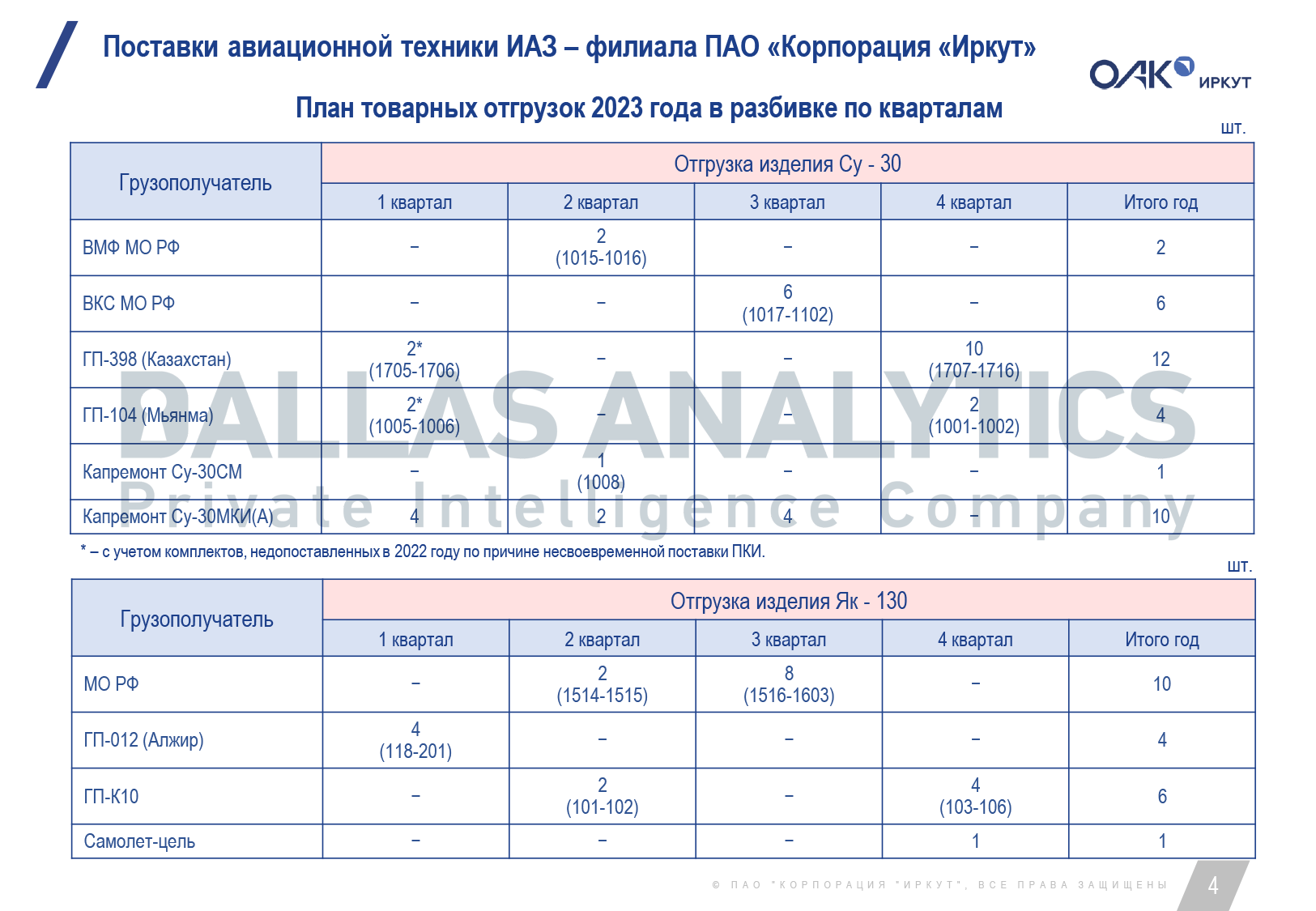
The Irkutsk Aviation Plant: planned shipments for 2023
Further primary documents obtained by Dallas Analytics corroborate this network. An internal 2022 report from the Irkutsk Aviation Plant (IAZ), then a branch of PJSC Irkut Corporation within United Aircraft Corporation (UAC), sets out the 2023 delivery schedule for Yak-130 advanced jet trainers and light attack aircraft.
The breakdown lists a consignee coded GP-K10. According to the schedule, two Yak-130s were to ship under that code in the second quarter of 2023 and four more in the fourth quarter, six in all. Every other foreign consignee on the slide is named and identified by its ISO country code: GP-398 is Kazakhstan, GP-104 Myanmar and GP-012 Algeria. Only K10 is left unnamed, where Iran’s code would be 364. The anonymity was deliberate, and it did not survive the paperwork further down the chain.
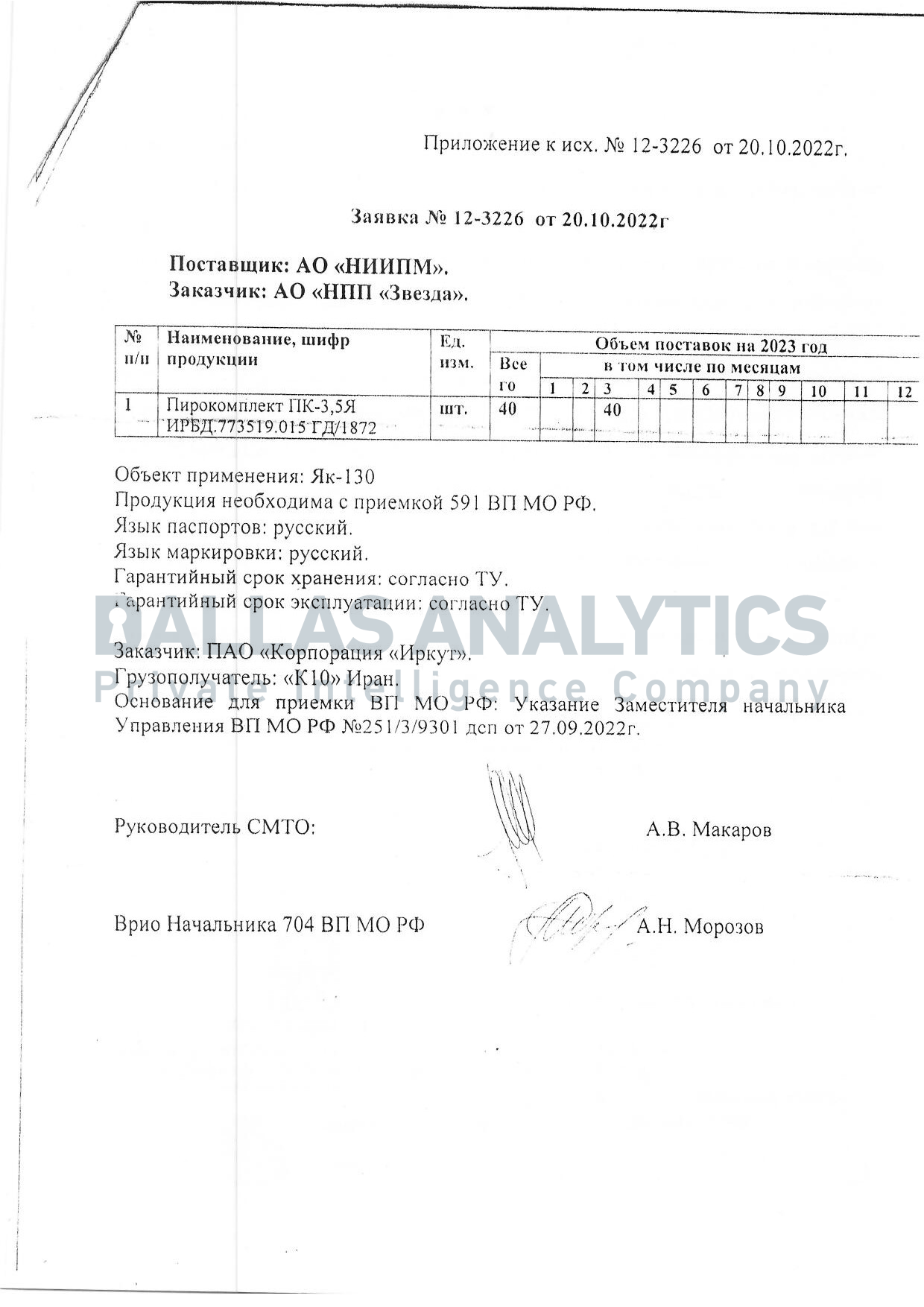
One document removes any doubt about who K-10 is. A supply request of 20 October 2022, No. 12-3226, from NPP Zvezda, the maker of Russia’s ejection seats, to the Research Institute of Polymer Materials (NIIPM) in Perm orders 40 PK-3.5Ya pyrotechnic kits, all for delivery in March 2023. The aircraft is named as the Yak-130 and the customer as PJSC Irkut Corporation. The consignee line reads, in plain Russian: «K10» Iran. The request is countersigned by the acting head of the defence ministry’s 704th Military Representation, and acceptance is authorised by an instruction from the ministry’s Directorate of Military Representations of 27 September 2022. The timing fits the Irkutsk plant’s schedule, with kits due in March and the first two aircraft for K-10 due to ship in the second quarter. It also matches documents on the same supply chain published earlier by United24 Media.
This internal timeline mirrors open-source evidence. In September 2023 Iranian state media broadcast footage of newly inducted Yak-130s at a base of the Islamic Republic of Iran Air Force (IRIAF), the first batch delivered under the K-10 agreement.
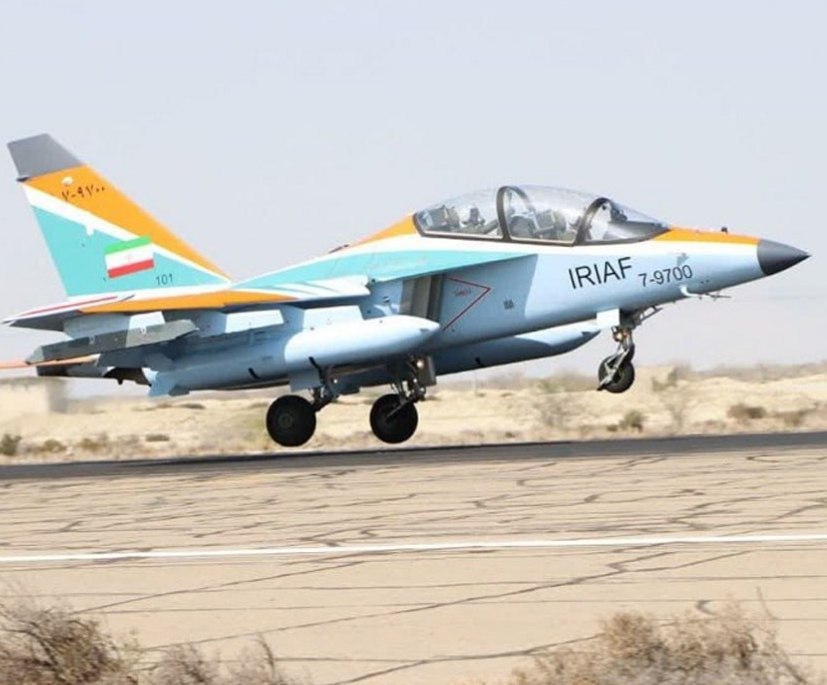
The airframe pictured is the first Yak-130 delivered to the IRIAF, tail number 101, based at the 8th Tactical Air Base in Isfahan. The same number appears against the K-10 consignee in the Irkutsk plant’s records, linking Russian state production schedules directly to Iran’s active inventory. On 4 March 2026 an Israeli F-35I shot down an Iranian Yak-130 over Tehran, combat confirmation that aircraft delivered through the K-10 contracts are in Iranian service.
The emergence of Izdeliye 347
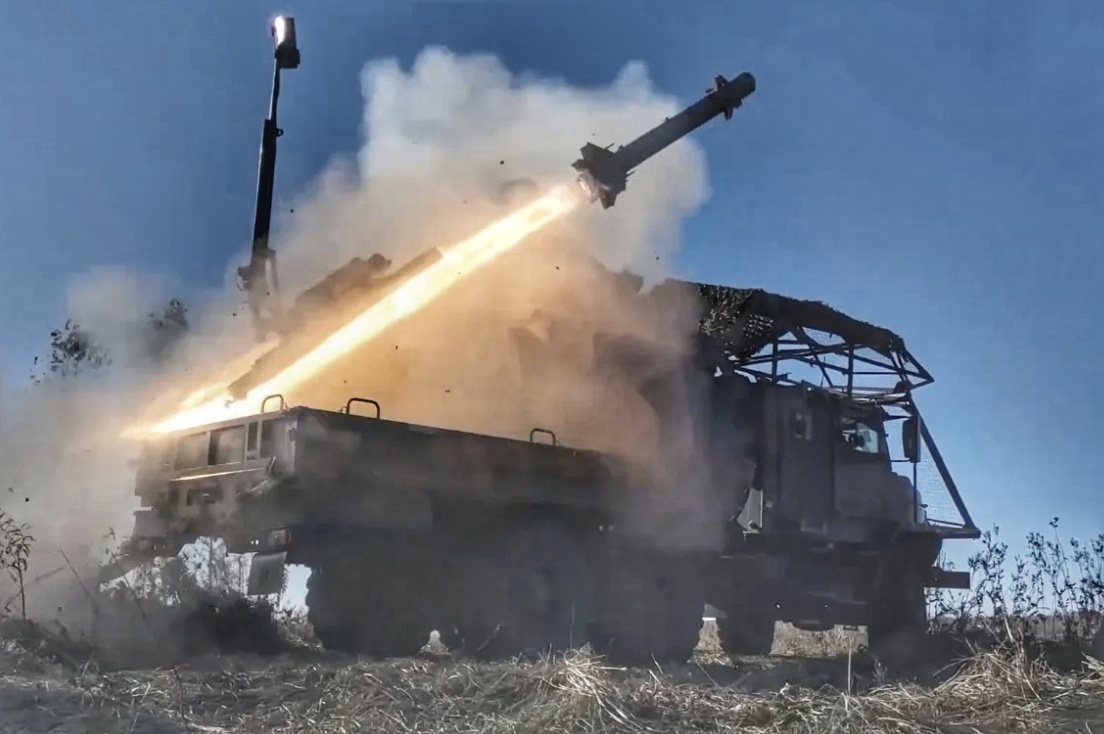
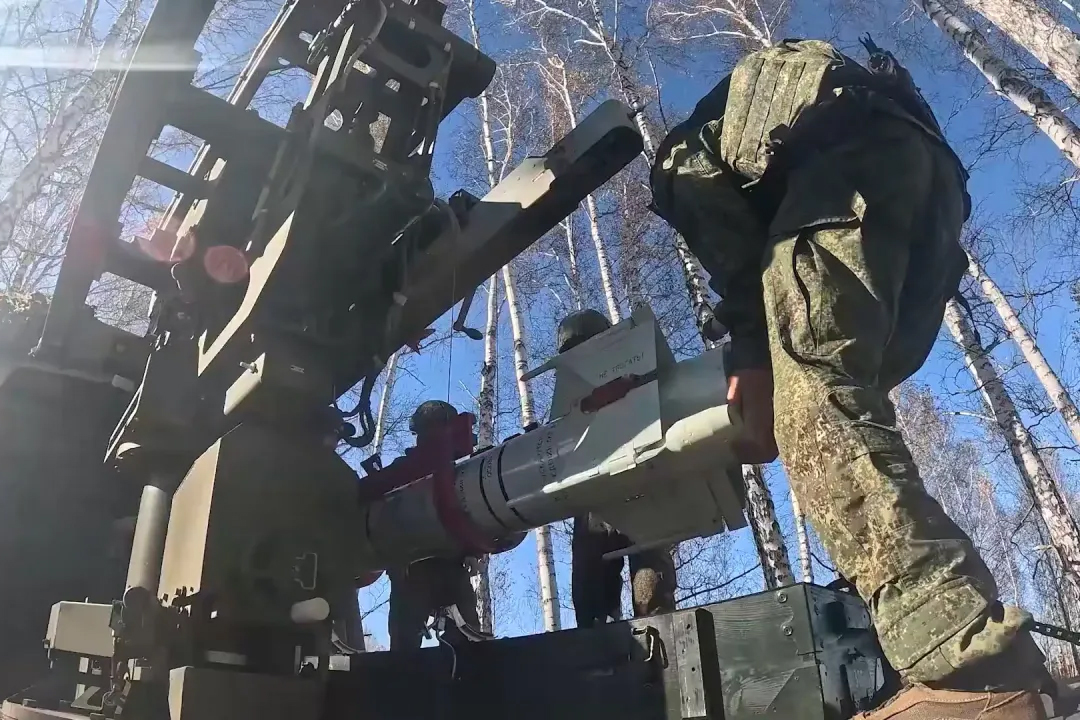
While the export of aviation launchers strengthened Iran’s new helicopter fleet, recent developments in Russia have greatly expanded how this missile can be used.
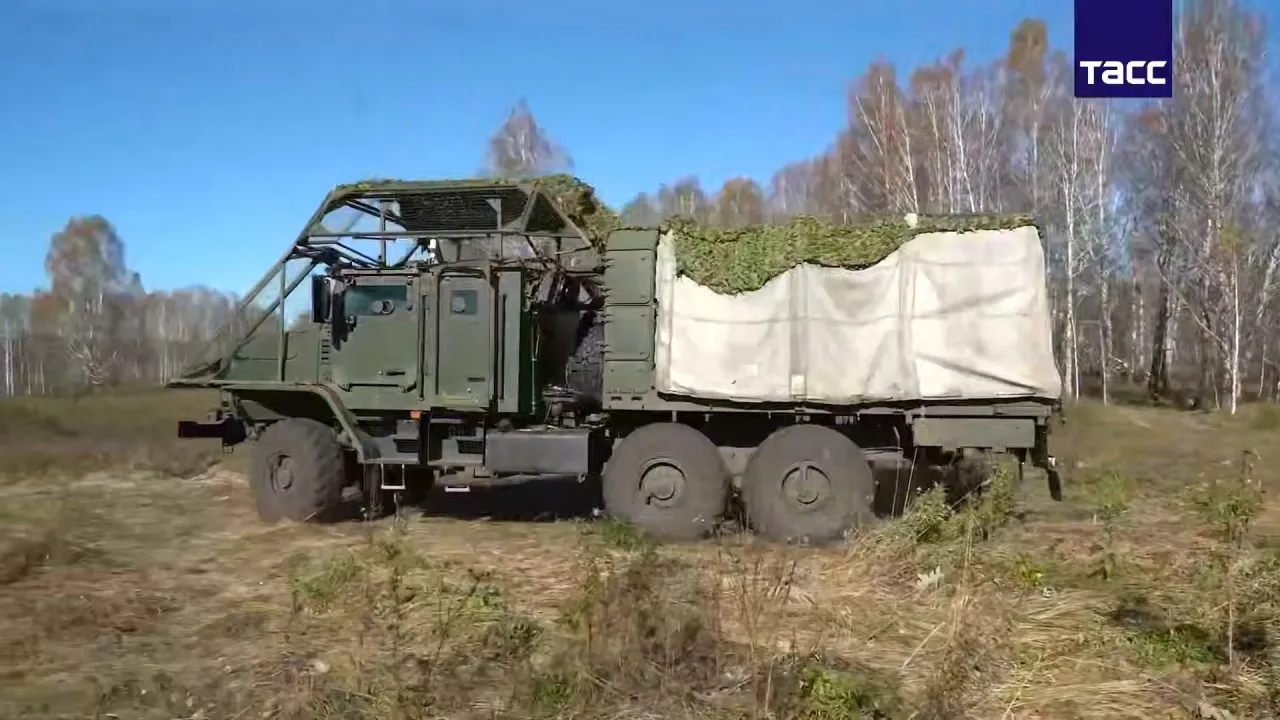
At the Tsentr-2026 strategic exercise (28 September to 3 October), the Russian military publicly unveiled a new mobile ground system, Izdeliye 347 (“Product 347”). Mounted on the bed of a Ural-63706 Tornado-U heavy lorry, it has a rotating twin-rail launcher, a mast-mounted radio datalink antenna and an operator’s console. Russian defence commentators noted that the platform required minimal engineering adaptation, relying on serial-production missiles and electronics.
Moving LMUR from air-to-surface to surface-to-surface use changes its strategic value.
Speed and reach
At about 230 metres a second, the missile covers 14 km in roughly a minute, several times faster than a strike drone. Firing from the ground forfeits the altitude a helicopter provides. By our estimate that costs about 5 km of range, leaving roughly 10 km for the original missile and 20 km for the version with an upgraded motor, which is the figure Russia’s defence ministry claims for Izdeliye 347. The missile keeps its operator, who can steer it onto the target in the final seconds. If the seeker locks on before launch, nobody needs to stay behind to guide it, and the lorry can drive off at once.
A hit-and-run weapon
The launcher can stay under canvas until the moment of firing, and the lorry can be on the move again within minutes. By our estimate one LMUR costs about as much as five to fifteen strike drones carrying 25 kg warheads, and drones have proved more effective along the Ukrainian front. The missile’s operator-guided mode also relies on a radio link, which would face constant jamming on the line of contact. For Moscow’s own war, it remains a marginal asset.
A tailored weapon for the Strait of Hormuz
What is marginal in Ukraine is close to ideal for the confined maritime choke points of the Middle East.
Iran’s conventional air force is obsolescent and heavily constrained, yet its greatest strategic leverage lies in narrow coastal waters. At its narrowest point the Strait of Hormuz is barely 39 km wide. Ground-launched LMURs able to strike targets up to 20 km away, on land or at sea, would give Iranian forces a formidable anti-surface capability without exposing vulnerable aircraft.
Concealed beneath ordinary cargo-vehicle tarpaulins, such launchers could fire from cover near the coast, ambush commercial tankers and naval vessels in international shipping lanes, and move before they are located.
Dallas Analytics has seen no operational deployment or photographic evidence of ground-launched LMURs in Iranian hands. But since Izdeliye 347 offers little on the heavily jammed Ukrainian front, its development raises an obvious question: why build it at all?
A compelling explanation is that Russia adapted the system to meet a specific export client’s requirements. Tehran, which already receives LMUR launch equipment, is the obvious candidate.
Strategic imperatives for Western policymakers
The documentary trail established by Dallas Analytics is hard to explain away. While senior Kremlin officials project neutrality, state-owned defence firms have been systematically supplying military hardware to the regime enforcing the blockade in Hormuz.
Two conclusions for Western capitals follow.
First, naval task forces in the Persian Gulf and the Gulf of Oman should update their threat libraries to account for ground-launched, electro-optically guided precision missiles disguised as civilian transport, and stress-test their defences against small, highly manoeuvrable missiles flying at low altitude.
Second, Western policymakers can no longer treat Moscow’s war in Ukraine separately from its destabilising arms deliveries in the Middle East. Ukraine did not close the Strait of Hormuz; Russia helped arm the regime that did. Global energy markets, and the drivers, airlines and manufacturers paying an inflated fuel premium, remain hostage to Iranian strikes on regional shipping. Future sanctions frameworks should designate Moscow as an active accomplice in the Gulf crisis, ruling out any diplomatic free pass or premature sanctions relief.